


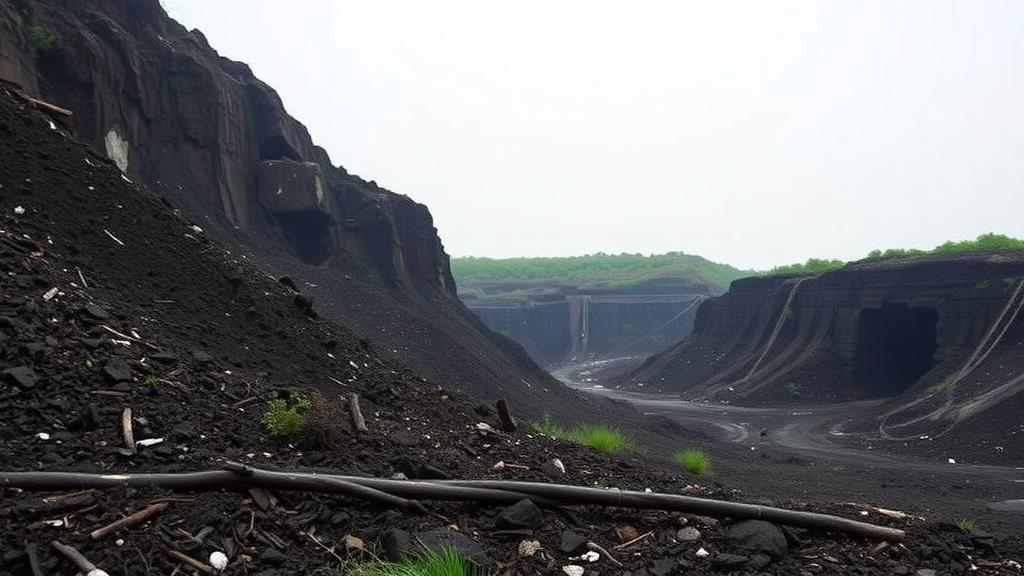
In the rolling hills of southeastern Nigeria, where the abandoned Okpara coal mine cuts through the densely populated Iva Valley of Enugu State, a silent hazard has been accumulating for more than two decades. New research published in Environmental Geochemistry and Health reveals that waste rock from the legacy mine, rich in uranium- and thorium-bearing Enugu Shale, has been quietly releasing natural radionuclides into the soil, water and food supply of a community of roughly 50,000 residents. The study, led by Maxwell Omeje of the University of Central Florida and Covenant University, together with colleagues in Nigeria, Ghana and Japan, presents what the authors describe as one of the highest documented dietary radionuclide ingestion doses ever recorded at a coal mining legacy site in West Africa.
The Okpara mine, also known as the Iva Valley mine, has stood unmanaged since its closure, with no post-closure environmental monitoring or containment strategy. That neglect matters because the geology of the Anambra Basin is unforgiving. The Enugu Shale that hosts the coal seams is naturally enriched in uranium and thorium decay chains, meaning the spoil heaps left behind are essentially uncontrolled deposits of naturally occurring radioactive material. When rainwater percolates through these dumps, it generates acid mine drainage, an acidic leachate that mobilizes radium, thorium and other radionuclides and carries them downslope into farmland and waterways. Wind adds a second dispersal pathway, lifting contaminated dust from the spoil piles and scattering it across the surrounding agricultural landscape.
To quantify the hazard, the team collected 24 environmental samples from across the affected area and analyzed them using certified gamma spectrometry, with measurements performed at Activation Analysis Laboratories in Ancaster, Canada, and at the Centre for Energy Research and Training at Ahmadu Bello University in Zaria, Nigeria. The technique identifies and quantifies gamma-emitting isotopes, allowing the researchers to determine activity concentrations of potassium-40, radium-226 and thorium-232 in each sample. From these measurements they derived eight separate hazard indices, all compliant with the assessment frameworks of the United Nations Scientific Committee on the Effects of Atomic Radiation and the International Commission on Radiological Protection, and they estimated dietary ingestion doses based on local cassava consumption, a staple crop grown throughout the valley.
The numbers are striking. Mean activity concentrations of radium-226 reached 51.23 plus or minus 11.79 becquerels per kilogram, exceeding the global average by a factor of 1.46, while thorium-232 averaged 68.86 plus or minus 16.45 becquerels per kilogram, a factor of 2.30 above the worldwide benchmark. The mean outdoor gamma dose rate of 75.64 nanograys per hour surpassed the world average in 87.5 percent of the samples collected. In practical terms, people living and farming in the valley are receiving measurably higher external gamma exposure than the global baseline, simply from the ground beneath their feet.
But the most alarming finding concerns what residents eat. The mean annual dietary ingestion dose was calculated at 2.43 millisieverts per year, exceeding the ICRP public exposure limit of 1 millisievert per year in every single sample, and radium-226 accounted for 68.8 percent of that total dose. Radium’s dominance on the ingestion pathway stems from its relatively high ingestion dose conversion factor, meaning each becquerel consumed delivers a larger effective dose than the same activity of thorium or potassium-40. Because cassava efficiently transfers radium from contaminated soil into its edible tubers, and because cassava forms such a large share of the local diet, the food chain acts as a powerful concentrating mechanism, funneling subsurface radioactivity directly into the bodies of the community.
The statistical structure of the hazard is also revealing. Thorium-232 emerged as the dominant contributor to the calculated outdoor gamma dose, accounting for roughly 55 percent of the outdoor dose rate with a strong correlation coefficient of R-squared equal to 0.804 and a p-value below 0.0001, while radium-226 dominates the ingestion pathway. This split reflects the different physics of the two exposure routes: thorium’s decay chain emits abundant gamma radiation that irradiates the body externally, whereas radium, chemically analogous to calcium, is readily absorbed through the gut and deposited in bone tissue, where its alpha emissions do the most biological damage. The excess lifetime cancer risk, calculated at a mean of 3.25 times ten to the minus four, exceeded global benchmarks in 66.7 percent of cases, translating into a measurable elevation of lifetime cancer probability for people who live and farm in the most contaminated zones.
Spatial analysis added a crucial layer of precision. Using cubic interpolation of the sample data, the researchers mapped contamination gradients across the valley and found that peak concentrations track the acid mine drainage axis in the central-eastern sector of the site. This pattern confirms the mechanistic picture: the acidic drainage channels act as radioactive highways, carrying radium and thorium from the spoil heaps outward into the fields where food is grown. The mapping also carries practical value for remediation, because it identifies exactly where containment and treatment efforts would deliver the greatest reduction in community dose.
The study also uncovered a regulatory blind spot with immediate construction implications. The representative level index, a screening tool used to judge whether earth materials are safe for building, exceeded the threshold value of 1.0 in 75 percent of samples, classifying those materials as unsuitable for unrestricted construction use. Yet in many Nigerian communities, mine spoil and local soil are routinely used for bricks, road fill and foundations, often without any radiological screening. The finding suggests that the hazard extends beyond farming into the built environment, and that material sourcing decisions in the valley may be compounding exposure without anyone realizing it.
What makes the Iva Valley case particularly significant is its comparative severity. According to the comparative data available at the time of writing, the authors identify the site as the most severe documented case of dietary radionuclide burden at a West African coal mine legacy site. It is also a warning about a broader, largely invisible class of risk. Coal mining worldwide disturbs formations that naturally contain uranium and thorium, and abandoned mines across Africa, Asia and Latin America sit unmonitored beside growing populations. Nigeria alone hosts numerous legacy extraction sites where naturally occurring radioactive materials have never been systematically surveyed, and previous studies have flagged elevated radioactivity around gold, tin and coal operations across the country.
The researchers call for immediate interventions, including treatment of the acid mine drainage, physical containment of the spoil heaps, agricultural restrictions in the most contaminated zones, and systematic monitoring of naturally occurring radioactive materials aligned with international safety standards. None of these measures currently exists at the site. The study’s message is ultimately about time: every year of inaction extends the exposure of 50,000 people through the food they eat, the dust they breathe and the ground they walk on. A mine that closed decades ago is still, in a very literal sense, radiating consequences into the present, and the Iva Valley results make a compelling case that legacy mining sites across the region deserve urgent radiological assessment before the hidden burden grows heavier still.
Subject of Research: Radiological hazard assessment of natural radionuclide contamination from a legacy coal mine in Enugu Iva Valley, Nigeria
Article Title: Elevated radiological hazards in a legacy coal mining area: unveiling hidden cancer risks from natural radionuclides in Enugu Iva Valley, Southeast Nigeria
Article References: Omeje, M., Sabri, S., Owusu-Appiah, J., Gyaase, D., & Orosun, M. M. (2026). Elevated radiological hazards in a legacy coal mining area: unveiling hidden cancer risks from natural radionuclides in Enugu Iva Valley, Southeast Nigeria. Environmental Geochemistry and Health, 48(15), Article 624. https://doi.org/10.1007/s10653-026-03502-3
Image Credits: AI Generated
DOI: 10.1007/s10653-026-03502-3
Keywords: natural radioactivity, radium-226, thorium-232, coal mining legacy, acid mine drainage, cancer risk, Enugu Shale, cassava, gamma spectrometry, Nigeria, ICRP, radiological hazard
Cite Scienmag News
Nathaniel Bowman. (October 5, 2026). Hidden Radiation Legacy: Abandoned Nigerian Coal Mine Delivers Alarming Cancer Doses to 50,000 People. Scienmag. https://scienmag.com/hidden-radiation-legacy-abandoned-nigerian-coal-mine-delivers-alarming-cancer-doses-to-50000-people/
Nathaniel Bowman. "Hidden Radiation Legacy: Abandoned Nigerian Coal Mine Delivers Alarming Cancer Doses to 50,000 People." Scienmag, 5 October 2026, https://scienmag.com/hidden-radiation-legacy-abandoned-nigerian-coal-mine-delivers-alarming-cancer-doses-to-50000-people/. Accessed 5 October 2026.
Nathaniel Bowman. "Hidden Radiation Legacy: Abandoned Nigerian Coal Mine Delivers Alarming Cancer Doses to 50,000 People." Scienmag. October 5, 2026. https://scienmag.com/hidden-radiation-legacy-abandoned-nigerian-coal-mine-delivers-alarming-cancer-doses-to-50000-people/


