

Wednesday, October 21, 2026
Science
No Result
View All Result
  • Login
  • HOME
  • SCIENCE NEWS
  • CONTACT US
  • HOME
  • SCIENCE NEWS
  • CONTACT US
No Result
View All Result
Scienmag
No Result
View All Result
Home Science News Biology

Molecular survey finds widespread Cryptosporidium and limited Giardia in Victorian pigs

October 21, 2026
in Biology
Alan Morgan
By Alan Morgan Scienmag Editorial Profile - Precision Agriculture
Reading Time: 2 mins read
0
Molecular survey finds widespread Cryptosporidium and limited Giardia in Victorian pigs

Molecular survey finds widespread Cryptosporidium and limited Giardia in Victorian pigs

65
SHARES
587
VIEWS
Share on FacebookShare on Twitter
ADVERTISEMENT

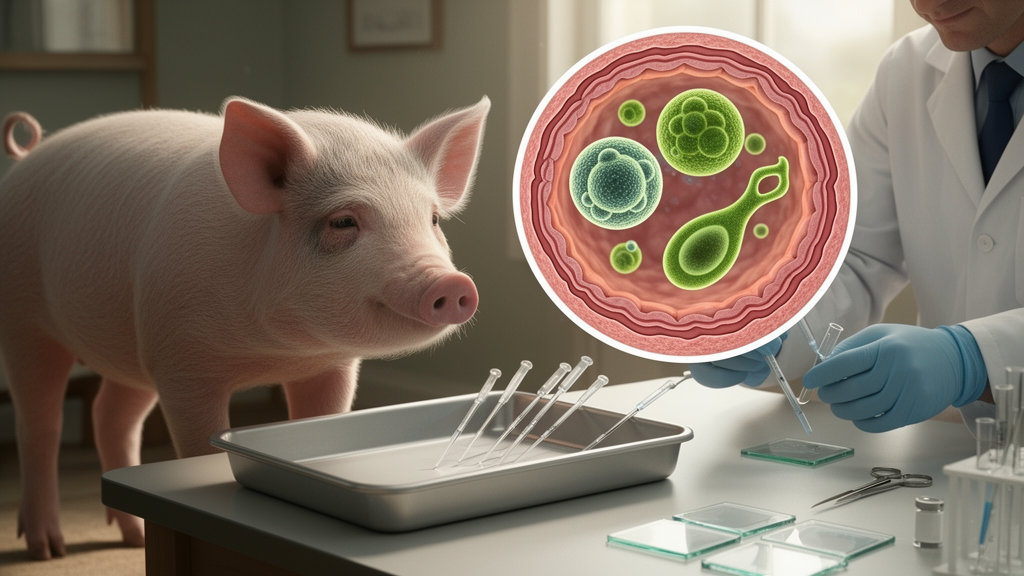
A molecular survey of pigs across 37 farms in Victoria, Australia, found Cryptosporidium in 51.1% of faecal samples and Giardia duodenalis in 1.1%, establishing the first molecular baseline for these enteric protozoa in the state. Cryptosporidium occurred on 28 of the 37 farms surveyed, while G. duodenalis was detected on three. The study also identified two Cryptosporidium subtypes previously recorded in humans, indicating that some parasite genotypes circulating in Victorian pigs have zoonotic potential.

Researchers collected 626 faecal samples representing multiple age groups from farms across Victoria. They used nested polymerase chain reaction assays targeting the small-subunit nuclear ribosomal RNA gene for Cryptosporidium and the tpi locus for G. duodenalis, then amplified the gp60 locus to characterise Cryptosporidium subtypes. Amplified products were analysed by Sanger sequencing. The cross-sectional survey estimated parasite prevalence and examined species composition and genetic diversity within the sampled pig population.

Cryptosporidium detections were dominated by two species. C. scrofarum accounted for 77.5% of Cryptosporidium-positive samples and C. suis for 18.4%. DNA from a third species, C. ubiquitum, was detected in three samples, all from a single farm. Subtyping identified the C. suis subtype XXVa-1 and the C. ubiquitum subtype XIIa; both have previously been identified in humans. This does not demonstrate transmission from pigs to people, but it shows that genotypes of public-health interest are present in the surveyed production environment.

By contrast, G. duodenalis was uncommon: seven of 626 samples were positive, corresponding to a prevalence of 1.1%. The infections occurred on three farms and comprised five samples with assemblage E and two with assemblage A. These findings describe low detected prevalence in this sample rather than establishing the parasite’s distribution throughout Victoria. Cryptosporidium prevalence, however, varied markedly among age groups and production systems, reaching 68.6% among weaners and 78.2% on semi-intensive farms, while it was absent from adult pigs.

The results show that Cryptosporidium is widespread across the Victorian pig farms included in the study, with detection in more than three-quarters of participating properties. The authors describe the work as the first molecular assessment of Cryptosporidium and G. duodenalis in pigs from Victoria and call for continued surveillance and targeted parasite management in Australian pig production. The geographic scope remains important: the estimates are based on 626 samples from 37 farms, and the absence of G. duodenalis outside three sampled farms should not be interpreted as proof that it is absent from other farms. Nevertheless, the baseline identifies frequent Cryptosporidium occurrence, limited detected G. duodenalis infection and zoonotically relevant Cryptosporidium genotypes in the state’s pig population.

Subject of Research: Molecular prevalence and genetic diversity of Cryptosporidium and Giardia duodenalis in pigs from Victoria, Australia

Article Title: First molecular survey of pigs in Victoria, Australia, reveals widespread Cryptosporidium infection, limited Giardia duodenalis occurrence and genotypes with zoonotic potential

Article References: Xu, J., Abbas, G., Gauci, C. G., Gasser, R. B., Jabbar, A., & Koehler, A. V. (2026). First molecular survey of pigs in Victoria, Australia, reveals widespread Cryptosporidium infection, limited Giardia duodenalis occurrence and genotypes with zoonotic potential. Parasites & Vectors. https://doi.org/10.1186/s13071-026-07739-w

Image Credits: AI Generated

DOI: 10.1186/s13071-026-07739-w

Keywords: Cryptosporidium, Giardia duodenalis, pig parasites, molecular epidemiology, zoonotic potential, Victorian agriculture, parasite surveillance, weaner pigs, First, molecular, survey, pigs

Cite Scienmag News

Alan Morgan. (October 21, 2026). Molecular survey finds widespread Cryptosporidium and limited Giardia in Victorian pigs. Scienmag. https://scienmag.com/molecular-survey-finds-widespread-cryptosporidium-and-limited-giardia-in-victorian-pigs/


Alan Morgan. "Molecular survey finds widespread Cryptosporidium and limited Giardia in Victorian pigs." Scienmag, 21 October 2026, https://scienmag.com/molecular-survey-finds-widespread-cryptosporidium-and-limited-giardia-in-victorian-pigs/. Accessed 21 October 2026.

Alan Morgan. "Molecular survey finds widespread Cryptosporidium and limited Giardia in Victorian pigs." Scienmag. October 21, 2026. https://scienmag.com/molecular-survey-finds-widespread-cryptosporidium-and-limited-giardia-in-victorian-pigs/

Tags: cross-sectional study of pig farm parasitologyCryptosporidiumCryptosporidium prevalence in Victorian pigsCryptosporidium species diversity in pigsCryptosporidium subtypes with human connectionFirstgenetic diversity of Cryptosporidium in pigsGiardia duodenalisGiardia duodenalis limited prevalence in pigsmolecularmolecular detection of enteric protozoa in livestockmolecular epidemiologymolecular survey of pig parasites in Australiaparasite surveillancePCR-based detectionpig parasitespigspublic health implications of zoonotic protozoasurveyVictorian agricultureweaner pigszoonotic potentialzoonotic potential of Cryptosporidium and Giardia
Share26Tweet16
Previous Post

Two L-shaped fins optimize Lauric-acid storage cycle in simulation

Next Post

Rhizobium and organic-mineral fertilizer improve faba bean in saline soil

Related Posts

Gene architecture predicts isoform diversity across four genomes
Biology

Gene architecture predicts isoform diversity across four genomes

October 21, 2026
Efficacy of statistical and design interventions for improving reproducibility in biomedical research
Biology

Efficacy of statistical and design interventions for improving reproducibility in biomedical research

October 21, 2026
Alpine moth study separates two species using anatomy and DNA barcodes
Biology

Alpine moth study separates two species using anatomy and DNA barcodes

October 21, 2026
Radiation suppresses PiC, triggering mitochondrial dysfunction and glioma cell death
Biology

Radiation suppresses PiC, triggering mitochondrial dysfunction and glioma cell death

October 21, 2026
Uncultured Gut Microbes Offer Obesity Leads, Not Yet Causal Answers
Biology

Uncultured Gut Microbes Offer Obesity Leads, Not Yet Causal Answers

October 21, 2026
Routine monitoring rediscovers Switzerland’s tiny Stactobia caddisfly
Biology

Routine monitoring rediscovers Switzerland’s tiny Stactobia caddisfly

October 21, 2026
Next Post
Rhizobium and organic-mineral fertilizer improve faba bean in saline soil

Rhizobium and organic-mineral fertilizer improve faba bean in saline soil

  • Mothers who receive childcare support from maternal grandparents show more optimized

    Mothers who receive childcare support from maternal grandparents show more parental warmth, finds NTU Singapore study

    27656 shares
    Share 11059 Tweet 6912
  • University of Seville Breaks 120-Year-Old Mystery, Revises a Key Einstein Concept

    1061 shares
    Share 424 Tweet 265
  • Bee body mass, pathogens and local climate influence heat tolerance

    682 shares
    Share 273 Tweet 171
  • Researchers record first-ever images and data of a shark experiencing a boat strike

    546 shares
    Share 218 Tweet 137
  • Groundbreaking Clinical Trial Reveals Lubiprostone Enhances Kidney Function

    531 shares
    Share 212 Tweet 133
Science

Embark on a thrilling journey of discovery with Scienmag.com—your ultimate source for cutting-edge breakthroughs. Immerse yourself in a world where curiosity knows no limits and tomorrow’s possibilities become today’s reality!

RECENT NEWS

  • Rhizobium and organic-mineral fertilizer improve faba bean in saline soil
  • Molecular survey finds widespread Cryptosporidium and limited Giardia in Victorian pigs
  • Two L-shaped fins optimize Lauric-acid storage cycle in simulation
  • GES4SEAS turns cumulative ocean pressures into operational management tools

Categories

  • Agriculture
  • Anthropology
  • Archaeology
  • Athmospheric
  • Biology
  • Biotechnology
  • Blog
  • Bussines
  • Cancer
  • Chemistry
  • Climate
  • Earth Science
  • Editorial Policy
  • Marine
  • Mathematics
  • Medicine
  • Pediatry
  • Policy
  • Psychology & Psychiatry
  • Science Education
  • Science News
  • Social Science
  • Space
  • Technology and Engineering

Subscribe to Blog via Email

Enter your email address to subscribe to this blog and receive notifications of new posts by email.

Join 5,150 other subscribers

© 2025 Scienmag - Science Magazine

Welcome Back!

Login to your account below

Forgotten Password?

Retrieve your password

Please enter your username or email address to reset your password.

Log In
No Result
View All Result
  • HOME
  • SCIENCE NEWS
  • CONTACT US

© 2025 Scienmag - Science Magazine

Discover more from Science

Subscribe now to keep reading and get access to the full archive.

Continue reading