


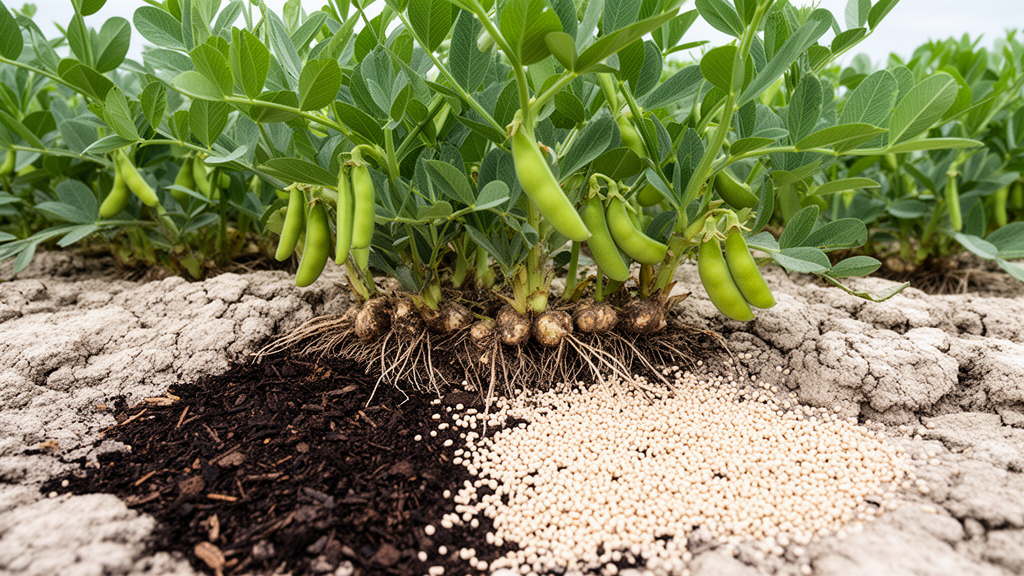
A two-season field experiment in marginally saline soil found that combining Rhizobium biofertilizer with organic amendments and mineral nutrients produced the strongest faba bean performance among the treatments tested. In the second season, the integrated treatment raised the soil fertility index to 0.99, available nitrogen to 47.7 mg/kg, available potassium to 104.4 mg/kg, and phosphatase activity to 93.81 µg PNP per gram of soil per hour.
The study was conducted in Kafr El-Sheikh, Egypt, where researchers compared an untreated control, Rhizobium plus phosphorus, a fertilizer treatment containing 50% inorganic nitrogen and 50% organic amendments with phosphorus, that organic-inorganic treatment combined with Rhizobium, and conventional inorganic nitrogen-phosphorus fertilizer. The greatest response came from integrating the bacterial inoculant with organic amendments and mineral nutrients, rather than from either Rhizobium or the organic-mineral fertilizer alone.
Plants receiving the combined treatment also showed improved physiological measurements in the second season. Their photosynthetic rate reached 17.12 µmol CO₂ m⁻² s⁻¹, relative water content rose to 82.43%, and plant nitrogen concentration reached 13.86 mg/g. Electrolyte leakage was 14.54%. Grain yield increased to 4,865 kg per hectare, the highest reported value for the integrated treatment.
Beyond the crop itself, the experiment detected changes in soil biological and chemical functioning. The improved phosphatase activity was accompanied by higher availability of nitrogen and potassium and a near-maximum soil fertility index. Residual fertility was evaluated through a follow-up soybean crop, which showed greater dry mass and nutrient accumulation in soil treated with the integrated combination. Together, these measurements support the conclusion that Rhizobium-assisted organic-mineral management improved both faba bean productivity and several indicators of soil functioning under the study’s marginally saline field conditions.
The results were obtained under a defined set of field conditions. The experiment covered two growing seasons at one location in Egypt and included five treatments. The findings therefore apply directly to the tested soils, management regime, and faba bean planting conditions, while leaving performance in other locations, salinity levels, climates, or varieties unresolved.
Organic and mineral components were tested together with and without Rhizobium, allowing the researchers to compare the integrated treatment with the same organic-mineral fertilizer applied without the inoculant. In addition, Rhizobium plus phosphorus was assessed as a separate treatment, as was conventional inorganic nitrogen-phosphorus fertilizer. The strongest measured response occurred when the bacterial, organic and mineral components were combined.
Several indicators showed a consistent pattern across plant performance, nutrient status and soil measurements. The second-season values for photosynthetic rate, relative water content, plant nitrogen and grain yield were highest under the integrated treatment, while soil fertility index, available nitrogen, available potassium and phosphatase activity also reached their strongest reported levels in that treatment. Electrolyte leakage was lower in the same treatment, at 14.54%.
The follow-up soybean measurements extended the assessment beyond faba bean harvest. Soil receiving the integrated treatment supported greater soybean dry mass and greater nutrient accumulation, indicating that the treatment left a measurable effect on residual soil fertility. The study does not isolate the precise mechanism responsible for these responses, but its field design directly documents the contrast among the five tested management treatments.
Overall, the experiment provides field-based evidence that adding Rhizobium to a blended organic-mineral fertilizer can improve faba bean productivity and several measures of soil functioning in marginally saline soil. The scale of the finding is bounded by the two-season, single-location study, and the results do not establish whether the same treatment effects would be obtained in other agricultural environments. Within the tested conditions, however, the combined approach delivered the clearest improvement among the options compared.
Subject of Research: Effects of Rhizobium-assisted organic-mineral fertilization on faba bean productivity and soil functioning in marginally saline soil.
Article Title: Rhizobium-assisted organic-mineral fertilization improves faba bean productivity and soil functioning in marginally saline soil
Article References: Alshaal, T., Elhawat, N., & Veres, S. (2026). Rhizobium-assisted organic-mineral fertilization improves faba bean productivity and soil functioning in marginally saline soil. BMC Plant Biology. https://doi.org/10.1186/s12870-026-10218-0
Image Credits: AI Generated
DOI: 10.1186/s12870-026-10218-0
Keywords: faba bean, Rhizobium, marginal salinity, biofertilizer, organic fertilizer, soil fertility, plant productivity, phosphatase activity, Egypt, field experiment, Rhizobium-assisted, organic-mineral
Cite Scienmag News
Alan Morgan. (October 21, 2026). Rhizobium and organic-mineral fertilizer improve faba bean in saline soil. Scienmag. https://scienmag.com/rhizobium-and-organic-mineral-fertilizer-improve-faba-bean-in-saline-soil/
Alan Morgan. "Rhizobium and organic-mineral fertilizer improve faba bean in saline soil." Scienmag, 21 October 2026, https://scienmag.com/rhizobium-and-organic-mineral-fertilizer-improve-faba-bean-in-saline-soil/. Accessed 21 October 2026.
Alan Morgan. "Rhizobium and organic-mineral fertilizer improve faba bean in saline soil." Scienmag. October 21, 2026. https://scienmag.com/rhizobium-and-organic-mineral-fertilizer-improve-faba-bean-in-saline-soil/


