


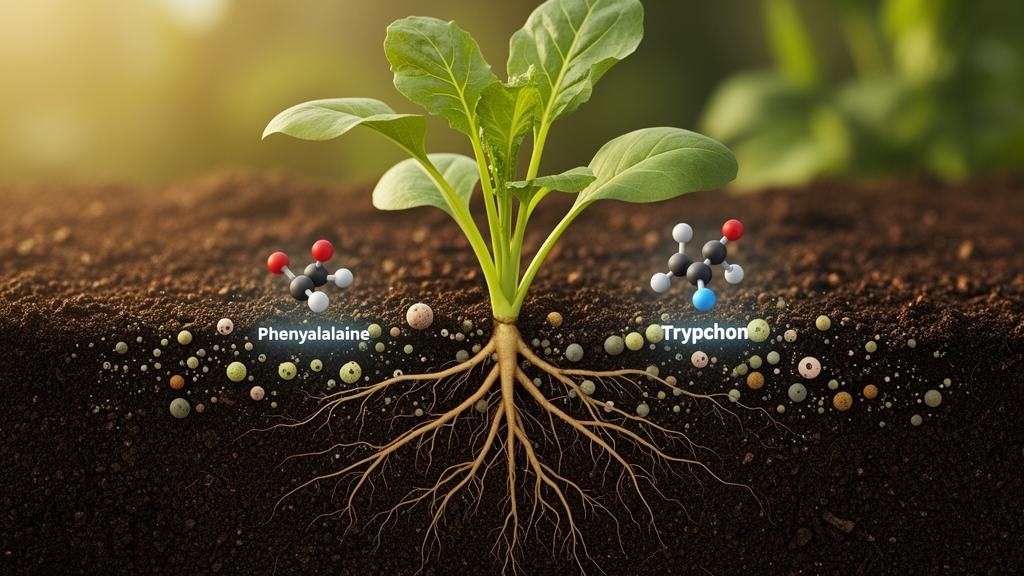
A critical synthesis of evidence from fruit, vegetable, ornamental and medicinal crops indicates that the aromatic amino acids phenylalanine, tryptophan and tyrosine can act as context-dependent biostimulants, influencing plant growth, nutrient acquisition, stress responses, specialized metabolism, yield and product quality. Their effects are not interchangeable: phenylalanine chiefly feeds phenylpropanoid pathways, tryptophan is linked to auxin and other indole compounds, and tyrosine supports tocochromanol, plastoquinone and additional specialized-metabolite pathways. The review finds promising experimental effects across multiple crops, but emphasizes that most evidence comes from controlled studies and that commercial efficacy remains largely unvalidated.
All three amino acids are synthesized through the plastid-localized shikimate pathway, which links primary carbon metabolism to a wide range of specialized plant compounds. Chorismate is the common precursor: phenylalanine and tyrosine arise through the prephenate branch, whereas tryptophan is produced through the anthranilate branch. The pathway is regulated by feedback, substrate availability, developmental demands, tissue specificity and environmental signals, making amino acid availability a dynamic metabolic state rather than a fixed property.
External supplementation does not necessarily raise all downstream products in proportion, because uptake, transport, enzyme activity and competing metabolic sinks determine how an applied compound is used. The same amino acid can therefore produce stronger, weaker or qualitatively different responses in different species, genotypes, tissues, developmental stages and production environments. Phenylalanine has the clearest and most extensively studied association with crop performance.
Its conversion by phenylalanine ammonia-lyase initiates phenylpropanoid metabolism, supplying compounds including flavonoids, anthocyanins, hydroxycinnamates, lignin, tannins, coumarins and stilbenes. These metabolites contribute to antioxidant protection, cell-wall reinforcement, ultraviolet shielding, pigmentation and defense. Experiments summarized in the review report increased plant height, biomass, chlorophyll, carotenoids, fruit set and marketable yield in crops including tomato, with separate studies linking phenylalanine treatment to better performance under salinity, chilling and pathogen challenge.
The strongest mechanisms for phenylalanine remain rooted in the distinction between precursor supply and pathway activity. Additional phenylalanine may increase the substrates available to phenylpropanoid metabolism, but enzyme activity, tissue-specific regulation, developmental stage and competing sinks determine whether downstream products accumulate. The review also notes that phenylalanine-derived coumarins can affect rhizosphere microbial communities and iron acquisition, while phenolic compounds and lignin contribute to structural and chemical defense.
However, these plant-mediated effects should not be confused with direct consumption of free phenylalanine by microbes. Similarly, the amino-acid-responsive chemotaxis observed in Pseudomonas fluorescens Pf0-1 demonstrates microbial sensing of phenylalanine, but it does not by itself establish selective recruitment of beneficial microorganisms or improved crop performance under field conditions. Tryptophan is distinguished by its role in indole-3-acetic acid, the principal naturally occurring auxin.
Through auxin-related regulation, it can affect cell division and elongation, vascular differentiation, root architecture, flowering, fruit set and development. Experiments report larger root systems, improved nutrient accumulation, greater vegetative growth and higher yields in cucumber, citrus, pear, apple, grapevine and other horticultural crops. Tryptophan also supplies serotonin, melatonin, camalexin and other indolic metabolites associated with signaling, defense and stress adaptation.
Its influence is particularly relevant when drought, salinity or nutrient limitation restricts root activity, although reported outcomes vary substantially with dose, cultivar, development stage and production environment. Tryptophan treatment has also been associated with increased total soluble solids, sugars, fruit size and, in selected studies, shelf life, but these compositional and quality measures do not by themselves establish improved nutrition or consumer acceptance. The plant microbiome adds another level to tryptophan’s activity.
Some plant-associated bacteria convert tryptophan into auxin through taxon-specific pathways, including the indole-3-acetamide, indole-3-pyruvate, tryptamine, indole-3-acetonitrile and tryptophan side-chain oxidase routes. One of the strongest causal examples involves the plant-growth-promoting bacterium Bacillus thuringiensis RZ2MS9: disruption of its ipdC gene reduced tryptophan-dependent auxin production by approximately 57% and impaired maize-root colonization, total root length, projected root area, lateral-root development and shoot dry matter. This establishes a causal microbial route in that experimental system, but it does not show that all horticultural responses to tryptophan are microbially mediated, or that the mechanism operates uniformly across rhizosphere communities.
Direct plant uptake and metabolism may also contribute, and the relative shares of plant-derived and microbial-derived auxin remain insufficiently resolved for many crops. Tyrosine remains the least investigated of the three molecules but occupies a distinct position in cellular protection. It contributes to tocopherols, plastoquinones, betalains, rosmarinic acid, benzylisoquinoline alkaloids and other compounds associated with antioxidant defense, photosynthesis and redox regulation.
Foliar tyrosine has been associated with improved growth, carbon dioxide assimilation and water-use efficiency in tomato, enhanced rooting and biomass in olive, and increased cluster weight, berry yield and selected quality traits in grapevine. Studies in spinach and beetroot report improved antioxidant capacity, reduced oxidative damage and greater tolerance of salinity, alkalinity or heavy-metal stress. These observations support a potential role in chloroplast protection, but the direct metabolic chain connecting external tyrosine to these outcomes remains less clearly established than for phenylalanine or tryptophan.
Tyrosine uptake, transport, dose-dependent responses and the relative importance of its downstream pathways therefore need more systematic investigation. Across crops, environmental stress and specialized-metabolite responses appear to converge on antioxidant protection, membrane stability and maintenance of photosynthesis, but the shared outcomes arise through different mechanisms. Phenylalanine-derived phenolics and lignin provide chemical and structural defense, tryptophan-associated auxin and indole pathways regulate roots, signaling and osmotic responses, and tyrosine-derived metabolites support chloroplast and cellular redox control.
Phenylalanine treatments have induced host defenses and reduced disease severity against Botrytis cinerea in tomato and petunia, while postharvest treatments have lowered fungal decay in mango, avocado, strawberry and citrus. These are host-mediated responses, not evidence that the amino acids directly kill pathogens, and they should not be equated with demonstrated replacement for commercial fungicides. Similarly, reduced malondialdehyde, increased antioxidant-enzyme activity or better membrane stability under stress indicate physiological protection; whether those changes translate into sustained yield depends on stress severity, duration, crop status and treatment conditions.
Effects on food quality are measurable but not yet equivalent to demonstrated consumer or health benefits. Phenylalanine can increase phenolics, flavonoids, anthocyanins and ascorbic acid, influencing fruit color, firmness, aroma and antioxidant-related characteristics. Tryptophan treatments have raised total soluble solids, sugars, fruit size and, in some studies, shelf life.
Amino acid treatment has also modified fructose, glucose and organic-acid concentrations in tomato and volatile aromatic compounds in grape. Postharvest phenylalanine has maintained firmness and delayed deterioration in tomato, strawberry and pear, yet evidence for comprehensive consumer acceptance, long-term commercial storage, processing stability and bioavailability is sparse. Yield and composition can also move independently: larger fruit may dilute metabolite concentrations, while stress treatments may increase phenolics without raising yield.
Increased plant antioxidant capacity or the concentration of a bioactive compound therefore indicates a compositional change, not a demonstrated benefit to human health, and changes measured at harvest may not survive storage, cooking, drying, juicing, fermentation or freezing. Translation will depend on crop-specific dosing and standardized field validation rather than a universal recipe. Foliar delivery is common in experiments, while root-zone application may better suit root development or nutrient acquisition, and treatment timing should match the intended outcome.
Responses can be nonlinear, and a concentration effective during vegetative growth may have a different effect during flowering, fruit set or storage. Field conditions add further uncertainty through rainfall, temperature, radiation, humidity, canopy structure, soil moisture, microbial transformation and spray uniformity. Multi-location trials across cultivars and seasons must therefore measure persistence, application efficiency, compatibility with other inputs, treatment costs, food safety, environmental effects and non-target impacts.
Postharvest adoption similarly requires optimization of concentration, treatment-to-storage interval, and compatibility with washing, coatings, refrigeration and modified-atmosphere packaging. The review identifies three linked priorities for future research: determining why identical treatments produce different responses among crops, separating direct plant effects from microbiome-mediated effects, and establishing reproducible commercial protocols. Comparative work should combine isotope tracing, metabolomics, transcriptomics, proteomics and functional genetics across cultivars and environments, while synthetic microbial communities and targeted mutants could clarify causal plant–microbe pathways.
The overall picture is promising but cautious: aromatic amino acids are metabolic regulators with measurable effects on growth, resilience, yield and quality, yet their practical value will be determined by mechanistically informed, crop-specific, economically justified and independently validated treatments rather than by controlled-condition effects alone.
Subject of Research: Mechanisms, horticultural applications and evidence gaps for aromatic amino acids used as biostimulants.
Article Title: Aromatic amino acids as multifunctional biostimulants in horticultural crops: mechanisms, applications and future perspectives
Article References: Manda-Hakki, K., & Hassanpour, H. (2026). Aromatic amino acids as multifunctional biostimulants in horticultural crops: mechanisms, applications and future perspectives. Journal of Agriculture and Food Research, Article 103380. https://doi.org/10.1016/j.jafr.2026.103380
Image Credits: AI Generated
DOI: 10.1016/j.jafr.2026.103380
Keywords: aromatic amino acids, plant biostimulants, shikimate pathway, phenylalanine, tryptophan, tyrosine, horticultural crops, plant stress tolerance, crop quality, plant microbiome, Aromatic, amino
Cite Scienmag News
Alan Morgan. (October 20, 2026). Aromatic amino acids show context-dependent biostimulant effects in horticulture. Scienmag. https://scienmag.com/aromatic-amino-acids-show-context-dependent-biostimulant-effects-in-horticulture/
Alan Morgan. "Aromatic amino acids show context-dependent biostimulant effects in horticulture." Scienmag, 20 October 2026, https://scienmag.com/aromatic-amino-acids-show-context-dependent-biostimulant-effects-in-horticulture/. Accessed 20 October 2026.
Alan Morgan. "Aromatic amino acids show context-dependent biostimulant effects in horticulture." Scienmag. October 20, 2026. https://scienmag.com/aromatic-amino-acids-show-context-dependent-biostimulant-effects-in-horticulture/


