


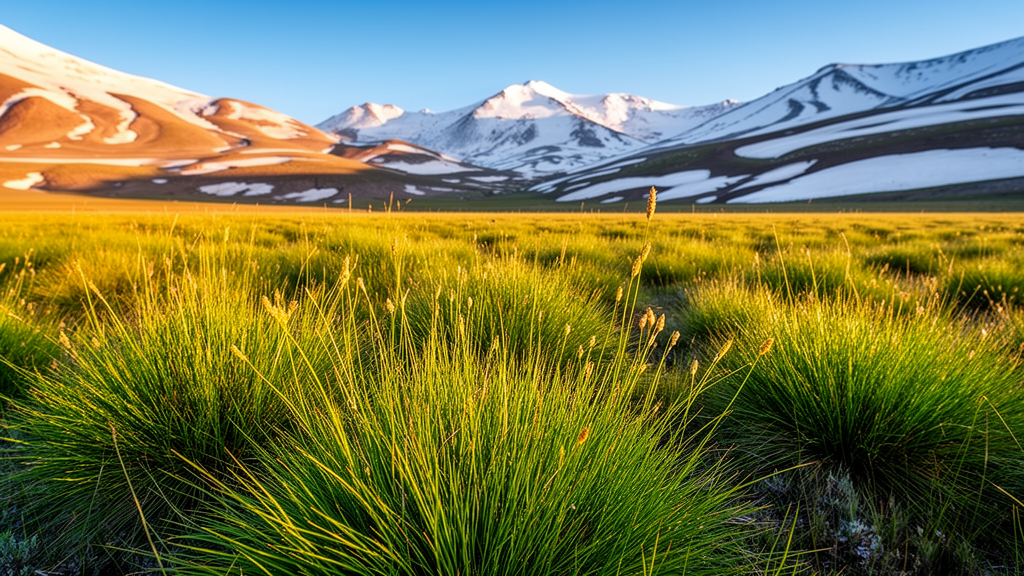
A long-term field warming experiment found that passive open-top chambers reduced two measured indicators of leaf stress in Kobresia pygmaea and increased its chlorophyll concentrations, with responses varying by sampling month and elevation. The study examined leaves of the dominant alpine meadow sedge at four sites on the northeastern Qinghai-Tibet Plateau during July, August and September 2022.
The experiment used transparent passive open-top chambers installed at elevations of 3,691, 3,786, 3,981 and 4,131 metres above sea level. The chambers were established in July 2014, allowing the 2022 measurements to represent long-term experimental exposure rather than only an acute response. At each elevation, warmed plots were paired with adjacent ambient control plots, with three plot-level replicates per treatment and sampling month. Healthy, fully expanded K. pygmaea leaves were collected from each plot and pooled at the plot level.
Across all sites and months, warming raised mean near-surface air temperature from 23.09 to 24.43 °C, an increase of 1.34 °C. Mean surface soil temperature rose by a similar 1.32 °C, from 22.56 to 23.88 °C. The treatment also produced a drier microclimate: relative humidity declined from 49.14% to 43.98%, a 5.16-percentage-point reduction, while surface soil moisture fell from 18.52% to 13.35%, a 5.17-percentage-point decrease. Air and soil temperatures generally declined from July to September, while humidity and soil moisture showed stronger variation among sites.
Leaf malondialdehyde content averaged 6.53 µmol g−1 in warmed plots, compared with 8.18 µmol g−1 in controls, representing a 20.2% reduction. Mean proline concentration declined from 51.18 to 28.02 µg g−1, a reduction of 45.3%. In this experiment, lower malondialdehyde was consistent with less membrane lipid peroxidation, while lower proline was consistent with less osmotic adjustment. The study did not directly measure cellular damage or plant water potential, so these measurements were interpreted as leaf-level physiological indicators rather than direct demonstrations of broader plant health.
Antioxidant enzyme responses differed by enzyme. Superoxide dismutase activity increased only slightly, from 136.52 to 139.78 U g−1, or 2.4%, whereas peroxidase activity rose from 171.40 to 216.48 U g−1, an increase of 26.3%. The factorial analysis identified warming effects on peroxidase but not a comparably strong warming effect on superoxide dismutase. These results indicate that warming altered the measured antioxidant response selectively rather than increasing all measured indicators equally.
Warmed plants also had substantially larger chlorophyll pools. Chlorophyll a increased from 1.35 to 2.33 mg g−1, or 72.0%, and chlorophyll b rose from 0.59 to 0.98 mg g−1, or 66.2%. Total chlorophyll increased from 1.94 to 3.30 mg g−1, a 70.2% rise. By comparison, the chlorophyll a/b ratio changed only slightly, from 2.44 to 2.58, and its warming effect was not significant in the factorial analysis. The measured result was therefore a larger overall pigment pool without a significant shift in the relative proportion of chlorophyll a and b.
Three-way factorial analysis of variance found significant effects of month, elevation and experimental treatment, as well as interaction effects, on most physiological indicators. Significant month-by-treatment and elevation-by-treatment interactions for several variables showed that the warming response was not uniform throughout the growing season or across the elevation gradient. The researchers therefore did not rely on uncorrected pairwise comparisons as the primary basis for statistical inference. Figure error bars represent standard deviations, and each treatment-elevation-month combination had three plot-level replicates.
Some warmed plots retained higher pigment concentrations later in the growing season, but researchers did not record direct phenological scores, so delayed senescence could not be confirmed. The measured results also applied to leaf traits of one species in one growing season and one year of sampling. They do not directly demonstrate changes in biomass, net primary productivity, community composition, ecosystem carbon exchange or pasture yield. The small number of plot-level replicates also limits the precision and generalizability of the experiment.
Overall, the field experiment found that moderate passive warming accompanied by surface drying was associated with lower leaf malondialdehyde and proline, substantially higher chlorophyll concentrations, and a selective increase in peroxidase activity in K. pygmaea. The magnitude of these responses depended on month and elevation. Because the study did not measure ecosystem productivity, carbon exchange or phenology directly, its findings support a bounded conclusion about measured leaf-level physiological responses at four alpine meadow sites rather than a conclusion about long-term ecosystem effects.
Subject of Research: Experimental warming effects on leaf physiology of Kobresia pygmaea across alpine meadow elevations
Article Title: Experimental warming alleviates leaf-level physiological stress of Kobresia pygmaea in alpine meadows on the Northeastern Qinghai-Tibet Plateau
Article References: Zheng, L., Wu, X., Ji, G., & Liu, G. (2026). Experimental warming alleviates leaf-level physiological stress of Kobresia pygmaea in alpine meadows on the Northeastern Qinghai-Tibet Plateau. BMC Plant Biology, 26(1), Article 1646. https://doi.org/10.1186/s12870-026-09905-9
Image Credits: AI Generated
DOI: 10.1186/s12870-026-09905-9
Keywords: Kobresia pygmaea, alpine meadows, experimental warming, open-top chambers, leaf physiology, chlorophyll, oxidative stress, elevation gradient, Qinghai-Tibet Plateau, Experimental, warming, alleviates
Cite Scienmag News
Gavin Prescott. (October 20, 2026). Experimental warming alleviates leaf-level physiological stress of Kobresia pygmaea in alpine meadows on the Northeastern Qinghai-Tibet Plateau. Scienmag. https://scienmag.com/experimental-warming-alleviates-leaf-level-physiological-stress-of-kobresia-pygmaea-in-alpine-meadows-on-the-northeastern-qinghai-tibet-plateau/
Gavin Prescott. "Experimental warming alleviates leaf-level physiological stress of Kobresia pygmaea in alpine meadows on the Northeastern Qinghai-Tibet Plateau." Scienmag, 20 October 2026, https://scienmag.com/experimental-warming-alleviates-leaf-level-physiological-stress-of-kobresia-pygmaea-in-alpine-meadows-on-the-northeastern-qinghai-tibet-plateau/. Accessed 20 October 2026.
Gavin Prescott. "Experimental warming alleviates leaf-level physiological stress of Kobresia pygmaea in alpine meadows on the Northeastern Qinghai-Tibet Plateau." Scienmag. October 20, 2026. https://scienmag.com/experimental-warming-alleviates-leaf-level-physiological-stress-of-kobresia-pygmaea-in-alpine-meadows-on-the-northeastern-qinghai-tibet-plateau/


