


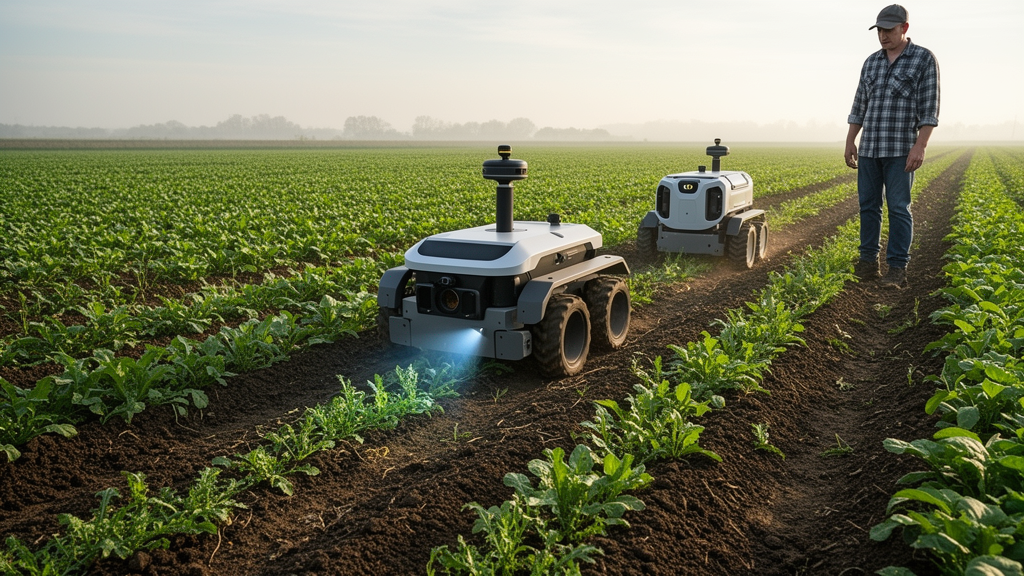
A peer-reviewed review by researchers at the University of Mississippi and Cornell University finds that artificial intelligence-guided weed management could reduce reliance on herbicides and manual labor, but the technologies also pose financial, ecological and technical challenges. The review examines three approaches: AI-guided lasers, robotic cultivators and precision sprayers. These systems use real-time image analysis to identify weeds in crop rows and then direct a laser, herbicide or mechanical action toward detected plants.
The authors present the technologies as potential tools for more targeted weed control, not as universal replacements for established methods. Stephen Duke, a research professor at the Ole Miss National Center for Natural Products Research, described AI-driven precision weed management as a possible third revolution in weed management. He said the previous two revolutions were the development of synthetic herbicides and herbicide-resistant crops during the past 100 years. “It looks to me like AI-driven precision weed management will be the next revolution,” Duke said. “This has the potential to drastically change how we manage our crops.” The review was published in the journal Engineering and considers both the opportunities and potential unintended consequences associated with combining artificial intelligence with three forms of weed-control machinery.
All three technologies rely on image analysis to distinguish weeds from crops while the equipment is operating. When a system detects a weed, a laser tool can direct a high-powered beam at the plant, a precision sprayer can apply herbicide to selected targets, and a robotic cultivator can remove weeds mechanically from the soil. This targeted approach is intended to limit treatment to identified weeds rather than applying an operation indiscriminately.
The performance of each system therefore depends partly on the image-recognition model used to recognize weeds under the conditions in which the machinery operates. The review covers the technical and biological context of these systems rather than reporting a new field experiment or a controlled comparison of all three approaches. One potential benefit is better crop safety, particularly in specialty crops such as fruits and vegetables.
Lynn Sosnoskie, an associate professor in Cornell University’s School of Integrative Plant Science, said such crops can be sensitive to herbicide exposure, which can delay crop emergence or cause damage and stunting. Although growers may accept some plant injury when weed suppression is a priority, precision technology can keep some, and sometimes all, herbicide off the crop, she said. The review also identifies possible reductions in chemical exposure for farm workers, less residue on crops and less herbicide entering the environment as potential benefits of reducing broadcast or excessive applications.
Lasers and robotic tillers may be particularly relevant to organic farmers, who do not use synthetic herbicides and rely largely on hand labor for weed control. Mechanized laser or cultivation systems could help organic growers manage larger areas without the same intensity of manual work. Purchase cost is one of the most significant barriers to adoption.
Some commercial mechanical and robotic weed-management systems can cost around $75,000 or more, while laser-based systems can cost more than $1 million. Duke described an organic farmer in the Netherlands who bought a robotic laser weeder for more than $1 million and reportedly acquired a second unit because the first had saved substantial effort. He cautioned that such an outcome would not be possible for every producer.
Farmers growing high-value crops may be able to support the investment, but many cannot, he said. Precision sprayers are expected to become less expensive as adoption increases, yet lower prices would not by themselves resolve resistance, soil-quality or model-performance concerns. Reduced herbicide use may not end the problem of herbicide-resistant weeds.
The review notes that farmers already face numerous weeds resistant to particular herbicides, although not every weed is resistant to every herbicide. Using less herbicide and directing it more precisely may therefore leave an existing resistance problem unresolved. Duke called resistant weeds a major agricultural challenge.
The authors distinguish the potential reduction in total herbicide application from the continuing need to manage resistant populations, meaning that more efficient spraying should not be equated with the disappearance of resistance. Robotic cultivation presents a different set of trade-offs. Excessive tillage can affect soil quality, so substituting robotic cultivation for hand weeding does not remove the environmental consequences of mechanical soil disturbance.
Artificial-intelligence models also face a transferability problem because many live-detection systems are trained on specific crops, weed species or environments. Companies have focused much of their development on western United States vegetable production, including Arizona, California, Oregon and Washington. Those regions have climates that differ from the Southeast, where a model may encounter weeds and growing conditions absent from its training data.
Systems intended for growers in Mississippi, Alabama and nearby southeastern areas would need training that reflects local weeds and environments. The review also warns that weeds can evolve in response to automated control. Some weeds resemble crops, a phenomenon called crop mimicry.
If these look-alike weeds survive treatment, they can reproduce and make crop-like weeds more prevalent. Over time, that process could favor weeds capable of evading machines designed to destroy them. Sosnoskie said the availability of precision technology does not free growers from the need to manage weeds. “With weed control, we always have to think about how the weed is going to respond or try to ‘win,’” she said.
The review’s central caution is that AI-guided systems may make weed treatment more selective and potentially less labor-intensive, while requiring continued attention to costs, resistance, soil effects, model transferability and the evolutionary responses of weeds.
Subject of Research: A review of artificial intelligence-guided weed management using lasers, robotic cultivators and precision sprayers
Article Title: Researchers study how AI could improve weed management
Article References: Researchers study how AI could improve weed management. Original publication (Bibliographic details unavailable.)
Image Credits: AI Generated
DOI: Not provided
Keywords: artificial intelligence, weed management, laser weeding, robotic cultivation, precision spraying, herbicide resistance, computer vision, crop safety, precision agriculture, soil quality, Researchers, improve
Cite Scienmag News
Alan Morgan. (October 20, 2026). Review assesses AI-guided weed control opportunities and risks. Scienmag. https://scienmag.com/review-assesses-ai-guided-weed-control-opportunities-and-risks/
Alan Morgan. "Review assesses AI-guided weed control opportunities and risks." Scienmag, 20 October 2026, https://scienmag.com/review-assesses-ai-guided-weed-control-opportunities-and-risks/. Accessed 20 October 2026.
Alan Morgan. "Review assesses AI-guided weed control opportunities and risks." Scienmag. October 20, 2026. https://scienmag.com/review-assesses-ai-guided-weed-control-opportunities-and-risks/


