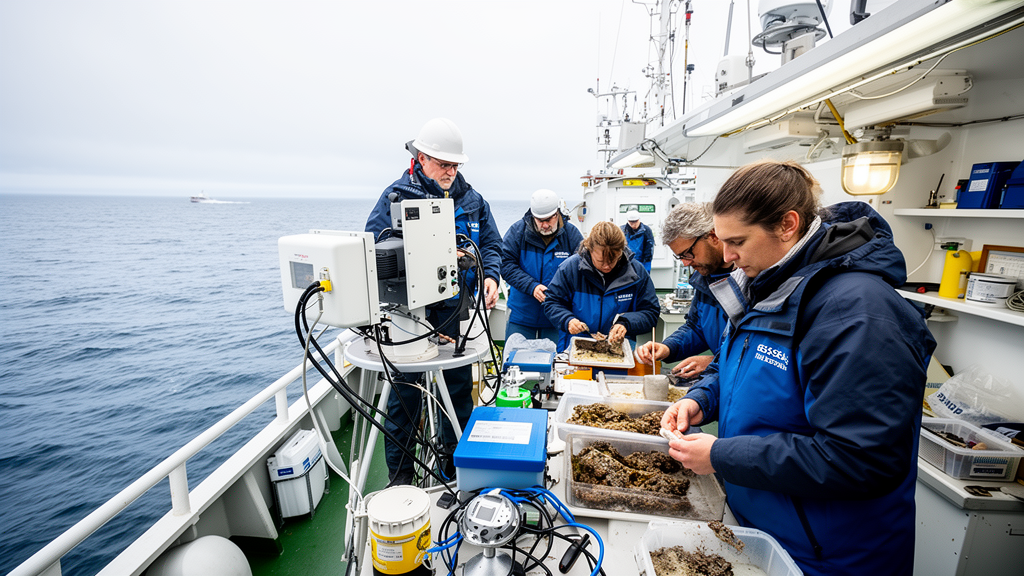
A four-year European project has developed and tested an operational framework for assessing how multiple human pressures—including climate change—affect marine ecosystems, the services they provide and the social benefits derived from them. The GES4SEAS initiative combined co-design with policy authorities, statistical and mechanistic models, and eight interoperable tools, including the Tikta assessment platform. Its authors describe the result not as a single predictive breakthrough but as an end-to-end workflow intended to make cumulative effects assessment more transparent, transferable and usable in ecosystem-based marine management.
The project addressed a persistent gap between marine governance and available science. European and global policies call for ecosystem-based management, Good Environmental Status and protection of biodiversity, but managers have often had to combine fragmented information about individual activities, their pressures and their consequences. The GES4SEAS framework links these elements in a continuous sequence: human activities generate pressures, pressures alter ecosystem components, those changes affect ecosystem functioning and services, and management measures are then evaluated for possible mitigation or restoration. A revised set of 26 ecosystem-based management principles helps structure that sequence, while guidance is provided on matching each analytical question with an appropriate method.
Co-design was treated as a scientific and operational requirement rather than a final consultation exercise. A Practitioners Advisory Board included national competent authorities from five countries, representatives of four Regional Seas Conventions, European agencies, the International Council for the Exploration of the Sea and an external contributor from Canada. Through iterative planning, design, implementation, testing and evaluation, this group helped define policy-relevant outputs, identify practical requirements and validate the emerging tools. The approach also connected researchers and prospective users through 11 “Learning Sites” spanning European regional seas and contrasting data conditions, giving the project a route for testing whether proposed workflows could operate outside the settings in which they were conceived.
The underlying science combines segmented regression and generalized additive models, qualitative and statistical approaches, and mechanistic food-web models. These methods can expose non-linear ecosystem responses, possible tipping points and feedbacks that may be missed when pressures are assessed separately. Statistical models can locate shifts along pressure gradients, while multivariate and machine-learning methods can reveal associations among multiple ecosystem components. Mechanistic models, including Ecopath with Ecosim-Ecospace applications, represent interactions among species and can test scenarios involving fisheries, climate change, marine protected areas, shipping and offshore wind farms. The authors stress that no single method captures every relevant interaction; the central advance is their integration within a transparent assessment process.
Scenario simulations showed why the spatial and biological scale of cumulative effects matters. In North Sea and Baltic Sea applications, offshore wind farms, altered shipping routes, fisheries restrictions, habitat restoration and climate effects were represented together. The models indicated that wind-farm impacts could be substantial for local seabird populations even when regional effects were smaller, while shipping effects were generally lower in the modeled scenarios except in areas with dense traffic and sensitive marine mammals or turtles. Habitat creation by turbines and reduced fishing in their footprints could sometimes offset modeled losses, but parameter estimates for wind farms and shipping still relied partly on expert judgment. The results therefore represent scenario estimates, not measured outcomes, and their transferability depends on local ecological and governance context.
At the center of the toolbox is Tikta, software designed to integrate cumulative-effects, environmental-status and ecosystem-service assessments. It includes an updated implementation of the Halpern and colleagues approach for linking pressures with ecosystem components, the Nested Environmental status Assessment Tool for evaluating environmental effects, and a module for ecosystem services that remained in development. Tikta combines data and metadata management with spatial analysis, maps and tables, scenario testing and uncertainty calculations. It was tested in all 11 Learning Sites, including data-rich regions such as the North Sea and Bay of Biscay and information-poor deep-sea areas. The cross-site exercise found that the software could be applied reproducibly, while revealing how strongly results can depend on missing data, sensitivity scores and modeling choices.
Several companion tools address complementary tasks. SEAS4GES asks 14 structured questions and ranks tools from a library of 35 according to a user’s objectives, expertise and available data. Pressure2Eco visualizes pathways linking activities, pressures and ecosystem components, identifies missing information and reports a Linkage Completeness Index. SCAIRM provides risk-based assessment for alternative planning scenarios, while the CIMPAL family maps cumulative effects of invasive alien species, jellyfish outbreaks and harmful algal blooms, including some positive contributions and ecosystem-service outcomes. GES4HABs and MAMBO help managers navigate bloom assessment and management pathways, and EasySat Indicators simplifies calculations from satellite data stored in NetCDF format. Together, these resources make an integrated workflow possible, but no tool can compensate for absent or poorly harmonized information.
The case studies also exposed practical barriers that shape interpretation. Satellite observations were useful for mapping broad spatial structure, seasonality, anomalies and bloom proxies, yet surface-oriented estimates can perform poorly in shallow, turbid or optically complex waters and require local validation. Environmental DNA improved the detection of rare, cryptic or small taxa and complemented microscopy, although primer choices, sequencing depth and incomplete reference databases can cause omissions. Lagrangian particle tracking was useful for transport and connectivity questions, but uncertainty remained high where hydrodynamic resolution, biological behavior and simplified particle proxies limited realism. Biologging and telemetry revealed where mobile animals overlapped with human activity, although overlap alone does not establish interaction or bycatch risk. Machine-learning models showed promise for harmful-algal-bloom risk rules, but their predictors varied by species and site, requiring sufficient data, validation and continuing updates.
Perhaps the most important operational finding was that low estimated impact does not automatically mean low risk. Apparent “coldspots” in cumulative-impact maps can reflect missing activities, underrepresented pressures or incomplete links between impact pathways. Temporal mismatch is another structural limitation: common assessment methods can describe spatial exposure and sensitivity without fully representing how activities, pressures and ecosystem responses change over time. GES4SEAS consequently treats outputs as time-bound snapshots with documented baselines, and it recommends testing alternative sensitivity settings as explicit scenarios. Locally justified sensitivity information is preferred, expert-derived scores must remain traceable, and uncertainty should accompany the results. A coordinated program of 25 case studies across the 11 Learning Sites generated these lessons through joint testing rather than isolated demonstrations.
Evidence of adoption remains less developed than evidence of technical capability. The project organized 17 training sessions at national, European and international scales, reporting several hundred participants, and its impact indicators anticipated use by authorities, scientists, consultancies and researchers. Table 1 records some progress in harmonizing Marine Strategy Framework Directive reporting and training, but also marks broader goals concerning official adoption of approaches for invasive species, blooms, jellyfish, pressure thresholds and ecosystem-based measures as not yet achieved. The framework’s portability rests on its modular design and inclusion of uncertainty analysis, adaptive management and scenario testing, but transfer beyond Europe would still require compatible data, institutional acceptance and locally validated assumptions. In short, the research supplies a tested decision-support architecture, not a universal measure of ocean health: its value comes from making assumptions, missing data and scenario-dependent outcomes visible at the point where marine management choices are made.
Subject of Research: Operational framework for cumulative marine impact assessment and ecosystem-based management
Article Title: From cumulative impacts to informed decisions: an operational ecosystem-based framework for sustainable ocean management
Article References: Borja, A., Elliott, M., Teixeira, H., Stelzenmüller, V., Katsanevakis, S., Coll, M., Ortega, M., Lynam, C. P., Papadopoulou, N., Berg, T., Andersen, J. H., Carstensen, J., Hemraj, D. A., Leal, M. C., Cubillos-Moreno, J. C., Piet, G., & Uyarra, M. C. (2026). From cumulative impacts to informed decisions: an operational ecosystem-based framework for sustainable ocean management. Frontiers in Ocean Sustainability, 4, Article 1925169. https://doi.org/10.3389/focsu.2026.1925169
Image Credits: AI Generated
DOI: 10.3389/focsu.2026.1925169
Keywords: marine governance, cumulative impacts, ecosystem-based management, marine ecosystems, climate change, decision-support tools, risk assessment, cumulative effects assessment, marine protected areas, Tikta software, cumulative, impacts
Cite Scienmag News
Violet Maxwell. (October 21, 2026). GES4SEAS turns cumulative ocean pressures into operational management tools. Scienmag. https://scienmag.com/ges4seas-turns-cumulative-ocean-pressures-into-operational-management-tools/
Violet Maxwell. "GES4SEAS turns cumulative ocean pressures into operational management tools." Scienmag, 21 October 2026, https://scienmag.com/ges4seas-turns-cumulative-ocean-pressures-into-operational-management-tools/. Accessed 21 October 2026.
Violet Maxwell. "GES4SEAS turns cumulative ocean pressures into operational management tools." Scienmag. October 21, 2026. https://scienmag.com/ges4seas-turns-cumulative-ocean-pressures-into-operational-management-tools/