


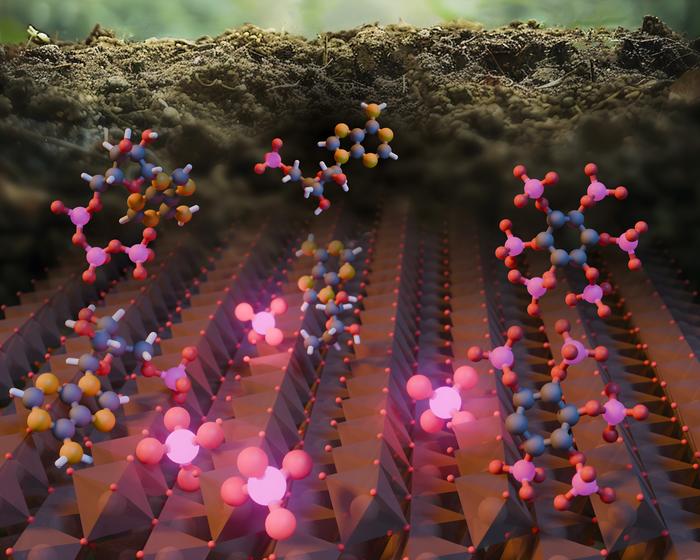
Northwestern University-led researchers have discovered a new way that nature cycles phosphorus, a finding that uncovers a missing piece of Earth’s puzzling phosphorus cycle.

Credit: Aristilde Research Group/Northwestern University
Northwestern University-led researchers have discovered a new way that nature cycles phosphorus, a finding that uncovers a missing piece of Earth’s puzzling phosphorus cycle.
The research will be published on Thursday (July 18) in the journal Nature Communications.
A critical nutrient for plant growth, phosphorus is a non-negotiable component of fertilizers. Without it, farmers cannot ensure plant health and boost crop yields. Understanding Earth’s phosphorus cycle, therefore, is important for protecting the global food supply.
Although organic forms of phosphorus are abundant in soils, plants and microbes need inorganic phosphorus to spur their own growth. In the organic form, phosphorus is connected to carbon atoms directly or indirectly, using oxygen as a bridge. So, plants and microbes secrete enzymes to break the carbon bond in organic phosphorus to generate bioavailable inorganic phosphorus.
While current understanding of the phosphorus cycle assumes that only enzymes from plants and microbes drive this transformation, the new Northwestern study shows there is another way. Iron oxide, a naturally occurring mineral in soils and sediments, can perform the reaction that transforms organic phosphorus to generate the inorganic form. Surprisingly, the researchers also found that iron oxide minerals recycle phosphorus at a similar rate as reported for enzymes in soils.
“Currently, the main source of phosphorus for fertilizers is from mining,” said Northwestern’s Ludmilla Aristilde, who led the work. “It’s a finite resource that we eventually will run out of. According to some estimates, we might run out in as soon as 50 years or in a couple hundred years. We are looking into ways to leverage nature-based solutions for phosphorus recycling because we cannot have food security without it. But, before we can do that, we need to understand the underlying mechanisms of natural phosphorus recycling. We found that minerals play an important, and previously unknown, role in the process.”
An expert in the dynamics of organics in environmental processes, Aristilde is an associate professor of environmental engineering at Northwestern’s McCormick School of Engineering. She also is a member of the Center for Synthetic Biology, International Institute for Nanotechnology and Paula M. Trienens Institute for Sustainability and Energy. Jade Basinski, a Ph.D. student in Aristilde’s laboratory, is the paper’s first author. Analeise Klein and Wiriya Thongsomboon, former postdoctoral researchers in the laboratory, are contributing authors.
Looking beyond biology
When dead vegetation or microbes decay in the soil, they leave behind a number of nutrients, including DNA and RNA, which are important classes of organic phosphorus. Microbes and living plants use enzymes to cleave phosphorus from nucleotides — structural components in DNA and RNA — in decaying organic matter to make it available as a recycled nutrient. Until now, most researchers assumed using enzymes was nature’s only mechanism for recycling organic phosphorus.
Aristilde and her collaborators, however, decided to explore whether another mechanism might be at play.
“Findings from field studies on the environmental dynamics of phosphorus suggested to consider mechanisms beyond biology for the transformation of organic phosphorus in sediments,” Aristilde said. “My group began looking at minerals, specifically iron oxides, because they are known to be able to serve as catalysts.”
The case of the missing phosphorus
In laboratory experiments, Aristilde and her team studied the fate of phosphorus in soils and sediments containing iron oxide minerals. After running multiple experiments and analyses, researchers found transformation products from the reaction in the solution. But part of the inorganic phosphorus was curiously missing.
Because iron oxide is known to trap phosphorus, the team wanted to examine the minerals more closely. To do so, they used a specialized X-ray technique at the Stanford Synchrotron Radiation Lightsource to solve the mystery.
“Lo and behold, we found that the phosphorus was clinging to the surface of the iron oxide,” Aristilde said. “Basically, the minerals can recycle phosphorus from DNA and RNA molecules. But not all organic phosphorus is released in the solution because it is stuck to the surface. The X-ray technique allowed us to find that a big fraction of the newly generated inorganic phosphorus was associated with iron oxides.”
Otherworldly insights
Aristilde’s team then measured how — and how much — inorganic phosphorus was produced from nucleotides. The researchers discovered that minerals recycle phosphates at a rate comparable to biology.
“We did not expect the rates to be so comparable to those reported for soil enzymes,” Aristilde said. “It changes the way we think about how phosphorus is recycled.”
Not only will the new information expand the way we think about how phosphorus cycles on our planet, it also can provide insights about our neighboring planets.
“Mars is red because it’s full of iron oxides,” Aristilde said. “If there is inorganic phosphorus found to be trapped in them, it is reasonable to ask: ‘Could this phosphorus have an organic origin from life?’”
The study, “Unraveling iron oxides as abiotic catalysts of organic phosphorus recycling in soil and sediment matrices,” was supported by the U.S. Department of Energy (award number DE-SC0021172).
Journal
Nature Communications
Method of Research
Experimental study
Subject of Research
Not applicable
Article Title
Unraveling iron oxides as abiotic catalysts of organic phosphorus recycling in soil and sediment matrices
Article Publication Date
18-Jul-2024
Cite Scienmag News
Bethany Barker. (July 18, 2024). Minerals play newly discovered role in Earth’s phosphorus cycle. Scienmag. https://scienmag.com/minerals-play-newly-discovered-role-in-earths-phosphorus-cycle/
Bethany Barker. "Minerals play newly discovered role in Earth’s phosphorus cycle." Scienmag, 18 July 2024, https://scienmag.com/minerals-play-newly-discovered-role-in-earths-phosphorus-cycle/. Accessed 4 September 2026.
Bethany Barker. "Minerals play newly discovered role in Earth’s phosphorus cycle." Scienmag. July 18, 2024. https://scienmag.com/minerals-play-newly-discovered-role-in-earths-phosphorus-cycle/

