


Milano, 18 luglio 2024 – A new study published in the journal PNAS Nexus reveals how social media algorithms favor politically sponsored content from certain parties given the same investment budget.

Credit: Politecnico di Milano
Milano, 18 luglio 2024 – A new study published in the journal PNAS Nexus reveals how social media algorithms favor politically sponsored content from certain parties given the same investment budget.
The research, a collaboration between the Politecnico di Milano, LMU – Ludwig Maximilians Universität of Munich, and the CENTAI institute of Turin, analyzed over 80,000 political ads on Facebook and Instagram before the 2021 German federal elections. These ads were placed by parties across the political spectrum and generated over 1.1 billion impressions during an election with more than 60 million eligible voters.
Investigating online campaign inequalities, significant discrepancies emerged in the advertising’s effectiveness and the intensity with which ads reached their targets, favoring more extremist groups.
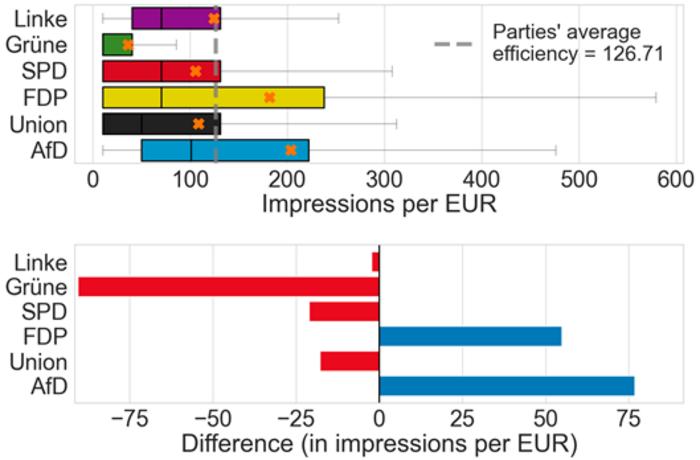
Using the collected data, it was found that over 70% of parties used user profiling in their ads. Additionally, calculating variations in advertising costs (impressions per euro spent) showed that not all parties achieved equal results with the same budget. The far-right AfD proved to be the most effective, with ads almost six times more efficient than competitors who had invested the same budget. The Greens were the least cost-effective party.
“The greater success of their advertising could be explained by the fact that the incendiary political issues promoted by populist parties tend to attract a lot of attention on social media. Consequently, algorithms would favor campaign ads with such content,” explains Francesco Pierri, a researcher from the Data Science research group of the Department of Electronics, Information, and Bioengineering at the Politecnico di Milano, who co-led the study.
Another finding of the study was the discrepancies for all parties between the targeted audience and the actual audience reached. While most parties tended to reach a younger audience than expected, the opposite occurred for the far-right. Pierri and his colleagues hypothesize that the algorithmic bias in ad distribution is based on known voter behavior.
“We see a systematic bias in how the political ads of different parties are distributed. If they aim at a specific audience or send contradictory messages on political issues to different groups, this can limit the political participation of disadvantaged groups,” Pierri continues. “Even worse, the algorithms used by the platforms do not allow verification if they involve biases in ad distribution. If, for example, some parties systematically pay higher prices than others for similar ads, this damages political competition. We need greater transparency from the platforms regarding political advertising to ensure fair and uncompromised elections.”
It is no surprise, then, that targeted political advertising on social media has raised serious concerns among political actors, researchers, and society in general. The calls to improve the monitoring of this form of electoral advertising to safeguard democratic integrity are growing stronger. Public pressure and regulatory efforts (e.g., the Digital Services Act in the EU) have pushed social media platforms to provide public access to political and social ads, allowing researchers to study them on a large scale.
Journal
PNAS Nexus
Method of Research
Meta-analysis
Subject of Research
People
Article Title
Systematic discrepancies in the delivery of political ads on Facebook and Instagram
Article Publication Date
1-Jul-2024
Cite Scienmag News
Denise Maddox. (July 18, 2024). Social media: How algorithms influence election campaigns. Scienmag. https://scienmag.com/social-media-how-algorithms-influence-election-campaigns/
Denise Maddox. "Social media: How algorithms influence election campaigns." Scienmag, 18 July 2024, https://scienmag.com/social-media-how-algorithms-influence-election-campaigns/. Accessed 3 September 2026.
Denise Maddox. "Social media: How algorithms influence election campaigns." Scienmag. July 18, 2024. https://scienmag.com/social-media-how-algorithms-influence-election-campaigns/

