


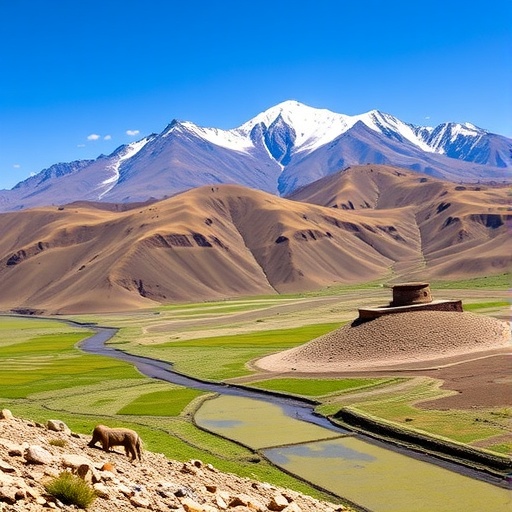
A new study published in Communications Earth & Environment suggests that cooling during the mid- to late Holocene reshaped how people farmed across the Tibetan Plateau, linking climate shifts to major agricultural transformations. Using evidence assembled from paleoclimate archives, the researchers argue that falling temperatures altered growing conditions, forcing communities to reorganize crop choices and field practices over time.
The work focuses on a period when regional climate became less favorable for certain farming strategies. As the plateau cooled, growing seasons shortened and moisture availability likely changed, affecting both crop productivity and the reliability of harvests. Rather than a gradual, uniform change, the authors describe a climate-driven transition that unfolded over multiple centuries, leaving a recognizable imprint on the agricultural landscape.
To connect climate with human land use, the team integrated chronologically constrained climatic indicators with knowledge of how agricultural systems respond to temperature and hydrology. Their approach emphasizes timing: when cooling intensified, agricultural adaptations followed, implying that communities were reacting to environmental stress rather than purely socioeconomic factors.
The study also discusses how cooling could interact with plateau-wide atmospheric circulation patterns. Even modest shifts in temperature can influence evapotranspiration and soil moisture balance in high-elevation environments. Those effects, in turn, can propagate through ecological systems—changing vegetation dynamics and the availability of land suitable for cultivation.
Crucially, the researchers interpret agricultural transformation as a coupled human–environment response. As conditions deteriorated, farming practices likely shifted toward crops or varieties better suited to cooler climates, while land management strategies may have evolved to mitigate risk. The resulting mosaic of land use patterns reflects the search for stability in an environment where climatic variability can strongly regulate agricultural outcomes.
By linking a specific Holocene cooling phase to measurable transformations in agriculture, the findings add weight to a broader view: on the Tibetan Plateau, climate was not merely background noise. It actively steered the timing and direction of human adaptation, shaping where and how food production could persist.
The implications extend beyond archaeology. If past cooling altered agricultural viability, then modern and future climate variability may similarly pressure high-altitude food systems. Understanding these long-term mechanisms can help refine risk assessments for regions where temperature and precipitation changes are expected to disrupt crop calendars and water resources.
For readers, the headline takeaway is straightforward: when the Tibetan Plateau cooled, farming changed. This study offers a detailed, data-driven bridge between paleoclimate history and human agricultural decision-making—highlighting how environmental thresholds can redirect entire subsistence strategies.
Cite Scienmag News
Alan Morgan. (July 27, 2026). Mid-to-late Holocene Cooling Drove Agricultural Changes on the Tibetan Plateau. Scienmag. https://scienmag.com/mid-to-late-holocene-cooling-drove-agricultural-changes-on-the-tibetan-plateau/
Alan Morgan. "Mid-to-late Holocene Cooling Drove Agricultural Changes on the Tibetan Plateau." Scienmag, 27 July 2026, https://scienmag.com/mid-to-late-holocene-cooling-drove-agricultural-changes-on-the-tibetan-plateau/. Accessed 4 September 2026.
Alan Morgan. "Mid-to-late Holocene Cooling Drove Agricultural Changes on the Tibetan Plateau." Scienmag. July 27, 2026. https://scienmag.com/mid-to-late-holocene-cooling-drove-agricultural-changes-on-the-tibetan-plateau/


