


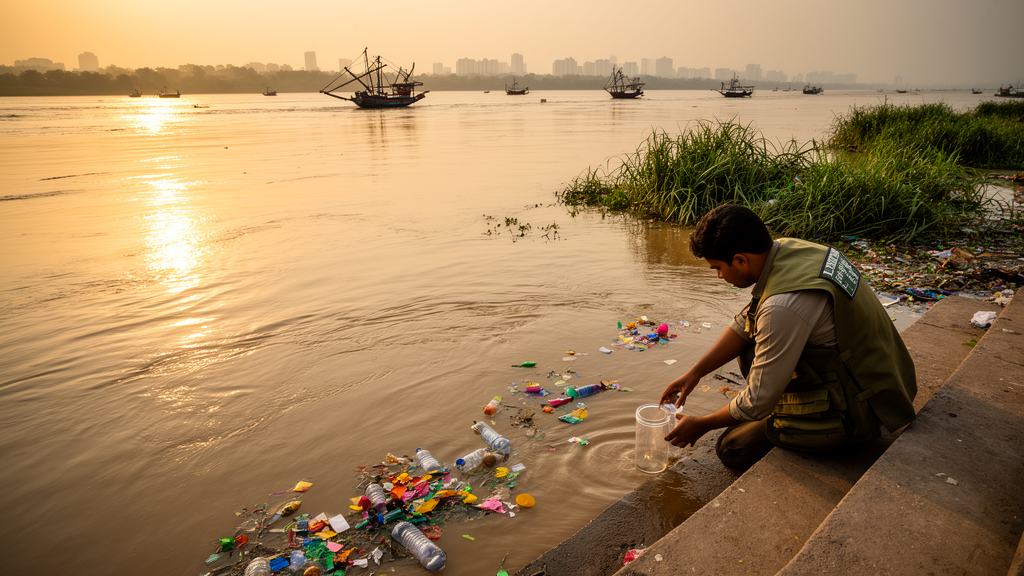
Microplastics have become one of the most pervasive pollutants of the modern era, and few waterways illustrate the problem as starkly as the Karnaphuli River in southeastern Bangladesh. A new review published in Environmental Science and Pollution Research has taken an unusually rigorous look at what we actually know about plastic contamination in this tropical river system, and the findings reveal both a serious pollution picture and a troubling gap between what is reported and what can be reliably concluded.
The review, led by Masuma Wahab of Government Hazi Mohammad Mohsin College in Chattogram and Abdul Hasib Mollah of the University of Barishal, applied a PRISMA-guided systematic literature review to synthesize fifteen peer-reviewed studies on microplastic contamination in the Karnaphuli River system. PRISMA, the Preferred Reporting Items for Systematic Reviews and Meta-Analyses, provides a standardized framework for identifying, screening, and appraising research evidence. Rather than simply tallying up pollution numbers, the authors critically evaluated the reliability of each study, the certainty with which sources could be attributed, and the pathways through which microplastics reach ecosystems and people.
The technical challenge at the heart of this review is one that plagues microplastic research worldwide. Studies of the Karnaphuli have used different sampling designs, different particle-size thresholds, different analytical methods, and different measurement units. Some report concentrations per cubic meter of water, others per kilogram of sediment, and still others per individual fish. Because of this methodological heterogeneity, the authors concluded that a statistical meta-analysis was not appropriate. Instead, they synthesized the evidence narratively, evaluating environmental occurrence, physicochemical characteristics, ecological receptors, and human exposure plausibility across the available literature.
What the fifteen studies consistently show is that microplastics are present throughout the Karnaphuli system, in the water column, in sediments, in fish, and in fishery products. Fibres, fragments, and films are frequently the dominant morphotypes, a pattern consistent with the breakdown of larger plastic debris and with the discharge of synthetic textile fibres from the region’s extensive garment industry. The river drains a densely populated industrial corridor that includes textile mills, municipal wastewater outfalls, port facilities, and unmanaged plastic waste, all of which are plausible contributors to the contamination load.
Yet the review is emphatic that source attribution remains mainly inferential. While industrial effluents, municipal wastewater, textile discharge, urban runoff, port activities, and unmanaged plastic waste are all reasonable candidates, the available studies have not established which sources contribute what fraction of the total microplastic burden. This matters because effective mitigation requires knowing where the plastic is coming from. Without source-specific sampling and polymer confirmation, remediation efforts risk targeting the wrong inputs or spreading resources too thin across multiple unverified pathways.
The authors expanded the traditional Source-Pathway-Receptor framework to organize their appraisal. In this model, sources are the origins of microplastic release, pathways are the transport mechanisms that carry particles through the environment, and receptors are the organisms and ecosystems that encounter them. The review found that while sources and pathways have received considerable attention in the Karnaphuli literature, receptors remain understudied. Aquatic plants, biofilms, plankton, and benthic organisms are all important potential receptors of microplastic contamination, yet Karnaphuli-specific data on these groups are scarce.
Fish ingestion evidence from the broader Bangladesh literature supports biological uptake and possible trophic transfer, with microplastics documented in the gastrointestinal tracts of multiple freshwater and estuarine species. However, the review notes that Karnaphuli-specific freshwater fish data remain limited. Studies from the nearby Meghna River estuary and the northern Bay of Bengal coast have documented microplastics in commercial fish species, but extrapolating those findings to the Karnaphuli requires caution given differences in hydrology, land use, and pollution sources.
Human dietary exposure through fish and dried fish is plausible but locally unquantified. Bangladesh has one of the highest per capita fish consumption rates in the world, and dried fish is a significant dietary component, particularly for coastal populations. Research from other Bangladeshi waterways has found that dried fish may be more prone to microplastic contamination than fresh fish, raising concerns about a potential trophic transfer pathway to human consumers. The review emphasizes that while this exposure route is biologically plausible, no Karnaphuli-specific study has yet quantified the actual dose of microplastics that local populations ingest through their diet.
The physicochemical characteristics of the microplastics found in the Karnaphuli, including their polymer types, sizes, colours, and degrees of weathering, influence how they interact with the environment. Weathered particles have altered surface chemistry that can enhance the sorption of organic contaminants and heavy metals, potentially making them vectors for co-pollutants. Additives leached from plastics, including plasticizers and flame retardants, add another layer of chemical complexity. The review highlights that these interactions are relevant to ecotoxicological risk but have not been systematically characterized for the Karnaphuli system.
The review concludes that the Karnaphuli River should be treated as a high-concern microplastic system requiring standardized monitoring, source-specific sampling, polymer confirmation, quality assurance and quality control transparency, and receptor-based studies. The authors argue that without these improvements, the evidence base for the Karnaphuli will remain fragmented and difficult to compare across studies, limiting both scientific understanding and policy response. Their expanded Source-Pathway-Receptor framework offers a template for appraising microplastic evidence in other data-scarce tropical river systems, where methodological heterogeneity and source-attribution uncertainty are common challenges.
Subject of Research: Environmental Science
Article Title: Microplastic contamination in the Karnaphuli River, Bangladesh: a PRISMA-guided critical appraisal of evidence reliability, source-attribution uncertainty, and receptor pathways
Article References: Wahab, M., & Mollah, A. H. (2026). Microplastic contamination in the Karnaphuli River, Bangladesh: a PRISMA-guided critical appraisal of evidence reliability, source-attribution uncertainty, and receptor pathways. Environmental Science and Pollution Research. https://doi.org/10.1007/s11356-026-38317-3
Image Credits: AI Generated
DOI: 10.1007/s11356-026-38317-3
Keywords: microplastics, Karnaphuli River, Bangladesh, water pollution, PRISMA review, Source-Pathway-Receptor, ecotoxicology, human exposure, Microplastic, contamination, Karnaphuli, River
Cite Scienmag News
Violet Maxwell. (October 16, 2026). Microplastics in Bangladesh’s Karnaphuli River: What a Critical Review Really Found. Scienmag. https://scienmag.com/microplastics-in-bangladeshs-karnaphuli-river-what-a-critical-review-really-found/
Violet Maxwell. "Microplastics in Bangladesh’s Karnaphuli River: What a Critical Review Really Found." Scienmag, 16 October 2026, https://scienmag.com/microplastics-in-bangladeshs-karnaphuli-river-what-a-critical-review-really-found/. Accessed 16 October 2026.
Violet Maxwell. "Microplastics in Bangladesh’s Karnaphuli River: What a Critical Review Really Found." Scienmag. October 16, 2026. https://scienmag.com/microplastics-in-bangladeshs-karnaphuli-river-what-a-critical-review-really-found/


