


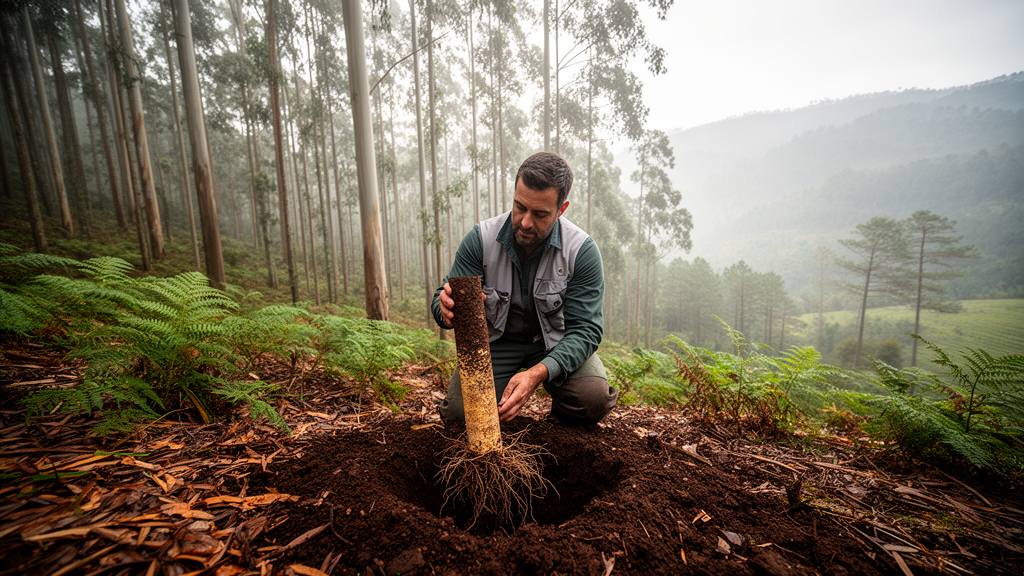
Deep beneath the green hills of Galicia, in the north-west corner of Spain, an invisible workforce decides how much carbon the region’s forests can lock away. That workforce is the soil microbial community, and according to a new study published in the Spanish Journal of Soil Science, its activity depends in surprising ways on which trees stand overhead. Researchers from the University of Santiago de Compostela and the Misión Biológica de Galicia of CSIC analyzed 54 forest plantations covering seven different plant covers, including birch, chestnut, eucalyptus, walnut, pines, oak and shrublands, and found that the choice of tree species leaves measurable fingerprints on soil moisture and microbial respiration, even when the underlying chemistry looks remarkably uniform.
The study area lies in the municipality of Rianxo, where the temperate-oceanic climate delivered an average temperature of 15.7 degrees Celsius and an accumulated precipitation of 1,774 liters per square meter in 2024. The parent material is mainly granitic, and the soils are mostly classified as Leptosols and Umbrisols. These forests are communal properties, owned collectively by villagers, and the sampling was carried out in collaboration with forest owner associations across five forest communities, from Campelo Vilar e Cerqueiras to Leiro, at altitudes ranging from 50 to 485 meters above sea level. In each of the 54 stands, the team collected 10 subsamples along a zig-zag transect, compositing them into a single sample per plot from the 0 to 20 centimeter soil layer in the summer of 2024.
Galician forest soils are, in general, acidic, rich in organic matter and poor in phosphorus. The measurements confirmed this regional signature: pH values ranged between 4.63 and 5.6, soil organic matter between 12.1 and 20.9 percent, nitrogen between 0.41 and 0.69 percent, and extractable phosphorus between just 4.0 and 8.4 milligrams per kilogram. The researchers attribute these properties primarily to the humid climate, which drives intense leaching and acidification, and to the acidic nature of the granitic parent material, rather than to the tree species themselves. Statistically, no significant differences emerged in these solid-phase chemical properties among the different forest covers, a finding the authors link partly to the young age of more than half of the plantations, most of which were less than six years old.
Where the tree species did matter was in soil water content. Soils under eucalyptus and birch plantations were the driest, averaging 13 and 14 percent respectively, while soils under shrublands held the most water at 27 percent on average, with statistically significant differences. The intermediate values fell between 19 percent under walnut and 25 percent under pine. The ability of eucalyptus to extract large amounts of soil water is well documented, although some authors argue that eucalyptus water depletion is more a myth tied to poor plantation management than an inherent trait of the trees. Birch, meanwhile, has been shown to deplete topsoil moisture compared with conifers such as spruce. Both the birch and eucalyptus stands in this study were established over shallow soils of roughly 50 centimeters that had been burnt by a wildfire in 2019, and the authors suggest that the fire disturbance, the soil management for tree establishment, or the low organic matter content, which reduces water retention, could all explain the dry conditions. Indeed, the team detected a significant positive correlation between soil water content and soil organic matter.
The most striking result concerns microbial respiration, the rate at which soil organisms release carbon dioxide as they decompose organic matter. Soils under walnut plantations showed the highest respiration rates, averaging 1,440 plus or minus 97 parts per million of carbon dioxide per gram, while soils under eucalyptus showed the lowest, at 537 plus or minus 211 parts per million per gram. When the values for all deciduous broadleaf species were pooled together, respiration under eucalyptus was significantly lower than under the deciduous forests, with the coniferous pine values falling in between. Soil respiration correlated positively with soil organic matter, total nitrogen and total carbon, and walnut soils happened to contain the highest organic matter content at 20.9 percent, while eucalyptus soils had the lowest at 12.1 percent.
The walnut result carries an intriguing biochemical twist. Walnut leaf litter is rich in phenolic compounds that can inhibit Gram-positive bacteria but leave fungi unaffected, and fungi are the main drivers of respiration in forest soils. This selective pressure could favor a fungal-dominated community and boost carbon dioxide efflux. The eucalyptus result, by contrast, may reflect a different mechanism: previous studies have described a decrease in fungal dominance within eucalyptus plantations, which could explain the suppressed respiration rates. The eucalyptus plots had all been burnt in 2019, whereas the walnut plots had no recent fire history, but meta-analyses suggest that total soil respiration generally recovers to pre-fire values within about five years, and around three years for temperate forests, making the fire explanation less conclusive.
For the pine plantations, which represented the largest group with 30 samples, the researchers compared respiration across stands of different ages but found no significant differences, although average values tended to decline with tree longevity, from 991 plus or minus 69 parts per million per gram in 2 to 4 year old stands to 774 plus or minus 162 parts per million per gram in stands aged 40 to 45 years. A similar age-related decline has been reported in other coniferous plantations. The team also measured the activity of beta-glucosidase, a key enzyme in the carbon cycle that completes the final step of cellulose hydrolysis by converting cellobiose to glucose, but detected no significant differences among the forest covers, with average values ranging from 60 plus or minus 5 micrograms of p-nitrophenol per gram per hour under walnut to 31 plus or minus 15 under shrublands. The authors suggest that the limited variability in edaphic properties and the young age of most stands may explain the lack of differentiation in this enzyme activity.
Aluminium emerged as another defining feature of these soils. Exchangeable aluminium concentrations averaged between 4.7 and 7.43 centimoles per kilogram, representing between 63 and 90 percent saturation of the exchange complex, with practically all samples exceeding 60 percent saturation, a threshold indicative of alic soils that can limit plant growth. The highest saturation values appeared under shrublands at 90 percent, pines at 86 percent and chestnut at 83 percent, although these differences were not statistically significant. Despite this potentially toxic aluminium load, timber production in Galicia remains high within the temperate-humid region, likely because soil organic matter complexes aluminium into less toxic forms, and anions such as sulfate and fluoride can also bind aluminium and reduce its toxicity. The soils under chestnut, shrubland and pine showed the lowest concentrations of exchangeable calcium and magnesium, possibly reflecting the high demand these species place on these base cations to cope with aluminium stress, and the team detected a strong correlation between exchangeable calcium and magnesium across their samples.
When all the physicochemical and biological properties were analyzed together using redundancy analysis, no structural differences between forest covers were detected. The permutation test revealed that stand age was the only significant factor affecting soil properties, while wildfire events were marginally significant. Community location, altitude, tree species, parental rock and soil depth had no significant effect. The first component of the analysis explained 21.1 percent of the variability and was related to soil respiration, higher in samples with greater organic matter content. The authors acknowledge that their initial hypothesis, that tree species would drive the biggest differences between native broadleaf species and intensive plantations, was not fulfilled, most likely because the different ages of the stands acted as a confounding factor, and because the analyses were restricted to the solid soil phase, which is less sensitive to change than the soil solution.
The implications reach far beyond Galicia. Forest soils are crucial carbon sinks, both above and below ground, yet the soil section is still sometimes excluded from carbon pool estimations despite the enormous amount of carbon stored in it. As climate change sharpens the urgency of maximizing the carbon that healthy forest soils can fix, the finding that which tree species are cultivated measurably alters soil microbial respiration should be considered when elaborating forestry exploitation plans. Soils under eucalyptus exhibited the lowest values for both moisture and microbial respiration, while broadleaf deciduous species generally supported higher microbial activity through greater litter inputs and root exudation. The authors call for further research integrating microbial community analysis with functional assessments, alongside evaluating long-term wildfire and management impacts, to guide forest management under specific edapho-climatic conditions in a warming world.
Subject of Research: Forest soil science
Article Title: Effect of Different Tree Plantations on the Chemical Properties and Microbial Activity in Galician Forests Soils
Article References: Barreiro, A., Míguez-González, A., Cela-Dablanca, R., Díaz-Raviña, M., Núñez-Delgado, A., Fernández-Sanjurjo, M. J., & Álvarez-Rodríguez, E. (2025). Effect of Different Tree Plantations on the Chemical Properties and Microbial Activity in Galician Forests Soils. Spanish Journal of Soil Science, 15, Article 14988. https://doi.org/10.3389/sjss.2025.14988
Image Credits: AI Generated
Keywords: forest soils, soil respiration, carbon sink, eucalyptus, soil microbiology, forestry management, Galicia, wildfire, Effect, Different, Tree, Plantations
Cite Scienmag News
Morgan Morrow. (October 16, 2026). Which Trees Galicia Plants Could Decide How Much Carbon Its Forest Soils Keep. Scienmag. https://scienmag.com/which-trees-galicia-plants-could-decide-how-much-carbon-its-forest-soils-keep/
Morgan Morrow. "Which Trees Galicia Plants Could Decide How Much Carbon Its Forest Soils Keep." Scienmag, 16 October 2026, https://scienmag.com/which-trees-galicia-plants-could-decide-how-much-carbon-its-forest-soils-keep/. Accessed 16 October 2026.
Morgan Morrow. "Which Trees Galicia Plants Could Decide How Much Carbon Its Forest Soils Keep." Scienmag. October 16, 2026. https://scienmag.com/which-trees-galicia-plants-could-decide-how-much-carbon-its-forest-soils-keep/


