


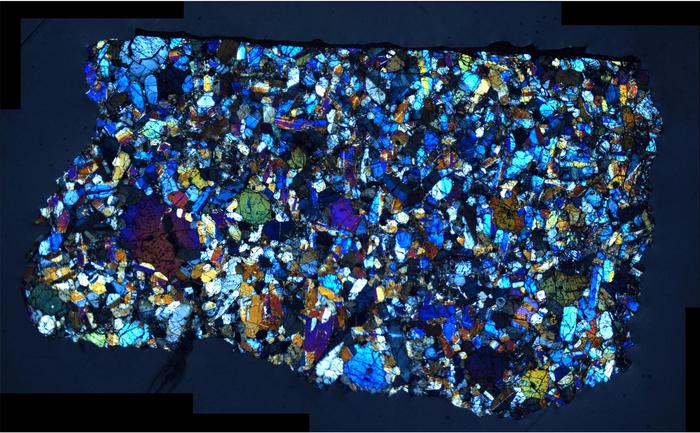
Mars has a distinct structure in its mantle and crust with discernible reservoirs, and this is known thanks to meteorites that scientists at Scripps Institution of Oceanography at UC San Diego and colleagues have analyzed on Earth.

Credit: Scripps Institution of Oceanography at UC San Diego
Mars has a distinct structure in its mantle and crust with discernible reservoirs, and this is known thanks to meteorites that scientists at Scripps Institution of Oceanography at UC San Diego and colleagues have analyzed on Earth.
Meteorites that formed roughly 1.3 billion years ago and then ejected from Mars have been collected by scientists from sites in Antarctica and Africa in recent decades. Scripps Oceanography geologist James Day and his colleagues report May 31 in the journal Science Advances on analyses of the chemical compositions of these samples from the Red Planet.
These results are important for understanding not only how Mars formed and evolved, but also for providing precise data that can inform recent NASA missions like Insight and Perseverance and the Mars Sample Return, said study lead Day.
“Martian meteorites are the only physical materials we have available from Mars,” said Day. “They enable us to make precise and accurate measurements and then quantify processes that occurred within Mars and close to the martian surface. They provide direct information on Mars’ composition that can ground truth mission science, like the ongoing Perseverance rover operations taking place there.”
Day’s team assembled its account of Mars’ formation using meteorite samples that all came from the same volcano, known as nakhlites and chassignites. Some 11 million years ago, a large meteor impact on Mars sheared away parts of the planet and sent the rocks hurtling into space. Some of those landed on Earth in the form of meteorites, with the first of these being discovered in 1815 in Chassigny, France and then in 1905 in Nakhla, Egypt.
Since then, more such meteorites have been discovered in locations including Mauritania and Antarctica. Scientists are able to identify Mars as their place of origin because these meteorites are relatively young, so come from a recently active planet, have distinct compositions of the abundant element oxygen compared to Earth, and retain the composition of Mars’ atmosphere measured on the surface by the Viking landers in the 1970s.
The team analyzed the two keystone nakhlite and chassignite meteorite types. Nakhlites are basaltic, similar to lavas erupting in Iceland and Hawaii today, but are rich in a mineral called clinopyroxene. Chassignites are almost exclusively made of the mineral olivine. On Earth, basalts are a main component of the planet’s crust, especially under the oceans, while olivines are abundant in its mantle.
The same is true on Mars. The team showed that these rocks are related to each other through a process known as fractional crystallization within the volcano in which they were formed. Using the composition of these rocks, they also show that some of the then-molten nakhlites incorporated portions of crust close to the surface that also interacted with Mars’ atmosphere.
“By determining that nakhlites and chassignites are from the same volcanic system, and that they interacted with martian crust that was altered by atmospheric interactions, we can identify a new rock type on Mars,” said Day. “With the existing collection of martian meteorites, all of which are volcanic in origin, we are able to better understand the internal structure of Mars.”
The team was able to do this because of the distinctive chemical characteristics of nakhlites and chassignites, as well as the characteristic compositions of other martian meteorites. These reveal an atmospherically altered upper crust to Mars, a complex deeper crust and a mantle where plumes from deep within Mars have penetrated to the base of the crust, while the interior of Mars’, formed early in its evolution have also melted to produce distinct types of volcanoes.
“What’s remarkable is that Mars’ volcanism has incredible similarities, but also differences, to Earth,” said Day. “On the one hand, nakhlites and chassignites formed in similar ways to recent volcanism in places like Oahu in Hawaii. There, newly formed volcanoes press down on the mantle generating tectonic forces that produce further volcanism.”
“On the other hand, the reservoirs in Mars are extremely ancient, separating from one another shortly after the Red planet formed. On Earth, plate tectonics has helped to remix reservoirs back together over time. In this sense, Mars provides an important link between what the early Earth may have looked like from how it looks today.”
Besides Day, Marine Paquet of Scripps Oceanography and colleagues from the University of Nevada Las Vegas and the French National Centre for Scientific Research contributed to the study. The NASA Solar Systems Workings and Emerging Worlds program funded the research.
Journal
Science Advances
Method of Research
Meta-analysis
Subject of Research
Not applicable
Article Title
A heterogenous mantle and crustal structure formed during the early differentiation of Mars
Article Publication Date
31-May-2024
COI Statement
The authors declare that they have no competing interests
Cite Scienmag News
Grant Pearson. (May 31, 2024). Martian meteorites deliver a trove of information on Red Planet’s structure. Scienmag. https://scienmag.com/martian-meteorites-deliver-a-trove-of-information-on-red-planets-structure/
Grant Pearson. "Martian meteorites deliver a trove of information on Red Planet’s structure." Scienmag, 31 May 2024, https://scienmag.com/martian-meteorites-deliver-a-trove-of-information-on-red-planets-structure/. Accessed 4 September 2026.
Grant Pearson. "Martian meteorites deliver a trove of information on Red Planet’s structure." Scienmag. May 31, 2024. https://scienmag.com/martian-meteorites-deliver-a-trove-of-information-on-red-planets-structure/

