


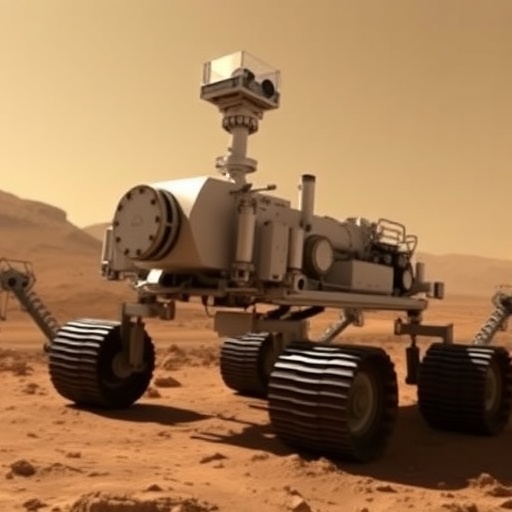
In a groundbreaking discovery that marks a new chapter in Mars exploration, NASA’s Curiosity rover has detected a complex array of organic molecules on the Red Planet, some of which bear striking resemblance to the fundamental building blocks of life on Earth. This unprecedented chemical experiment, conducted in situ on Martian soil, represents the first time such a diverse suite of organics has been identified beyond our planet, opening tantalizing possibilities about Mars’ ancient habitability and its potential to have supported microbial life billions of years ago.
The chemical signatures emerged from an innovative experiment carried out by Curiosity’s Sample Analysis at Mars (SAM) instrument suite. The SAM suite performed the first-ever trial of a sophisticated chemical technique involving tetramethylammonium hydroxide (TMAH), a reagent capable of breaking down larger, more complex organic macromolecules into smaller fragments suitable for detection and detailed molecular analysis by the rover’s onboard instruments. This chemical approach allows for a deeper understanding of the variety and structure of the organics preserved within Martian soils, specifically those in a region rich with clay minerals, known to be excellent repositories for organic compounds over geological timescales.
Located in the Glen Torridon area within Gale Crater, the experimental site is characterized by its high concentration of clay minerals, which have long been hypothesized to be favorable for the preservation of organics. These minerals act as natural shields, protecting fragile molecules from the harsh radiation environment at the surface of Mars. The rover’s selection of this site was strategic, aimed squarely at maximizing the likelihood of retrieving well-preserved samples that would reveal chemical fingerprints of past Martian environments that were conducive to sustaining life.
Among the more than twenty different organic compounds identified, a nitrogen-bearing molecule structurally similar to the precursors of DNA was detected for the first time on Mars. This is significant because nitrogen is a key component of nucleic acids, the molecules responsible for storing and transmitting genetic information on Earth. The presence of such complex molecules suggests that the chemical inventory of ancient Mars was richer and more biochemically diverse than previously understood, providing compelling evidence that the planet had the ingredients necessary for the emergence of life.
Additionally, Curiosity identified benzothiophene, a compound composed of fused sulfur and carbon rings, commonly delivered to planets via meteorites. The discovery of this sulfurous molecule underlines the possibility that ancient Mars received organic material through extraterrestrial delivery mechanisms similar to those that influenced Earth’s prebiotic chemistry. This supports a growing body of research suggesting meteorite infall played a critical role in seeding terrestrial planets with life’s raw materials during the early solar system.
This multifaceted scientific endeavor was led by Dr. Amy J. Williams, a geoscientist from the University of Florida, who has been integral to both the Curiosity and Perseverance rover missions. Dr. Williams emphasizes that the organics preserved on Mars date back approximately 3.5 billion years, coinciding with a period when Mars exhibited stable surface water and climate conditions potentially hospitable to microbial life. Such a temporal context is key to understanding how life’s building blocks may not merely have been present but actively accumulated and preserved in favorable niches on the planet.
The implications of these findings extend far beyond this single mission. The success of the SAM TMAH experiment sets a precedent for future exploration missions, including the Rosalind Franklin rover mission to Mars and NASA’s Dragonfly expedition aimed at Saturn’s moon Titan. Both missions plan to incorporate similar chemical techniques to probe for organic molecules, enhancing our ability to detect biosignatures and unravel the complex chemistry of extraterrestrial environments.
Notably, the study highlights the limitations inherent in rover-based chemical analyses. While the experiment could detect organics, it cannot definitively discriminate whether these molecules are remnants of ancient life or the result of non-biological geochemical processes, or even delivered via meteorites. To resolve this ambiguity, scientists advocate for the eventual return of Martian samples to Earth-based laboratories, where the full suite of analytical tools could decisively evaluate the origin and complexity of these organics.
Curiosity’s continued investigation deepens our insight into Mars’ past environmental conditions, confirming that the planet once harbored a variety of organic compounds preserved beneath its surface. This discovery bolsters the view that Mars was once a habitable world, with chemical resources capable of supporting life’s biochemical frameworks. The potential identification of life’s molecular precursors on Mars invigorates astrobiology and planetary science fields, inspiring renewed enthusiasm for uncovering whether life ever truly arose on the Red Planet.
Since its landing in Gale Crater in 2012, Curiosity has persistently advanced our understanding of Mars’ geological and chemical history. The recent experiment, conducted in 2020, represents one of the most ambitious chemical analyses performed by the rover, leveraging the unique properties of clay-rich sediments to unlock ancient organic secrets locked in Martian rock. SAM’s capabilities have been pivotal in unveiling clues about Mars’ atmosphere, surface chemistry, and now, its complex organic content.
The discovery of complex organics encompassing nitrogen-containing molecules resembling DNA precursors, alongside sulfur-containing aromatic compounds, develops a new framework to interpret Mars’ chemical evolution. It emphasizes the necessity for continued robotic exploration complemented by astrobiological vigilance, integrating chemistry, geology, and planetary science to identify potential habitats and biosignatures remotely before sample return missions provide definitive answers.
As humanity inches closer to answering the age-old question of whether life exists beyond Earth, the findings from Curiosity’s pioneering TMAH experiment underscore the Red Planet’s enigmatic yet promising chemical landscape. This research elevates Mars as a prime candidate for studying the origins of life in our solar system, fostering collaboration across disciplines to expand the search for extraterrestrial organic chemistry and, ultimately, life itself.
Cite Scienmag News
Drew Townsend. (April 21, 2026). Mars Rover Discovers Novel Organic Compounds in Groundbreaking Experiment. Scienmag. https://scienmag.com/mars-rover-discovers-novel-organic-compounds-in-groundbreaking-experiment/
Drew Townsend. "Mars Rover Discovers Novel Organic Compounds in Groundbreaking Experiment." Scienmag, 21 April 2026, https://scienmag.com/mars-rover-discovers-novel-organic-compounds-in-groundbreaking-experiment/. Accessed 3 September 2026.
Drew Townsend. "Mars Rover Discovers Novel Organic Compounds in Groundbreaking Experiment." Scienmag. April 21, 2026. https://scienmag.com/mars-rover-discovers-novel-organic-compounds-in-groundbreaking-experiment/


