

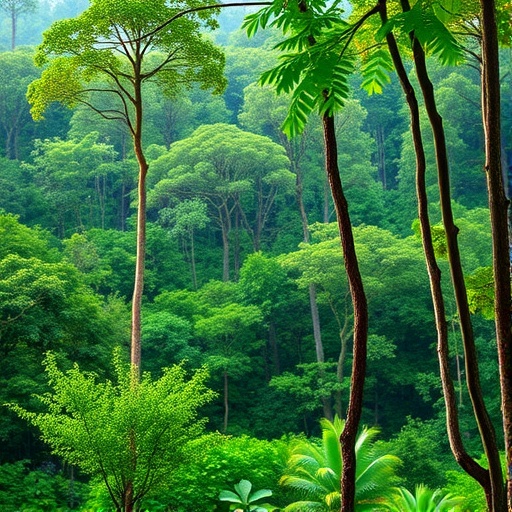
A formal author correction linked to a study in Nature Plants is drawing renewed attention to one of the most visible—and potentially misleading—features of tropical forest recovery: the early abundance of non-native and invasive trees in young secondary forests. The research, led by A.F. Resende, L. Poorter, F.A.R. Matos and colleagues, examines how introduced tree species appear during the first stages of forest regeneration in the Neotropics, and how their presence changes as recovering forests mature. The corrected record is associated with the article titled “Non-native and invasive tree species are abundant in neotropical secondary forest but decline over time,” published in Nature Plants in 2026.
Secondary forests develop after the original vegetation has been cleared, heavily disturbed or abandoned. Across the Neotropics, these recovering forests are expanding as agricultural land is left unused, pasture is converted or human activity shifts elsewhere. At first, the landscape is often dominated by grasses, shrubs and fast-growing pioneer trees. These early colonizers thrive in bright conditions, tolerate fluctuating temperatures and exploit soils with abundant nutrients released after disturbance. Such environments can also favor non-native species, particularly trees introduced for timber, fruit, shade, fuel or ornamental purposes. Their early success, however, does not necessarily mean that they will remain dominant as the forest develops.
The distinction between a non-native species and an invasive species is central to interpreting the study’s message. A non-native tree is one that occurs outside its historical geographic range because of human activity. An invasive tree is a non-native species that spreads, establishes and produces ecological or economic impacts in its new environment. The two categories overlap, but they are not identical. Some introduced trees remain rare or confined to plantations, while others reproduce successfully beyond cultivation and become persistent components of wild vegetation. The article’s title indicates that both non-native and invasive trees can be common in young Neotropical secondary forests, yet their abundance tends to decline over time.
That pattern is consistent with the ecological process known as succession. In the first years after disturbance, open canopies allow intense sunlight to reach the ground. Plants that grow rapidly under high light can gain a competitive advantage, especially if they produce large numbers of seeds or resprout efficiently after cutting or fire. As trees grow, the canopy closes and the forest floor becomes darker, cooler and more humid. Leaf litter accumulates, root systems occupy more soil and competition for water and nutrients intensifies. These changes create a progressively stronger environmental filter. Species adapted to open, disturbed habitats may then lose their advantage, while shade-tolerant native trees gradually increase in relative abundance.
The decline of introduced trees over time does not imply that they are ecologically irrelevant during the early stages of recovery. Young secondary forests can function as reservoirs of biological diversity, carbon sinks and corridors connecting isolated remnants of old-growth vegetation. If invasive species dominate these forests, they may alter light availability, litter chemistry, nutrient cycling and the regeneration of native plants. Some introduced trees form dense stands that suppress seedlings beneath them; others change the frequency of fire or modify relationships with pollinators and seed dispersers. Even when their abundance later falls, early effects may influence the speed and direction of succession, leaving ecological legacies that persist after the species itself becomes less common.
At the same time, the presence of non-native trees should not automatically be interpreted as evidence that forest recovery has failed. Tropical succession is not a simple return to a single historical endpoint. The composition of a recovering forest depends on the intensity and duration of land use, the distance to surviving forests, soil conditions, climate, seed dispersal and continued human disturbance. Introduced trees may be especially visible in abandoned fields because they are already present in nearby plantations, gardens or roadsides. This is an example of propagule pressure: the repeated arrival of seeds or vegetative material can greatly increase the probability that a species will establish. As native trees arrive and canopy conditions change, the balance may shift.
The study’s central message is therefore more nuanced than a headline about invasive species taking over tropical forests. Non-native and invasive trees can be abundant at the beginning of forest regeneration, but their prevalence may diminish as secondary forests age. This temporal pattern matters because a single survey cannot reveal whether an introduced species is expanding, stable or gradually disappearing from the community. Researchers need chronosequences—sets of forests representing different ages—or long-term monitoring plots to reconstruct changes through time. They also need to distinguish absolute abundance from relative abundance. An introduced tree can continue growing in number while becoming less dominant if native species increase even faster.
For conservation scientists and land managers, the findings point toward a more targeted approach. Early intervention may be most valuable where invasive trees are capable of forming persistent stands, preventing native regeneration or spreading into intact forest. In other locations, natural succession may reduce their importance without intensive removal. Decisions should be based on species-specific traits, local conditions and measurable impacts rather than on origin alone. Monitoring should include seedling recruitment, canopy structure, reproductive output and changes in native species composition. Remote sensing can identify canopy patterns over large areas, while permanent field plots reveal processes that satellites cannot easily detect, including seedling survival and competition below the canopy.
The author correction itself is an important part of the scientific record. Corrections are issued when authors or journals identify an error or omission that needs to be amended after publication. They can involve details in the text, figures, tables, acknowledgements, author information or other elements of the article. The citation supplied for this correction does not specify which part of the original publication was changed, so it would be inaccurate to assume that the correction alters the study’s results or conclusions. What remains clear from the corrected title and bibliographic record is the ecological observation at the heart of the work: introduced trees are conspicuous in young Neotropical secondary forests, but their contribution generally declines as recovering forests develop.
That conclusion arrives at a moment when secondary forests are becoming increasingly important in global environmental policy. They occupy millions of hectares and may help restore habitat, store atmospheric carbon and reconnect fragmented landscapes, but their ecological value depends on what grows there and how the vegetation changes over decades. The new correction brings attention back to a critical question in restoration ecology: whether early dominance by introduced species represents a permanent transformation or a temporary phase of succession. In many cases, the answer may be determined by time, local management and the ability of native forests to recolonize. Understanding that trajectory can help conservationists protect the forests that recover naturally while directing limited resources toward invasions that truly threaten long-term ecosystem function.
Subject of Research: Non-native and invasive tree species in Neotropical secondary forests and their changes during forest succession.
Article Title: Author Correction: Non-native and invasive tree species are abundant in neotropical secondary forest but decline over time.
Article References: Resende, A.F., Poorter, L., Matos, F.A.R. et al. Author Correction: Non-native and invasive tree species are abundant in neotropical secondary forest but decline over time. Nat. Plants (2026). https://doi.org/10.1038/s41477-026-02408-3
Image Credits: AI Generated
DOI: 10.1038/s41477-026-02408-3
Keywords: non-native species, invasive trees, secondary forests, Neotropics, forest succession, ecological restoration, biodiversity, tropical ecology, forest regeneration


