


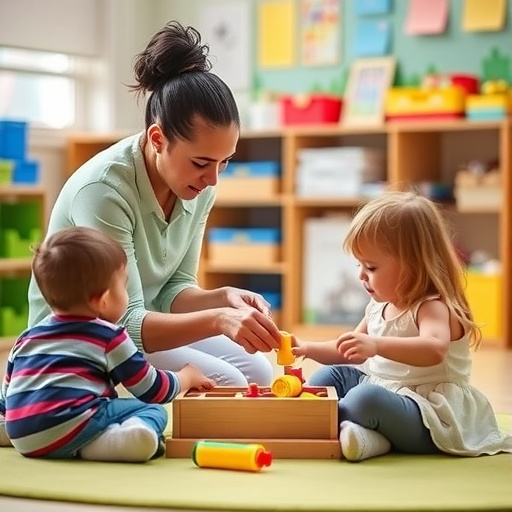
COLUMBUS, Ohio — In classrooms where children build towers, invent stories, sort pretend groceries or negotiate the rules of a game, learning may be taking place in ways that are easy for adults to overlook. A new study of preschool teachers in two Midwestern states suggests that the scientific case for play-based learning is widely accepted by educators, yet the social support needed to use it confidently may vary sharply by community. The researchers found that urban preschool teachers were significantly less likely than suburban teachers to report that families in their classrooms considered play essential to learning, raising concerns about whether different children have equal access to developmentally appropriate early education.
The study, published in the Early Childhood Education Journal, surveyed 110 preschool teachers working in rural, suburban and urban settings. Researchers examined three factors that can shape how play is used in classrooms: teachers’ knowledge and beliefs about the relationship between play and learning, their perceptions of family attitudes toward play, and their perceptions of whether curricula support playful learning. The results showed that teachers’ own beliefs and perceptions of curricular support did not significantly differ across regions. The major difference emerged in how teachers viewed family expectations. Urban teachers were considerably less likely than suburban teachers to say that families believed play was essential for children’s learning.
That finding is notable because the teachers themselves overwhelmingly recognized the academic value of play. In the survey, 96.9% agreed or strongly agreed that play supports academic learning. The result challenges a persistent assumption that play and formal education are competing goals, particularly during the preschool years. Instead, researchers describe high-quality playful learning as an active instructional approach that combines children’s agency and engagement with intentional guidance from adults. The activity may appear spontaneous, but teachers can design the environment, introduce materials, ask targeted questions, model vocabulary and guide children toward specific developmental or academic objectives.
During a pretend restaurant game, for example, children may practice early literacy by writing menus, develop mathematical reasoning by counting items or handling prices, and strengthen language skills by explaining choices and taking turns in conversation. A block-building activity can involve spatial reasoning, measurement, planning and problem-solving. Dramatic play can also require children to negotiate social roles, regulate emotions and understand perspectives different from their own. These experiences do not eliminate the need for direct teaching, but they place emerging skills inside meaningful situations in which children are motivated to use them.
Erin Fox, the study’s lead author and a recent doctoral graduate in human development and family science at The Ohio State University, said one of the most widespread misconceptions is that play does not support learning. Many adults readily associate play with social and emotional development, she noted, but may be less familiar with evidence showing that carefully supported play can also advance early literacy and mathematics. That misunderstanding can influence the questions parents ask, the types of programs they choose and the pressure teachers feel to demonstrate learning through visibly academic tasks such as worksheets, drills or extended whole-group instruction.
Kelly Purtell, an associate professor of human sciences at Ohio State and a co-author of the study, said teachers have increasingly described a shift in how families talk about preschool. Some parents expect preschool to function primarily as preparation for kindergarten, with children learning recognizable academic content before they enter formal schooling. Those expectations are understandable, especially when families are navigating competitive enrollment systems or worrying about whether their children will be ready for the next educational stage. However, when readiness is defined too narrowly, activities that build the foundations of later achievement may be dismissed simply because they do not resemble conventional schoolwork.
The researchers speculate that urban families may be more exposed to messages emphasizing school readiness and formal academic preparation, although the survey cannot establish why regional differences appeared. The study did not measure parents’ beliefs directly; rather, it captured teachers’ perceptions of family support. It also involved a relatively small sample from two Midwestern states, meaning the results should not be treated as a universal description of all urban, suburban or rural preschool communities. Regional categories can conceal substantial differences in income, school resources, cultural expectations, program quality and access to early-childhood services. Even so, the pattern points to a potentially important source of inequity: teachers may have similar knowledge about play, but different communities may place different levels of pressure on them to use it.
That pressure matters because teachers’ instructional decisions are shaped not only by their training and curriculum but also by what they believe families and administrators expect to see. If playful learning is perceived as insufficiently rigorous, teachers may reduce the time children spend exploring, collaborating and making choices, replacing those experiences with more visibly academic activities. Such a shift could be particularly consequential in preschool, when children are developing executive function, oral language, motor coordination and social competence alongside early reading and numeracy. These abilities are interconnected: children must sustain attention, communicate, remember instructions and manage frustration in order to benefit from later academic instruction.
The study’s authors argue that families should feel comfortable asking teachers how play is being used and what children are learning through it. Explaining the instructional design behind classroom activities may help bridge the gap between what play looks like and what it accomplishes. Teachers can make learning goals visible by describing the skills involved in a game, sharing examples of children’s reasoning, or showing how an activity connects to language, mathematics, science or social development. The goal is not to persuade families that every form of play is automatically educational, but to clarify the difference between unstructured free time and intentional playful learning supported by professional knowledge.
At a time when preschool classrooms face growing demands to produce measurable academic outcomes, the findings offer a warning and an opportunity. The warning is that unequal family expectations may influence which children receive rich, play-based learning experiences, even when teachers across regions understand their value. The opportunity is to broaden the definition of school readiness so that it includes curiosity, communication, self-regulation, flexible thinking and the ability to cooperate with others—not only the ability to recognize letters or numbers. Play, the researchers emphasize, is not a retreat from serious education. When thoughtfully designed and guided, it is one of the ways young children practice the intellectual, social and emotional skills that make future learning possible.
Web References: https://doi.org/10.1007/s10643-026-02276-8; https://crane.osu.edu/staff-members/erin-fox/; https://ehe.osu.edu/graduate/human-development; https://ehe.osu.edu/human-sciences/directory?id=purtell.15
References: Early Childhood Education Journal; DOI: 10.1007/s10643-026-02276-8; Ohio State University
Cite Scienmag News
Courtney Benton. (August 20, 2026). Study finds overwhelming preschool teacher support for play-based learning. Scienmag. https://scienmag.com/study-finds-overwhelming-preschool-teacher-support-for-play-based-learning/
Courtney Benton. "Study finds overwhelming preschool teacher support for play-based learning." Scienmag, 20 August 2026, https://scienmag.com/study-finds-overwhelming-preschool-teacher-support-for-play-based-learning/. Accessed 3 September 2026.
Courtney Benton. "Study finds overwhelming preschool teacher support for play-based learning." Scienmag. August 20, 2026. https://scienmag.com/study-finds-overwhelming-preschool-teacher-support-for-play-based-learning/


