


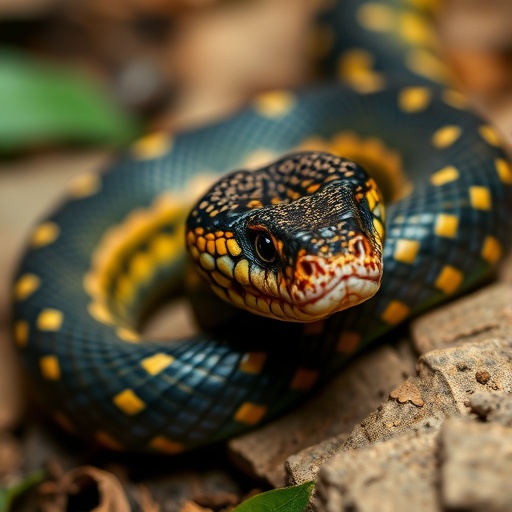
A new species of groundsnake from the forests of New Guinea has been named after Guns N’ Roses guitarist Slash, whose birth name is Saul Hudson and who has spent much of his life supporting reptiles, zoos, museums, and natural-history education. The snake, formally described as Lielaphis slashi, is a reddish-brown species measuring approximately 28 inches, or 71 centimeters, in length. Its scientific name recognizes Slash’s long-standing interest in reptiles, including his well-known ownership of a pet reticulated python. The discovery also highlights how much biological diversity remains undocumented in New Guinea, an island whose tropical forests are among the most species-rich and least completely studied ecosystems on Earth.
The decision to honor Slash was made by Sara Ruane, Associate Curator of Herpetology at the Field Museum and senior author of the study published in Zootaxa. Ruane first encountered the musician through a copy of Reptiles Magazine that she received as a twelve-year-old. The magazine featured Slash holding his pet python, and the image made a lasting impression on the young reptile enthusiast, who later became a scientist specializing in snake evolution and taxonomy. When Ruane encountered the opportunity to name a previously unrecognized species, she revisited Slash’s interview in the magazine and recalled his interest in museums, zoos, natural history, and searching for snakes as a child.
Slash said he was honored and humbled to have a New Guinea groundsnake named after him. The naming is more than a celebrity connection: in zoological nomenclature, a species name can preserve a cultural association while formally recognizing a person’s contribution to public interest in science or conservation. Once published according to the rules of zoological naming, Lielaphis slashi becomes the accepted scientific designation for the species. The name also connects a globally recognized musician with the work of field biologists, museum collections, and the detailed comparative research required to determine whether an unusual animal represents a new species rather than a variant of one already known.
The snake was first encountered during nocturnal fieldwork in New Guinea in 2006 by Chris Austin, a professor and curator of herpetology at the Louisiana State University Museum of Natural Science. Groundsnakes in the genus Lielaphis are active primarily at night, and researchers commonly locate them after sunset near the bases of large trees, where the animals search for prey. Night surveys in New Guinea can be challenging and potentially dangerous because several highly venomous snakes have appearances similar to nonvenomous groundsnakes. Careful handling, photography, specimen documentation, and later laboratory analysis are therefore essential for accurate identification.
At first, the snake’s external appearance did not clearly distinguish it from related species. This is a common problem in modern taxonomy, particularly among groups whose members share similar body shapes, coloration, and ecological habits. Researchers examined physical characteristics including the arrangement and number of scales, traits that can provide reliable diagnostic evidence when compared systematically across specimens. They then combined those observations with molecular data. The genetic results showed that L. slashi forms a distinct evolutionary lineage rather than representing a population of another recognized groundsnake species.
The study’s first author, Tianqi Huang, a postdoctoral researcher at the Field Museum working with Ruane, said the team used multiple genetic analyses to test the snake’s relationship to other members of its genus. Molecular approaches can reveal evolutionary differences that are not visible externally, especially when closely related species retain similar anatomical features. The researchers also applied ecological modeling to compare the environmental conditions associated with L. slashi and those preferred by similar snakes. The combination of genetic divergence, morphological differences, and habitat modeling provided independent lines of evidence supporting recognition of the animal as a separate species.
Much about L. slashi remains unknown because snakes are difficult to observe in the wild. They can disappear rapidly into dense vegetation, and many aspects of their behavior, reproduction, population size, and geographic distribution have not yet been documented. Anatomical features offer clues about its possible diet. Species in this group often possess relatively large teeth toward the rear of the mouth, an arrangement that may help them seize small, slippery-scaled lizards or reptile eggs. Unlike constrictors such as boas, however, the snake does not immobilize prey by wrapping around and squeezing it. The groundsnake is also nonvenomous and does not produce venom capable of seriously harming humans.
The discovery comes as New Guinea’s forest habitats face increasing pressure from human activity. Coffee farming, mining, and associated infrastructure can fragment or replace the ecosystems in which groundsnakes and countless other organisms live. Because many New Guinea species have not yet been formally described, their conservation needs can remain invisible to researchers, policymakers, and land managers. Ruane emphasized that naming species is an essential step in understanding ecosystems: scientists cannot effectively assess or protect organisms whose existence, distribution, and ecological roles have not been documented. A formal description creates a scientific reference point for future surveys and conservation assessments.
The research involved scientists from the Field Museum, Rutgers University, Louisiana State University Museum of Natural Science, Slippery Rock University, the American Museum of Natural History, the Papua New Guinea National Museum and Art Gallery, the Virginia Museum of Natural History, and the University of Kentucky. Their collaboration reflects the increasingly integrative nature of species discovery, which now combines field observation, museum collections, anatomical comparison, DNA-based analyses, and computational ecology. The study formally describes Lielaphis slashi as a new Papuan groundsnake from New Guinea, while also drawing attention to the island’s still-undiscovered biodiversity and the urgency of protecting its forests before species can be studied.
News Publication Date: 11-Aug-2026
Web References: https://doi.org/10.11646/zootaxa.5866.2.6
References: Zootaxa, DOI: 10.11646/zootaxa.5866.2.6
Cite Scienmag News
Margaret Porter. (August 21, 2026). Newly discovered jungle snake named after Guns N’ Roses guitarist Slash. Scienmag. https://scienmag.com/newly-discovered-jungle-snake-named-after-guns-n-roses-guitarist-slash/
Margaret Porter. "Newly discovered jungle snake named after Guns N’ Roses guitarist Slash." Scienmag, 21 August 2026, https://scienmag.com/newly-discovered-jungle-snake-named-after-guns-n-roses-guitarist-slash/. Accessed 3 September 2026.
Margaret Porter. "Newly discovered jungle snake named after Guns N’ Roses guitarist Slash." Scienmag. August 21, 2026. https://scienmag.com/newly-discovered-jungle-snake-named-after-guns-n-roses-guitarist-slash/


