


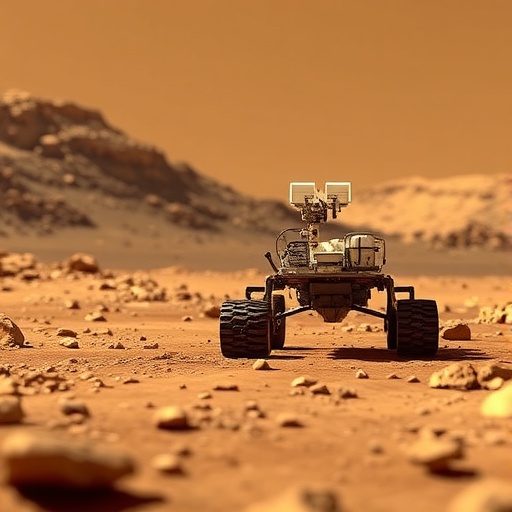
In an unprecedented breakthrough that continues to reshape our understanding of Mars, a team of scientists has unveiled the identification of diverse organic molecules on the Red Planet, as reported in the latest issue of Nature Communications. This monumental finding emerges from the pioneering use of the Sample Analysis at Mars (SAM) instrument suite’s TMAH (tetramethylammonium hydroxide) experiment conducted by the Mars rover. The discovery provides new, compelling evidence that Mars harbors complex organic chemistry, which has profound implications for the planet’s habitability and the search for past life.
The experiment employed an innovative approach to analyze Martian soil samples, leveraging the SAM instrument’s pyrolysis gas chromatography–mass spectrometry (GC-MS) capabilities combined with TMAH derivatization chemistry. By doing so, the scientists successfully stabilized and identified a wide array of organic molecules that are otherwise difficult to detect due to the harsh oxidative conditions of the Martian surface. This methodological advancement separates the recent findings from prior analyses that either detected limited organics or faced ambiguities caused by surface perchlorates and cosmic radiation.
Significantly, the organic compounds identified include a variety of carboxylic acids, amines, and unique nitrogen-containing species, pointing to complex carbon-based chemistry beyond simple hydrocarbons. These molecules were discovered in sedimentary samples drilled from ancient lakebed deposits within Jezero Crater, the rover’s landing site, which is hypothesized to have supported aqueous environments billions of years ago. This context bolsters the argument that Mars may have once possessed conditions conducive to prebiotic chemistry or even microbial life.
The choice to use TMAH was critical, as this reagent facilitates in situ methylation, transforming otherwise labile organic acids into methyl esters, which are much more stable and amenable to detection. This derivatization technique is established on Earth for its efficacy in environmental organic analysis but had not been employed in planetary exploration until now. The ability to perform such complex chemical enhancement directly on Mars marks a watershed moment in extraterrestrial chemistry research.
Crucially, the team’s analytical pipeline incorporated rigorous blank runs and contamination controls to ensure the Martian origin of the organics. The detection thresholds and isotopic compositions reflect minimal terrestrial interference, confirming the findings as indigenous to Mars. The presence of nitrogen-bearing organics suggests not just basic carbon chemistry but potential biologically relevant molecules, which have motivated intense discussions about Mars’ past habitability.
Furthermore, the distributions of these organic molecules across different samples indicate spatial heterogeneity that mirrors diverse depositional environments on ancient Mars. The sediment layers show signatures indicative of alteration by water-rock interactions, supporting the hypothesis that the detected organics have been subjected to, and preserved by, aqueous processes. This scenario paints a picture of a chemically dynamic early Mars potentially capable of sustaining life’s precursors.
The implications extend into astrobiology, opening new doors for examining Mars’ organic inventory with a fresh lens. While detection does not prove biology, these complex molecules serve as a tantalizing proxy for understanding the planet’s potential to host microbial ecosystems or at least to have undergone prebiotic organic evolution. This study revitalizes efforts to target upcoming missions to similar lakebed environments and subsurface contexts where organics might be sheltered from degradation.
Additionally, the integration of SAM’s TMAH experiment exemplifies how instrument innovation and chemistry-driven methodologies can dramatically enhance planetary exploration capabilities. This “chemical magnifying glass” effect, wherein low-abundance, volatile, or reactive organics become detectable, sets a precedent for designing future Mars landers and rovers with more sophisticated organic detection suites.
It is anticipated that comparative studies between Martian organics and those found in carbonaceous chondrites or cometary materials will further refine interpretations of the Red Planet’s carbon cycle and its sources of organic matter. Did these compounds originate from endogenous geochemical processes, exogenous delivery via meteorites, or potential biological pathways? Such questions now gain fresh relevance and urgency.
Mars’ surface radiation and oxidative soil chemistry had long been considered formidable obstacles for preserving organic matter, leading some to doubt the feasibility of detecting complex organics in situ. This new study challenges that notion decisively, demonstrating that with targeted chemical enhancements, valuable organic data can be extracted despite the inhospitable environment. This plays a pivotal role in guiding future sample return strategies.
The research team also noted that the detection of diverse organic molecules via TMAH derivatization complements previous non-derivatized approaches, together constructing a multi-dimensional picture of Mars’ organic chemistry. This combined data enhances the interpretation of Mars’ geochemical history and informs models of planetary evolution and potential bio-signature preservation.
Looking ahead, these findings underscore the necessity for further chemical innovation in planetary missions, especially regarding the capture and preservation of delicate organic compounds in extraterrestrial settings. Instruments that can apply in situ derivatization and other chemical treatments could become standard, vastly expanding the scope of astrobiological exploration on Mars and beyond.
The study marks an exhilarating chapter not only in Mars exploration but in astrochemistry, planetary science, and the enduring quest to answer one of humanity’s most profound questions: is life unique to Earth, or did it arise elsewhere in the cosmos? The diverse Martian organics exposed by this first SAM TMAH experiment draw us much closer to that answer, igniting both scientific intrigue and public imagination.
This transformative discovery heralds the arrival of a new era of Martian chemical analysis, blending technological ingenuity with scientific perseverance. As data continue to stream in from ongoing rover operations, the tantalizing puzzle of Mars’ organic chemistry — and its potential biological significance — promises many more enthralling revelations in the years to come.
Cite Scienmag News
Violet Maxwell. (April 21, 2026). Organic Molecules Discovered on Mars by SAM TMAH. Scienmag. https://scienmag.com/organic-molecules-discovered-on-mars-by-sam-tmah/
Violet Maxwell. "Organic Molecules Discovered on Mars by SAM TMAH." Scienmag, 21 April 2026, https://scienmag.com/organic-molecules-discovered-on-mars-by-sam-tmah/. Accessed 3 September 2026.
Violet Maxwell. "Organic Molecules Discovered on Mars by SAM TMAH." Scienmag. April 21, 2026. https://scienmag.com/organic-molecules-discovered-on-mars-by-sam-tmah/


