


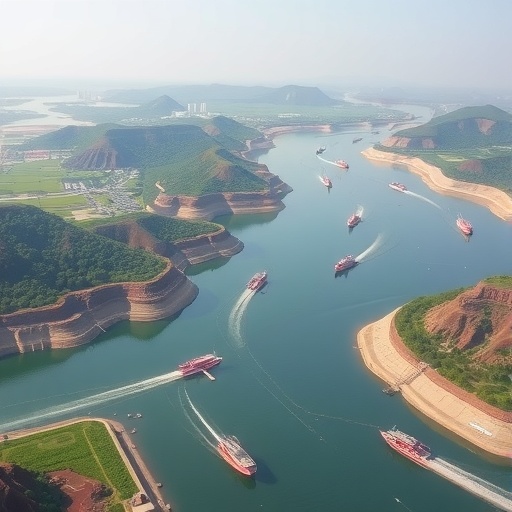
In the vast and dynamic landscapes of the Yellow River Delta, a groundbreaking study has unveiled the critical ecological role of managed hydrological connectivity. This emerging concept, which integrates human intervention with natural water flow processes, reveals new avenues for sustaining biodiversity and ecosystem resilience in one of China’s most ecologically sensitive and economically vital regions. The comprehensive research spearheaded by Fu, Sun, Fan, and colleagues, recently published in Communications Earth & Environment (2026), offers unprecedented insights into how deliberate water management practices can enhance the ecological stability of deltaic wetlands.
The Yellow River Delta, characterized by its intricate river networks, tidal influences, and wetland mosaics, faces increasing pressures from agricultural expansion, urbanization, and climate variability. Traditionally, efforts to preserve such environments have focused on either protecting natural watercourses or implementing flood control measures. However, this seminal study redefines the paradigm by conceptualizing hydrological connectivity not merely as a natural state but as an attribute that can and should be actively managed to balance ecological and socio-economic priorities.
Hydrological connectivity refers to the water-mediated transfer of matter, energy, and organisms within or between elements of the hydrological cycle. In wetland ecosystems, this connectivity dictates the flow of nutrients, supports fish migration routes, and maintains habitat diversity. The researchers underscore that unregulated or disrupted water flow can fragment habitats, degrade water quality, and ultimately threaten the intricate web of life that the Yellow River Delta supports. Their findings emphasize that managing this connectivity through engineered and adaptive practices not only mitigates environmental degradation but also supports biodiversity conservation and sustainable livelihoods.
Through a series of field experiments, remote sensing technologies, and hydrodynamic modeling, the team has mapped the spatial and temporal dynamics of water movement within the delta’s wetlands. By overlaying these data with ecological surveys, they identified specific connectivity patterns essential for key species, such as native fish populations and migratory birds. The precision of these analyses enabled the design of targeted water management interventions, ranging from timed sluice gate operations to restoration of natural channels, all aimed at optimizing ecological outcomes.
An innovative aspect of the study is its integration of managed hydrological connectivity into ecological planning frameworks. This approach departs from traditional water management aimed primarily at flood prevention or irrigation. Instead, it recognizes the delta as a coupled human-natural system where ecological health is a critical input rather than a byproduct of water policies. This conceptual shift could inspire similar strategies in other deltaic and wetland regions worldwide, where water management often struggles to reconcile environmental and economic demands.
The authors also document significant ecological responses following the implementation of managed connectivity strategies. For instance, increased connectivity during critical breeding seasons enhanced habitat availability for fish spawning, thereby boosting population recruitment. Simultaneously, controlled water pulses helped stimulate nutrient cycling in the wetlands, fostering richer plant diversity and improved water quality. These ecological benefits, in turn, bolster ecosystem services vital to local communities, including fisheries, flood mitigation, and carbon sequestration.
Moreover, the study sheds light on the socio-political dimensions of managing hydrological connectivity. Stakeholder engagement, particularly involving farmers, fishers, and local governments, proved essential for operationalizing water management schedules and maintaining infrastructure. This collaborative governance model not only ensured the sustainability of environmental interventions but also helped alleviate conflicts arising from water allocation. The researchers advocate for institutional mechanisms that foster adaptive management and knowledge co-production to sustain these benefits in the long term.
From a technological standpoint, the use of high-resolution satellite imagery combined with in-situ water quality sensors marks a significant advancement in monitoring hydrological connectivity. These tools allow real-time tracking of water levels, flow velocities, and sediment transport, providing actionable data for water managers. The study highlights how integrating such technologies can facilitate timely decisions, such as releasing water from retention basins or adjusting irrigation timings, to mimic natural hydrological fluctuations beneficial to ecosystems.
Climate change introduces additional complexity to managing the Yellow River Delta’s hydrology. Increased variability in precipitation, rising sea levels, and more frequent extreme weather events threaten to disrupt established connectivity patterns. The authors argue that managed hydrological connectivity offers a resilient framework that can buffer these impacts. By maintaining flexible water pathways and promoting habitat heterogeneity, this strategy enhances the delta’s adaptive capacity in the face of environmental uncertainty.
The implications of this research extend beyond ecological gains, touching on economic and policy dimensions central to China’s regional development goals. Sustainable water management in the Yellow River Delta aligns with national priorities to protect water resources, reduce pollution, and promote green development. Implementing managed hydrological connectivity could serve as a model for integrating environmental stewardship into broader socio-economic strategies, advancing the dual aims of conservation and development.
Importantly, the study stresses that managed hydrological connectivity is not a one-size-fits-all blueprint but a context-dependent approach. The diverse hydrological regimes and ecosystem types within the delta necessitate tailored management plans that reflect local conditions and community needs. By combining scientific rigor with participatory planning, the framework proposed by Fu and colleagues offers a replicable and adaptable template for ecological water management in complex wetland systems globally.
In conclusion, the research encapsulates a transformative view of water management—one that embraces complexity and seeks harmony between human activity and natural processes. The Yellow River Delta’s managed hydrological connectivity emerges as a vital ecological attribute, enhancing habitat connectivity, ecosystem service provision, and resilience. Future research directions may explore long-term ecological monitoring and expand socio-economic evaluations to further refine and optimize this innovative approach.
As ecosystems worldwide grapple with accelerating environmental change and competing human demands, the concept of managed hydrological connectivity presents a forward-looking paradigm. It invites policymakers, scientists, and communities to rethink water as a dynamic, manageable resource crucial for sustaining life and livelihoods in vulnerable wetland landscapes. The Yellow River Delta stands as a living laboratory where lessons learned today may chart a sustainable path for water stewardship tomorrow.
Cite Scienmag News
Violet Maxwell. (April 28, 2026). Managing Hydrological Connectivity in Yellow River Delta. Scienmag. https://scienmag.com/managing-hydrological-connectivity-in-yellow-river-delta/
Violet Maxwell. "Managing Hydrological Connectivity in Yellow River Delta." Scienmag, 28 April 2026, https://scienmag.com/managing-hydrological-connectivity-in-yellow-river-delta/. Accessed 3 September 2026.
Violet Maxwell. "Managing Hydrological Connectivity in Yellow River Delta." Scienmag. April 28, 2026. https://scienmag.com/managing-hydrological-connectivity-in-yellow-river-delta/


