

Tuesday, July 14, 2026
Science
No Result
View All Result
  • Login
  • HOME
  • SCIENCE NEWS
  • CONTACT US
  • HOME
  • SCIENCE NEWS
  • CONTACT US
No Result
View All Result
Scienmag
No Result
View All Result
Home Science News Space

Magnetic Fields and Colliding Ejecta in Precessing SS 433 Jets

July 14, 2026
in Space
Reading Time: 3 mins read
0
Magnetic Fields and Colliding Ejecta in Precessing SS 433 Jets

Magnetic Fields and Colliding Ejecta in Precessing SS 433 Jets

65
SHARES
587
VIEWS
Share on FacebookShare on Twitter
ADVERTISEMENT

The spectacular jets of the microquasar SS 433 have long fascinated astronomers, offering a rare glimpse into the complex interplay of gravity, magnetic fields, and particle dynamics near compact objects. These relativistic outflows, ejected from an accreting stellar-mass black hole or neutron star, display a striking precession and powerful radio emission, making SS 433 one of the most exotic binary systems in the Milky Way. However, the intricate magnetic field topology that governs these jets has remained an enigmatic puzzle—until now.

Recent advances in numerical simulations have shed light on the magnetic field structures within SS 433’s jets, revealing a connection between the field orientation and the jet’s morphology. Observations show that the magnetic fields align parallel to the jet’s bulk velocity at subparsec scales, a configuration that defies simple theoretical expectations. This alignment hints at a deeper underlying process shaping both the jet dynamics and the associated magnetic fields.

A team of researchers has now proposed a compelling explanation for this phenomenon based on the interactions of discrete ejecta within the jet flow. Rather than a smooth continuous emission, SS 433’s jets appear to be composed of a sequence of discrete plasma bullets expelled at slightly varying velocities. These differences cause internal collisions, which the simulations suggest naturally reconfigure and align the magnetic fields along the jets’ propagation direction.

These colliding ejecta generate elongated plasma structures that exhibit enhanced dynamical stability. This stability likely allows these plasma bullets to travel farther without significant disruption or mixing with the surrounding interstellar medium. Such resilience not only explains the observed longevity of the jet features but also accounts for the well-organized magnetic topology detected by radio polarization measurements.

The researchers’ state-of-the-art magnetohydrodynamical simulations track the complex evolution of these magnetic fields in three dimensions, capturing the nonlinear interplay between particle collisions, field line stretching, and reconnection events in real time. Their results underscore how small velocity variations lead to prompt ejecta interactions, which in turn dictate the large-scale magnetic field geometry observed in SS 433.

This model challenges previous assumptions that magnetic field alignment in relativistic jets arises primarily from large-scale ordered fields at the jet base. Instead, it highlights the role of dynamical processes on subparsec scales in shaping jet morphology and magnetic characteristics. This insight not only deepens our understanding of SS 433 but could also inform interpretations of jet phenomena in other galactic and extragalactic systems.

By correlating discrete ejecta collisions with magnetic alignment, the study provides a unifying framework for interpreting polarized radio signals from relativistic jets. It also paves the way for future observational campaigns aiming to resolve jet substructure with even greater detail. Ultimately, these findings mark a significant step forward in decoding how magnetic fields evolve in one of the universe’s most extreme environments.

As SS 433 continues its cosmic dance with precessing jets and exotic plasma bullets, astronomers now have a robust physical mechanism to explain its magnetic mysteries, opening new horizons in high-energy astrophysics and jet physics.


Subject of Research: Magnetic field topology and dynamics in relativistic jets of SS 433

Article Title: Magnetic field topology and colliding discrete ejecta in the precessing jets of SS 433

Article References:
López-Miralles, J., Perucho, M., Vallés-Pérez, D. et al. Magnetic field topology and colliding discrete ejecta in the precessing jets of SS 433. Nat Astron (2026). https://doi.org/10.1038/s41550-026-02922-6

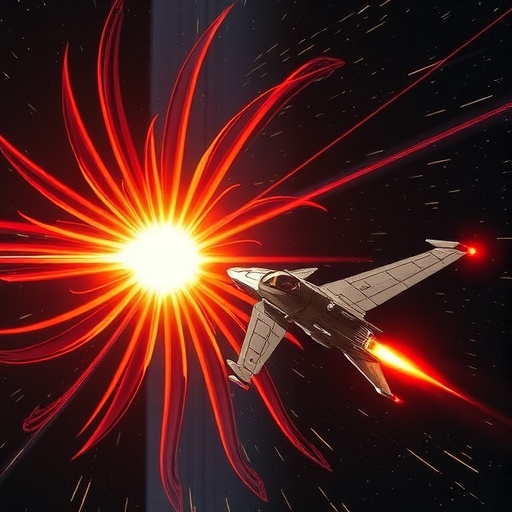
Image Credits: AI Generated

DOI: https://doi.org/10.1038/s41550-026-02922-6

Tags: compact object accretion and jet launchingdiscrete plasma bullets in jet flowsjet morphology and magnetic structuresmagnetic field alignment in astrophysical jetsMagnetic field topology in microquasar jetsmagnetic fields and jet emission mechanismsmagnetic reconnection in relativistic outflowsnumerical simulations of jet magnetic fieldsplasma ejecta interactionsrelativistic jet dynamicsSS 433 jet precessionsuperluminal jet motion in binary systems
Share26Tweet16
Previous Post

Osteoclasts Trigger DCC Loop Causing Chronic Low Back Pain in Mice

Next Post

Europe advances integrated charging and energy systems for optimal V2G deployment

Related Posts

How Supermassive Black Holes Sustain Their Growth
Space

How Supermassive Black Holes Sustain Their Growth

July 14, 2026
Astronomers Discover Four Nearby White Dwarf Stars Hidden in Space
Space

Astronomers Discover Four Nearby White Dwarf Stars Hidden in Space

July 14, 2026
KAIST launches space sensors with fully electrically reconfigurable optical functions
Space

KAIST launches space sensors with fully electrically reconfigurable optical functions

July 14, 2026
Discovery of Sugar Molecules in Interstellar Space Revealed
Space

Discovery of Sugar Molecules in Interstellar Space Revealed

July 13, 2026
Multimessenger Universe Advances Frontier AI Training Techniques
Space

Multimessenger Universe Advances Frontier AI Training Techniques

July 10, 2026
Isotopic Evidence Reveals Late Molecular Cloud Infall in Outer Solar System
Space

Isotopic Evidence Reveals Late Molecular Cloud Infall in Outer Solar System

July 10, 2026
Next Post
Europe advances integrated charging and energy systems for optimal V2G deployment

Europe advances integrated charging and energy systems for optimal V2G deployment

  • Mothers who receive childcare support from maternal grandparents show more

    Mothers who receive childcare support from maternal grandparents show more parental warmth, finds NTU Singapore study

    27656 shares
    Share 11059 Tweet 6912
  • University of Seville Breaks 120-Year-Old Mystery, Revises a Key Einstein Concept

    1061 shares
    Share 424 Tweet 265
  • Bee body mass, pathogens and local climate influence heat tolerance

    682 shares
    Share 273 Tweet 171
  • Researchers record first-ever images and data of a shark experiencing a boat strike

    546 shares
    Share 218 Tweet 137
  • Groundbreaking Clinical Trial Reveals Lubiprostone Enhances Kidney Function

    531 shares
    Share 212 Tweet 133
Science

Embark on a thrilling journey of discovery with Scienmag.com—your ultimate source for cutting-edge breakthroughs. Immerse yourself in a world where curiosity knows no limits and tomorrow’s possibilities become today’s reality!

RECENT NEWS

  • Veillonella ratti alters gut microbiome to prevent EAE disease progression
  • China’s Resource Cities Face Divergent Wealth Paths and Policy Challenges
  • Seasonal Cycle Balances Tropical Rain-Band Asymmetry
  • Detecting Exclusionary Nationalism in Prewar Japan Through Language Analysis

Categories

  • Agriculture
  • Anthropology
  • Archaeology
  • Athmospheric
  • Biology
  • Biotechnology
  • Blog
  • Bussines
  • Cancer
  • Chemistry
  • Climate
  • Earth Science
  • Editorial Policy
  • Marine
  • Mathematics
  • Medicine
  • Pediatry
  • Policy
  • Psychology & Psychiatry
  • Science Education
  • Social Science
  • Space
  • Technology and Engineering

Subscribe to Blog via Email

Enter your email address to subscribe to this blog and receive notifications of new posts by email.

Join 5,146 other subscribers

© 2025 Scienmag - Science Magazine

Welcome Back!

Login to your account below

Forgotten Password?

Retrieve your password

Please enter your username or email address to reset your password.

Log In
No Result
View All Result
  • HOME
  • SCIENCE NEWS
  • CONTACT US

© 2025 Scienmag - Science Magazine

Discover more from Science

Subscribe now to keep reading and get access to the full archive.

Continue reading
