


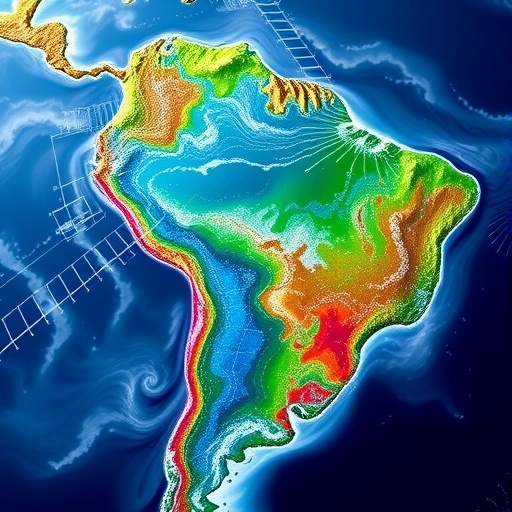
South America’s rivers may begin far above the ground. A new study examining the continent’s “aerial rivers” reveals how corridors of water vapor moving through the atmosphere can shape rainfall, river flow and drainage systems across one of the planet’s most hydrologically diverse regions. Published in Nature Communications, the research by Weng, Fu, Hung and colleagues focuses on the connection between atmospheric transport and the rivers that eventually carry water across the land.
The term “aerial rivers” describes narrow, elongated bands of concentrated moisture in the atmosphere. They are often compared with atmospheric rivers because they transport enormous quantities of water vapor from one region to another, sometimes across thousands of kilometers. When these moisture corridors encounter mountains or weather systems, the air is forced upward, cooling the water vapor and producing intense precipitation. That rainfall can feed streams, recharge soils and wetlands, and alter the timing and volume of runoff entering major river basins.
South America is an especially important natural laboratory for studying this process. The continent contains the Amazon Basin, the world’s largest river system by discharge, as well as the Andes, the Pantanal wetlands, the La Plata Basin and extensive drylands in the west and south. Moisture does not simply arrive from the Atlantic and fall locally. It can be recycled through forests, redirected by mountain ranges and transported across national borders before returning to the surface as rain or snow. The study investigates how these aerial pathways correspond to different hydrological regimes and drainage patterns across the continent.
A hydrological regime describes the seasonal rhythm of water movement through a landscape. In a river system, that rhythm may be controlled by rainfall, snowmelt, glacier melt, evaporation, groundwater exchange or a combination of these processes. In the Andes, for example, precipitation stored as seasonal snow and ice can delay the delivery of water to downstream valleys. In tropical basins, rainfall may be more closely linked to atmospheric moisture transport and convection. By connecting aerial rivers with these contrasting regimes, the research helps explain why neighboring watersheds can respond very differently to the same large-scale climate conditions.
The drainage system is the landscape’s physical network for moving water. It includes headwater streams, tributaries, floodplains, wetlands and main river channels, all shaped by topography and geology. Atmospheric moisture can influence this network in several ways. Persistent wet-season transport may sustain broad floodplains and high river discharge, while short-lived but intense moisture pulses can trigger flash floods, landslides and rapid channel changes. In mountainous terrain, the location and direction of aerial rivers may determine which slopes receive the heaviest precipitation and which valleys experience the greatest hydrological stress.
One of the study’s broader scientific contributions is its effort to view atmospheric and terrestrial water systems as a single connected process. Conventional maps often show rivers as blue lines drawn across the ground, while atmospheric circulation is analyzed separately using weather data. Yet the water in a river may have traveled through a complex chain of evaporation, atmospheric transport, condensation and runoff before reaching a gauge station. Tracking that chain can reveal why rainfall anomalies in one region may produce flooding or drought far downstream, even when local weather appears ordinary.
This perspective is increasingly important as climate change reshapes the water cycle. A warmer atmosphere can hold more water vapor, potentially intensifying moisture transport when conditions favor the formation of atmospheric rivers. At the same time, warming can reduce snow and glacier storage in the Andes, changing the seasonal timing of runoff. Some locations may face heavier rainfall and flooding, while others could lose dependable dry-season water supplies. Understanding the baseline behavior of aerial rivers provides a foundation for detecting how these systems are shifting and for identifying communities and ecosystems most exposed to the changes.
The findings also carry implications for forecasting and water management. River discharge models become more useful when they account not only for rainfall over a basin but also for the pathways that deliver moisture to it. Improved monitoring of atmospheric rivers could strengthen early warnings for floods, landslides and extreme rainfall, particularly in regions where weather stations are sparse. It could also support decisions about reservoir operations, agricultural planning, hydropower generation and wetland conservation. Because many South American watersheds cross political boundaries, understanding shared atmospheric sources may be as important as mapping shared rivers.
By placing South America’s drainage networks beneath the lens of atmospheric moisture transport, the research turns an invisible movement of water vapor into a visible part of the continent’s geography. The study’s central message is that rivers do not begin only where water touches the ground. They also begin in the atmosphere, in moving corridors that connect oceans, forests, mountains and cities. As climate pressures grow, tracing those aerial rivers may become essential for predicting where water will arrive, when it will arrive and how powerfully it will reshape the landscapes below.
Cite Scienmag News
Russell Cooper. (August 3, 2026). Scientists map hydrology and drainage networks of South America’s atmospheric rivers. Scienmag. https://scienmag.com/scientists-map-hydrology-and-drainage-networks-of-south-americas-atmospheric-rivers/
Russell Cooper. "Scientists map hydrology and drainage networks of South America’s atmospheric rivers." Scienmag, 3 August 2026, https://scienmag.com/scientists-map-hydrology-and-drainage-networks-of-south-americas-atmospheric-rivers/. Accessed 3 September 2026.
Russell Cooper. "Scientists map hydrology and drainage networks of South America’s atmospheric rivers." Scienmag. August 3, 2026. https://scienmag.com/scientists-map-hydrology-and-drainage-networks-of-south-americas-atmospheric-rivers/


