


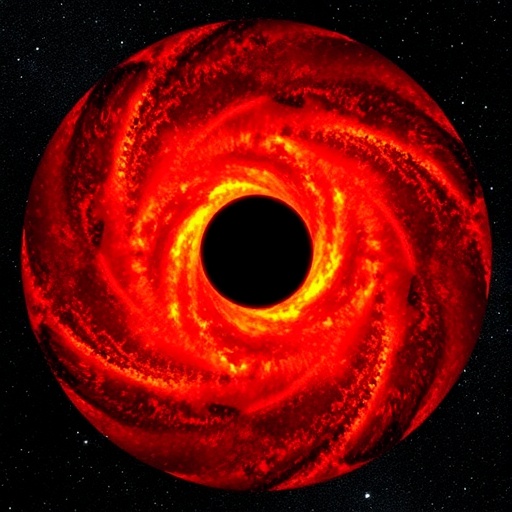
The Sloan Digital Sky Survey has released its twentieth data collection, opening an unprecedented window onto the feeding, growing and sometimes violently changing supermassive black holes that shape the evolution of galaxies. Data Release 20, or DR20, brings together more than 3.3 million optical spectra gathered from half a million galaxies and 1.5 million stars. A major focus of the release is the Black Hole Mapper program, part of the fifth generation of the survey, SDSS-V, which is designed to investigate quasars and active galactic nuclei across billions of years of cosmic history.
For the first time, DR20 includes optical spectra obtained with the BOSS spectrograph at Las Campanas Observatory in Chile, complementing observations made at Apache Point Observatory in New Mexico. The two facilities give SDSS-V access to both hemispheres, allowing astronomers to survey a wider and more representative portion of the sky. By combining this coverage with robotic fiber-positioning technology, researchers can observe thousands of objects efficiently and return repeatedly to selected targets whose brightness or spectral behavior changes over time.
One of the release’s most powerful components is SPIDERS, short for SPectroscopic IDentification of eROSITA Sources. The program links optical spectra from SDSS with X-ray detections made by the eROSITA space telescope. Approximately 200,000 X-ray sources now have optical identifications and measured redshifts, which reveal how far away they are and how much energy they produce. This creates the largest and most uniform spectroscopic follow-up sample of X-ray sources assembled to date, turning a map of high-energy points of light into a three-dimensional survey of the energetic Universe.
Most of the X-ray sources in this sample are active galactic nuclei, powered by material spiraling into supermassive black holes at the centers of galaxies. As gas falls inward, it forms a hot accretion disk and can generate intense radiation across the electromagnetic spectrum. X-rays often arise from a high-temperature region known as the corona, located above the disk. Because X-rays can reveal the central engine even when visible light is obscured, they provide astronomers with an important way to identify black holes hidden behind thick clouds of gas and dust.
The combined SDSS and eROSITA data are already reshaping estimates of how black holes grew through cosmic time. Astronomers use the X-ray luminosity function—a statistical census of black holes divided by brightness and distance—to track the population from the nearby Universe to redshifts approaching six. At those distances, the light began its journey when the Universe was less than a billion years old. The survey finds that extremely luminous quasars were more common in the early Universe than many previous studies suggested, indicating that enormous black holes were able to gain mass at remarkable speeds during cosmic dawn.
The observations also reveal a substantial population of black holes that optical surveys alone fail to detect. Dust and gas can absorb ultraviolet and visible radiation, concealing an active nucleus from conventional searches. Yet even X-ray observations do not capture the entire story. When researchers calculate the total mass accumulated by supermassive black holes over cosmic history, they find that black holes selected through soft X-ray emission account for only a minority of the growth seen in the local Universe. The result implies that roughly 70 to 90 percent of supermassive black-hole growth occurred behind heavy obscuring material or during phases in which X-ray emission itself was strongly suppressed.
DR20 also follows quasars as they change. The Black Hole Mapper’s Reverberation Mapping program repeatedly observes selected targets and measures the time delay between variations in the accretion disk and the response of the broad-line region, a rapidly moving cloud of gas surrounding the black hole. Because the delay reflects the size of this region, and the gas velocity can be measured from broadened emission lines, researchers can estimate black-hole masses using a form of geometric physics. The method offers a way to weigh distant black holes that cannot be directly imaged.
Another time-domain effort, the All-Quasar Multi-Epoch Spectroscopy program, monitors tens of thousands of quasars over multiple observing epochs. Its data can reveal changing outflows, possible pairs of orbiting supermassive black holes and “changing-look” quasars that unexpectedly switch between active and apparently dormant states. Some spectra proved so unusual that they disrupted established automated analysis pipelines. Scientists therefore visually inspected the most challenging observations, creating a valuable catalog of rare and abnormal objects that could expose physical processes missing from standard models of quasar activity.
The scale and flexibility of the project are made possible by SDSS-V’s Robotic Focal Plane System, installed on both the Sloan Foundation Telescope at Apache Point Observatory and the du Pont Telescope at Las Campanas Observatory. Hundreds of robotic positioners arrange optical fibers across the focal plane, directing light from selected galaxies, stars and quasars into the BOSS spectrographs. The system can be reconfigured rapidly, supporting repeated observations and Target of Opportunity campaigns when transient or rapidly changing sources demand immediate attention. All DR20 Black Hole Mapper products are publicly available through SDSS archive services, including spectra, catalogs, X-ray counterparts, visual classifications and analysis tools. Researchers, educators and the public can explore the data through web interfaces, SQL queries and Python-based notebooks, making this vast record of cosmic black-hole activity accessible far beyond the original collaboration.
Web References: SDSS Data Release 20; SDSS Data Release 20 announcement
References: Merloni, A., Lamer, G., Liu, T., et al. (2024). The SRG/eROSITA all-sky survey: First catalog of X-ray sources (eRASS1). Astronomy & Astrophysics, 682, A34. ADS Abstract; Publisher Full Text
Keywords
SDSS-V, Data Release 20, Black Hole Mapper, supermassive black holes, quasars, active galactic nuclei, eROSITA, SPIDERS, X-ray astronomy, reverberation mapping, cosmic dawn, galaxy evolution, astronomical spectroscopy
Cite Scienmag News
Grant Pearson. (August 3, 2026). SDSS-V Data Release 20 Maps Supermassive Black Holes Across the Entire Sky. Scienmag. https://scienmag.com/sdss-v-data-release-20-maps-supermassive-black-holes-across-the-entire-sky/
Grant Pearson. "SDSS-V Data Release 20 Maps Supermassive Black Holes Across the Entire Sky." Scienmag, 3 August 2026, https://scienmag.com/sdss-v-data-release-20-maps-supermassive-black-holes-across-the-entire-sky/. Accessed 4 September 2026.
Grant Pearson. "SDSS-V Data Release 20 Maps Supermassive Black Holes Across the Entire Sky." Scienmag. August 3, 2026. https://scienmag.com/sdss-v-data-release-20-maps-supermassive-black-holes-across-the-entire-sky/


