


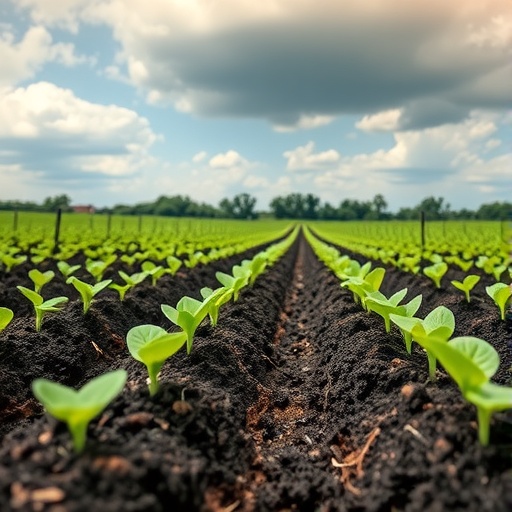
Phosphorus stands as a cornerstone element for agricultural productivity, essential for plant development and crop yields. Yet, the challenge of applying phosphorus fertilizers efficiently has plagued farmers for decades. Typically, only a limited proportion of applied phosphorus fertilizer is absorbed by crops, while the remainder becomes immobilized in the soil matrix or leaches into aquatic ecosystems. This inefficiency not only escalates costs for farmers but also triggers environmental concerns, including eutrophication, which depletes oxygen in water bodies and harms aquatic life.
Emerging research in the journal Biochar unveils a sophisticated approach to overcoming these limitations by harnessing machine learning to tailor phosphorus availability through the application of pristine biochar. Biochar, a carbon-dense substance generated via pyrolysis—a thermal decomposition of biomass under oxygen-restricted conditions—has shown promise as a soil amendment due to its ability to influence soil chemistry, water retention, and nutrient cycling. However, the interaction between biochar properties and soil phosphorus dynamics has remained enigmatic and inconsistent across diverse environments.
The recent study approaches this problem by aggregating an extensive dataset compiled from 534 biochar-soil interaction samples extracted from 32 independent studies worldwide. These samples encompass a variety of biochar characteristics, such as feedstock type and pyrolysis temperature, alongside detailed soil property measurements including pH and total phosphorus content. Leveraging the power of machine learning, the research team evaluated three distinct predictive models: Random Forest, Support Vector Regression, and Artificial Neural Networks, aiming to identify the most robust method to forecast changes in plant-available phosphorus induced by biochar amendments.
Among these methodologies, the Random Forest algorithm emerged as the preeminent predictor, recording an exceptional test-set R² of 0.9107, illustrating its capacity to elucidate more than 91% of the variance in soil phosphorus response to biochar. This model surpassed its counterparts not only in accuracy but also in minimizing prediction errors, thus offering a reliable toolset for precision soil nutrient management. By transforming the application of biochar from a traditional trial-and-error approach into a science-driven practice, this model paves the way for informed decision-making tailored to localized soil and environmental conditions.
The study’s in-depth analyses revealed that among the plethora of biochar attributes, the pyrolysis temperature stands as the dominant determinant in regulating soil phosphorus availability. Biochars produced at moderate pyrolysis temperatures strike a balance, exhibiting optimized porosity and reactive surface functionalities conducive to phosphorus mobilization. Contrarily, biochars subjected to higher pyrolysis temperatures tend to promote phosphorus immobilization, potentially mitigating phosphorus runoff and subsequent eutrophication in water bodies. These contrasting effects underscore the nuanced, non-linear interactions between biochar characteristics and soil nutrient dynamics.
Furthermore, the model highlights the importance of additional environmental and application variables, such as the rate of biochar application, soil pH, and the initial total phosphorus concentration within the soil. These variables exhibit complex interdependencies; for example, the efficacy of biochar in enhancing phosphorus availability is contingent upon suitable application rates in conjunction with specific soil pH levels, reinforcing that a singular approach cannot universally optimize phosphorus management.
Intriguingly, the findings suggest that pristine biochar—without resorting to chemical modifications often applied to augment nutrient binding or release—can match or even surpass the phosphorus regulatory capabilities of modified variants under certain conditions. This insight holds considerable implications for cost reduction and environmental stewardship, as pristine biochar production demands less energy and fewer chemical inputs, facilitating more sustainable agricultural interventions.
The implications of these findings extend beyond phosphorus management to signify a paradigm shift in precision agriculture. Combining advanced soil chemistry, environmental science, and artificial intelligence offers unprecedented opportunities to fine-tune nutrient application, balancing economic viability with ecological preservation. This integrative approach enhances fertilizer use efficiency and curtails nutrient losses, optimizing crop productivity while safeguarding water quality.
Corresponding author Yutao Peng elucidates this vision by emphasizing that machine learning not only forecasts the behavior of biochar in soils but also fosters a predictive framework that can guide practitioners toward context-specific best practices. This approach empowers farmers and land managers to select biochar products and adjust their application protocols based on quantitative assessments of soil conditions and biochar attributes, moving closer to a data-driven stewardship of nutrient management.
Moreover, the research highlights the layered complexity inherent to phosphorus cycling in terrestrial ecosystems. The nonlinear relationships, identified through SHAP (Shapley Additive Explanations) analysis, underscore the necessity of multifactorial models that encapsulate intricate soil-biochar interactions rather than simplistic models that overlook these critical dynamics. It is this sophistication that equips the Random Forest model with its superior predictive prowess.
The environmental benefits arising from optimized biochar application are profound. By reducing excess phosphorus leaching, biochar can prevent downstream eutrophication events, which degrade water quality and aquatic biodiversity. The capacity to promote phosphorus passivation also provides a tool for mitigating nutrient runoff from agricultural landscapes—a key concern under intensifying agricultural activities and climate change pressures.
The study thus signals a broader movement within sustainable agriculture: embracing multidisciplinary innovations that meld computational intelligence with agronomic practices. Such synergy prompts greater resource-use efficiency and elevates sustainability metrics across diverse farming systems. It also prompts reconsideration of how emerging technologies can be democratized and integrated into routine agronomic decision-making.
Lead author Jia Liu remarks on the balance that must be struck between maximizing crop yields and minimizing environmental impacts. The successful application of machine learning-driven biochar management aligns these dual objectives, fostering a future where agricultural intensification does not compromise ecological integrity. This balance is quintessential for meeting the global demand for food production while addressing environmental challenges at scale.
In summary, this groundbreaking work demonstrates that precision regulation of soil phosphorus availability via pristine biochar is not only feasible but can be systematically guided by sophisticated machine learning tools. As agriculture confronts escalating demands and environmental mandates, such innovation offers a beacon of hope — promising smarter, more sustainable nutrient management strategies poised to reshape the future of farming.
Cite Scienmag News
Alan Morgan. (May 26, 2026). Machine Learning Enhances Precision Use of Biochar for Soil Phosphorus Management in Agriculture. Scienmag. https://scienmag.com/machine-learning-enhances-precision-use-of-biochar-for-soil-phosphorus-management-in-agriculture/
Alan Morgan. "Machine Learning Enhances Precision Use of Biochar for Soil Phosphorus Management in Agriculture." Scienmag, 26 May 2026, https://scienmag.com/machine-learning-enhances-precision-use-of-biochar-for-soil-phosphorus-management-in-agriculture/. Accessed 3 September 2026.
Alan Morgan. "Machine Learning Enhances Precision Use of Biochar for Soil Phosphorus Management in Agriculture." Scienmag. May 26, 2026. https://scienmag.com/machine-learning-enhances-precision-use-of-biochar-for-soil-phosphorus-management-in-agriculture/


