


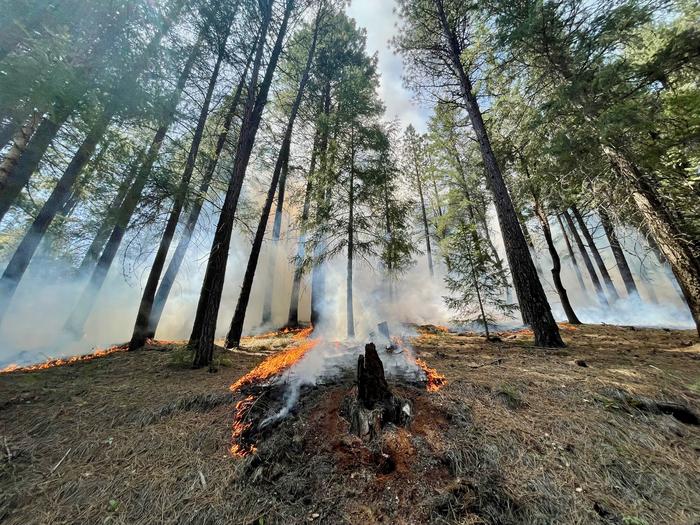
Not all forest fires have devastating effects. Low- and moderate-severity forest wildfires can reduce the intensity of future conflagrations for as long as 20 years in certain climates, according to new research by the University of California, Davis.

Credit: Andrew Latimer/UC Davis
Not all forest fires have devastating effects. Low- and moderate-severity forest wildfires can reduce the intensity of future conflagrations for as long as 20 years in certain climates, according to new research by the University of California, Davis.
The extent of reduced severity of these second fires, or reburns, and the duration of the moderating effect, varies by climate, forest type and other factors. But initial fires continue to mitigate future severity even during extreme weather, such as wind, high temperatures and drought, research published in the journal Ecological Applications finds.
The researchers used satellite remote sensing to study more than 700 reburn fires over the past 50 years throughout the western United States. The findings shed light on the positive effect some of these blazes can have on forest resilience and could play a key role in helping land managers decide where to focus risk reduction efforts while adapting to a changing climate.
“We’re living in a time with increasing wildfire, which poses challenges for our communities and landscapes,” said lead author Claire Tortorelli, an ecologist for the U.S. Forest Service who did the research while a postdoctoral scholar at UC Davis. “Some previous fires can have moderating effects on future fire behavior. It’s important to understand how past wildfires are going to affect what happens in the future.”
A knowledge gap
A lot of research has focused on high-severity fires, but there’s a gap in knowledge when it comes to less intensive fires where most of the tree canopy is left intact. Tortorelli and others sought to better understand what happened after these low- and moderate-severity fires.
In addition to the remote sensing data, they examined severity of the first and second fires and factors such as weather, forest type and climate. Then they modeled the reburn severity to determine how long and how strong the effect of the first fire was on later fuels and risk under different climate, weather and forest conditions.
Researchers found that forests of the California coast and Southwest have longer lasting effects than those in the Sierra and Cascades.
“It’s all about the vegetation and fuels that are coming back after fire,” Tortorelli said. “We still need a more nuanced understanding of local fuels for managers to know how their specific system is going to burn in a future fire or how soon to come back and re-treat.”
The reduced severity could last up to 20 years in some systems but the effect lessened over time. Follow-up treatments such as prescribed burns or mechanical thinning can help prolong the work the initial fire did in reducing fuels and future fire risk.
“We can leverage lower severity fires as a kind of initial fuel reduction treatment,” Tortorelli said. “While I don’t think they’re going to do all the work for us, and we need to pair them with management actions, they can do some of the heavy lifting, especially that initial lift.”
Widespread effect
The reburn effect could be widespread even in areas with high-severity wildfires because many of those blazes have areas that burn with low to moderate severity, said Andrew Latimer, a co-author and Department of Plant Sciences professor who co-supervised Tortorelli’s research.
“If you add up how much area that is, that’s way more than we’ve so far been able to treat through mechanical thinning and prescribed burning, and so it’s the biggest form of fuel reduction that’s happening,” Latimer said. “It opens this window of opportunity to keep forests in good shape.”
Derek Young in the Department of Plant Sciences co-supervised the research, which was supported by the University of California National Lab Fees Research Program.
Journal
Ecological Applications
DOI
Article Title
Moderating effects of past wildfire on reburn severity depend on climate and initial severity in Western US forests
Article Publication Date
15-Aug-2024
Cite Scienmag News
Russell Cooper. (August 19, 2024). Less severe forest fires can reduce intensity of future blazes. Scienmag. https://scienmag.com/less-severe-forest-fires-can-reduce-intensity-of-future-blazes/
Russell Cooper. "Less severe forest fires can reduce intensity of future blazes." Scienmag, 19 August 2024, https://scienmag.com/less-severe-forest-fires-can-reduce-intensity-of-future-blazes/. Accessed 4 September 2026.
Russell Cooper. "Less severe forest fires can reduce intensity of future blazes." Scienmag. August 19, 2024. https://scienmag.com/less-severe-forest-fires-can-reduce-intensity-of-future-blazes/

