


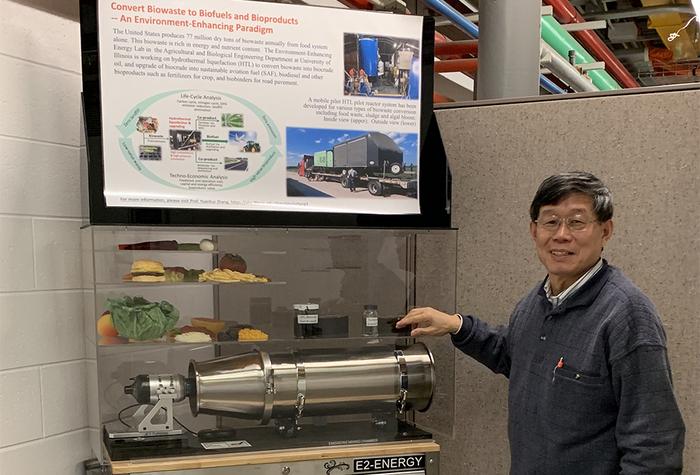
URBANA, Ill. – As the world faces the challenges of mitigating climate change and providing resources for a growing population, there is increasing focus on developing circular economies for sustainable production. But to evaluate strategies and impacts, it is necessary to have reliable metrics. Researchers at the University of Illinois Urbana-Champaign have developed a Circularity Index that provides a comprehensive method to quantify circularity in bioeconomic systems. In a new paper, they outline the method and apply it to two case studies – a corn/soybean farming operation and the entire U.S. food and agriculture system.

Credit: College of ACES
URBANA, Ill. – As the world faces the challenges of mitigating climate change and providing resources for a growing population, there is increasing focus on developing circular economies for sustainable production. But to evaluate strategies and impacts, it is necessary to have reliable metrics. Researchers at the University of Illinois Urbana-Champaign have developed a Circularity Index that provides a comprehensive method to quantify circularity in bioeconomic systems. In a new paper, they outline the method and apply it to two case studies – a corn/soybean farming operation and the entire U.S. food and agriculture system.
“The traditional economic system is linear – we produce, distribute, use, and dispose of products. To increase sustainability, we need to develop a circular economy. Rather than just using natural resources, we must recover, reuse, and recycle waste materials,” said lead author Yuanhui Zhang, a professor in the Department of Agricultural and Biological Engineering (ABE), part of the College of Agricultural, Consumer and Environmental Sciences and The Grainger College of Engineering at the U. of I.
“Circular bioeconomy has become a hot topic in research, but most studies are merely descriptive and there’s no way to measure impacts. To move the technology forward, we need measurements to quantify effects, establish benchmarks, compare approaches, and identify weak spots,” he said.
In the paper, the researchers provide a step-by-step outline of the Circularity Index (CI), which measures circularity on a scale from 0 to 1. Zero means the system is completely linear, and 1 means it is completely circular. The index includes eight categories: take, make, distribute, use, dispose, recover, remake, and reuse. The CI is computed by entering available data into each of these categories.
Zhang and his colleagues demonstrate how to use the CI in two case studies. The first examines nitrogen cycling in a corn-soybean farm in the Midwestern United States. The researchers enter production and output data for a period of 8 years, and compare the effect of two different fertilizer treatments: urea versus manure. They calculate the CI to be 0.687 for urea and 0.86 for manure, indicating the use of manure fertilizer provides a more circular economy.
In the second case study, Zhang and his colleagues look at the U.S. food and agriculture system, focusing on energy use. Drawing on national data from the USDA, EPA, and DOE, they compare the current system with an approach based on the Environment-Enhancing Food Energy and Water System framework, which involves recovery, remake, and reuse of organic waste. They find the existing system has a CI of 0.179, while the EE-FEWS approach would lead to a CI of 0.84.
“Our current production system relies primarily on fossil fuel, with some use of solar and wind energy. But there is very little recovery of biowaste. If we recover food waste and manure and turn it into energy and fertilizer, we can recycle it back to the agricultural systems it originates from. Employing the EE-FEWS framework would greatly improve circularity of the U.S. bioeconomy,” Zhang explained.
The CI is a scalable method that can be used on different resource types and systems, depending on the focus of interest. Resources can be minerals, such as carbon or nitrogen, or non-mineral, such as water or energy. Systems can range from a process or a farm to an industry sector, a national economy, or even the global economy.
“We know it’s important to reduce fossil fuel use, increase renewable resources, and minimize our water consumption. But to do so effectively, we need to know how much, and what the weak links and tradeoffs are. The CI provides a single number that allows you to establish a baseline, compare systems, and determine best strategies for action,” Zhang said.
The CI can serve as an indicator to support policy initiatives such as the United Nations’ Sustainable Development Goals. It also has potential commercial value; for example, food companies can demonstrate their production circularity to consumers.
The paper, “A scalable index for quantifying circularity of bioeconomy systems,” is published in Resources, Conservation and Recycling [DOI: 10.1016/j.resconrec.2024.107821]. Authors are Yuanhui Zhang, Sabrina Summers, James Jones, and John Reid.
Journal
Resources Conservation and Recycling
Article Title
A scalable index for quantifying circularity of bioeconomy systems
Article Publication Date
1-Aug-2024
Cite Scienmag News
Courtney Benton. (August 19, 2024). Illinois researchers develop index to quantify circular bioeconomy. Scienmag. https://scienmag.com/illinois-researchers-develop-index-to-quantify-circular-bioeconomy/
Courtney Benton. "Illinois researchers develop index to quantify circular bioeconomy." Scienmag, 19 August 2024, https://scienmag.com/illinois-researchers-develop-index-to-quantify-circular-bioeconomy/. Accessed 8 September 2026.
Courtney Benton. "Illinois researchers develop index to quantify circular bioeconomy." Scienmag. August 19, 2024. https://scienmag.com/illinois-researchers-develop-index-to-quantify-circular-bioeconomy/

