


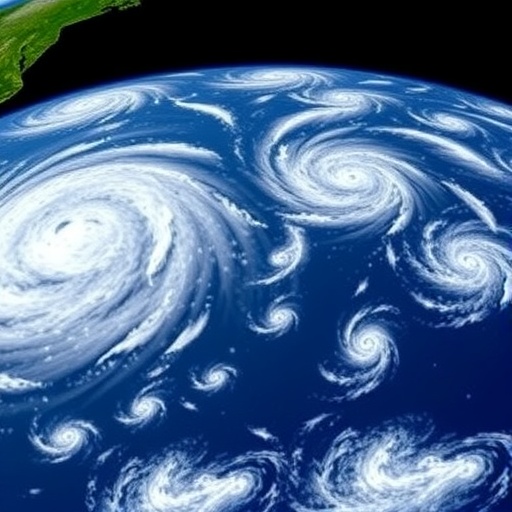
In the vast and dynamic system of Earth’s climate, tropical cyclones have long been recognized as powerful meteorological phenomena capable of dramatic short-term impacts on oceanic and atmospheric conditions. However, their influence on the global carbon cycle, particularly their role as agents of carbon exchange between the ocean and atmosphere, has remained enigmatic. An innovative international study, recently published in Nature Geoscience, sheds new light on this complex relationship. Utilizing a sophisticated synthesis of sparse and diverse observational data, researchers now provide compelling evidence of how tropical cyclones contribute to ocean carbon outgassing and the evolving nature of this process in a warming world.
The ocean, covering over 70% of Earth’s surface, plays a critical role as a sink in the global carbon cycle, absorbing an estimated 20 to 30 percent of anthropogenic CO₂ emissions annually—amounting to roughly 1.0 to 3.0 petagrams of carbon. Despite this, the transient but forceful disturbances caused by tropical cyclones introduce complexities in how CO₂ is exchanged at the air-sea interface. Traditionally, the intense winds and resulting surface mixing during cyclones are understood to accelerate sea-to-air CO₂ flux, leading to net carbon outgassing. Yet, counteracting processes such as cyclone-induced sea surface cooling tend to enhance ocean carbon uptake, creating a delicate and dynamic balance that is sensitive to climatic changes.
The study advances understanding by constructing a daily-resolved, global air-sea CO₂ flux dataset, overcoming prior limitations presented by the sporadic nature of CO₂ measurements during and after tropical cyclone events. This dataset has facilitated a detailed quantification of tropical cyclone contributions to the global carbon cycle from 1993 through 2020. Early in the period assessed, tropical cyclones were responsible for approximately 16% of the global annual ocean carbon flux, confirming their substantial impact on ocean-atmosphere carbon exchange. However, intriguingly, this contribution diminished substantially over recent decades, falling to a mere 4.5% by the late 2010s.
The mechanism driving this trend is linked to the effects of global warming on upper-ocean stratification. Increasing surface temperatures create a sharper vertical thermal gradient between the warm surface layer and the cooler subsurface waters beneath. When tropical cyclones pass through such stratified waters, they induce more pronounced cooling in the surface ocean, commonly referred to as “cold wakes.” These cold wakes enhance the disequilibrium in CO₂ partial pressures between the ocean and atmosphere, allowing the ocean to absorb more CO₂ following cyclone passage. Consequently, the net carbon flux shifts increasingly toward uptake rather than outgassing.
This nuanced understanding suggests that the historical carbon release associated with cyclones is being offset progressively by post-cyclone oceanic carbon absorption, a dynamic that could reverse tropical cyclones’ traditional role in ocean biogeochemistry within the next couple of decades. Model projections indicate that if anthropogenic CO₂ emissions remain unabated, the balance could tip as early as 2035, with tropical cyclones potentially becoming a net carbon sink. While this might initially seem beneficial from a carbon budget perspective, it signals an acceleration of ocean acidification processes, which pose significant threats to marine ecosystems by altering seawater chemistry and diminishing habitat suitability for numerous species.
The research highlights an urgent need for attention to anthropogenic carbon mitigation strategies. The fate of tropical cyclone-induced carbon fluxes, whether contributing to atmospheric CO₂ increases or enhancing oceanic sequestration, hinges critically on future emission trajectories. Immediate and substantial emission reductions could prolong the current downward trend in cyclone-related carbon outgassing, delaying any reversal until the mid-century or beyond. This temporal delay may afford ecosystems and climate systems valuable time to adapt, albeit not without inevitable challenges.
Authors emphasize that the increased stratification in upper ocean layers under global warming is the principal driver of these observed changes. With surface water temperatures rising more rapidly than subsurface waters, cyclones generate more substantial vertical mixing and cooler surface “cold wakes,” thereby intensifying CO₂ uptake. These findings provide essential insights into the feedback mechanisms linking atmospheric CO₂ increase, ocean stratification, and extreme weather events, deepening our understanding of how climate change alters natural carbon cycling features.
Furthermore, the study draws attention to the fact that tropical cyclones do not act uniformly across ocean basins. Their contribution to carbon outgassing varies regionally, reflecting differing environmental conditions, cyclone frequency, and oceanographic characteristics. Overall, tropical cyclones accounted for roughly 9% to 23% of ocean carbon outgassing in the main basins examined, though this spatial heterogeneity demands further investigation with enhanced observational coverage and improved modeling frameworks.
Crucially, the dataset employed in this study capitalizes on advanced remote sensing and observational networks, coupled with sophisticated data assimilation and interpolation techniques, to bridge gaps in traditional in situ measurements. This approach represents a major methodological leap, enabling higher-resolution temporal and spatial analyses of air-sea CO₂ fluxes under extreme weather events. Such methodological advancements facilitate more accurate assessment of short-lived yet influential processes, positioning researchers to better anticipate future carbon cycle responses to ongoing climatic transformations.
The implications of these findings extend beyond carbon cycle science. The intensification of ocean acidification driven by increased CO₂ uptake in the wake of tropical cyclones could exacerbate the degradation of marine biodiversity hotspots, threaten fisheries and coastal livelihoods, and alter biogeochemical cycles in ways that feedback into climate systems. Understanding and forecasting these interactions are therefore imperative for integrated climate risk assessments and for informing policy decisions that address both climate mitigation and marine conservation.
In summation, the study paints a compelling picture of a planetary system in flux, wherein the role of tropical cyclones in ocean-atmosphere carbon exchange is modulated by anthropogenic warming-induced changes in ocean thermal structure. This evolving role—from a historical net source of atmospheric carbon to a possible future net sink—underscores the complex interplay of climatic variables influencing Earth’s carbon reservoirs. Effective mitigation strategies must be pursued with an appreciation of these intricate dynamics, ensuring a more resilient and sustainable future for both atmospheric regulation and marine ecosystems.
News Publication Date: 25-May-2026.
Web References: http://dx.doi.org/10.1038/s41561-026-01985-4
Cite Scienmag News
Russell Cooper. (May 25, 2026). Tropical Cyclones Influence the Global Carbon Cycle—But Climate Warming Could Flip Their Impact. Scienmag. https://scienmag.com/tropical-cyclones-influence-the-global-carbon-cycle-but-climate-warming-could-flip-their-impact/
Russell Cooper. "Tropical Cyclones Influence the Global Carbon Cycle—But Climate Warming Could Flip Their Impact." Scienmag, 25 May 2026, https://scienmag.com/tropical-cyclones-influence-the-global-carbon-cycle-but-climate-warming-could-flip-their-impact/. Accessed 4 September 2026.
Russell Cooper. "Tropical Cyclones Influence the Global Carbon Cycle—But Climate Warming Could Flip Their Impact." Scienmag. May 25, 2026. https://scienmag.com/tropical-cyclones-influence-the-global-carbon-cycle-but-climate-warming-could-flip-their-impact/


