


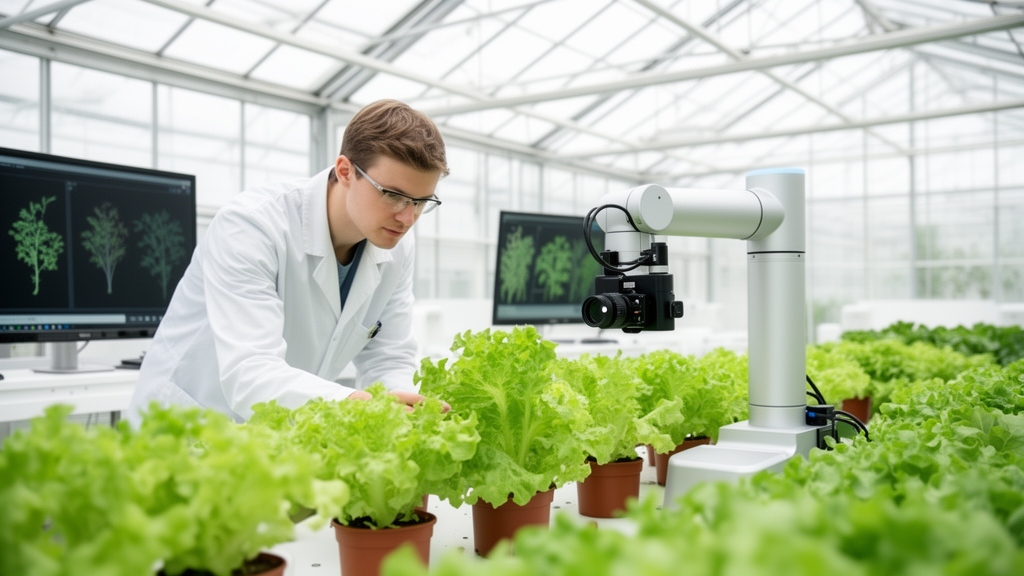
Imaging-based phenotyping of leafy green crops has advanced rapidly in its ability to observe plants, but a new scoping review concludes that the field remains far stronger at measuring than at interpreting or acting on what it measures. The review, published in Smart Agricultural Technology, analyzed 59 peer-reviewed studies published between 2020 and 2025 that applied RGB, multispectral, hyperspectral, thermal, fluorescence, three-dimensional, LiDAR, and related imaging technologies to leafy green crops such as lettuce, spinach, kale, and cabbage.
The authors, following the PRISMA Extension for Scoping Reviews guidelines, searched the Web of Science Core Collection and Scopus databases, initially in December 2025 and again in an updated search on June 13, 2026. From 203 records retrieved in the updated search, 78 duplicates were removed, and successive screening stages narrowed the pool to 59 included studies. Screening, data extraction, and thematic coding were performed by a single reviewer, a limitation the authors acknowledge, along with the restriction to English-language articles and two bibliographic databases.
The research landscape that emerges is heavily concentrated. China led with 21 publications, or 35.6 percent of the total, followed by the United States with 10 publications, or 16.9 percent. South Korea, Brazil, and the Netherlands each contributed four studies. Crop representation is even narrower: of 61 crop representations across the 59 studies, lettuce accounted for 43, or 70.5 percent, with cabbage at 18.0 percent and spinach at just 4.9 percent. The authors note that more than one million hectares are cultivated for lettuce globally each year, but they caution that most algorithms and methods have been developed and validated in a single species, so transferability across other leafy greens remains unproven.
Publication activity fluctuated considerably across the review period. Only one study appeared in 2020, rising to eight in 2021 and fourteen in 2022, then dipping to nine in 2023 and seven in 2024 before climbing sharply to twenty in 2025. Greenhouses were the most common research environment, hosting 22 of the 56 studies with classifiable growing environments, followed by open-field settings with 15, growth chambers with 8, controlled-environment agriculture or indoor farming systems with 6, and laboratories with 5. Imaging contexts were roughly balanced between in situ acquisition directly from growing plants, at 27 studies, and facility-based platforms requiring plant transfer, at 24.
The review classified the studies into four application domains: 22 addressed growth and development monitoring, 9 focused on stress detection and stress response phenotyping, 11 examined nutrient, pigment, and physiological status assessment, and 17 supported breeding and genetic phenotyping. In growth monitoring, the authors found a striking emphasis on multidimensional plant representation. Two-dimensional canopy geometry appeared in 8 core studies and three-dimensional reconstructions using point clouds, voxel models, and spatial reconstruction also appeared in 8, while simple linear measurements such as plant height and leaf length appeared in only 5. A single three-dimensional model can simultaneously yield dimensional traits, reconstructed leaf area, plant volume, surface area, and structural metrics derived from convex hulls, voxels, and point cloud distributions.
Temporal monitoring showed a similar sophistication. Among 17 core growth phenotyping studies, longitudinal and high-frequency longitudinal monitoring each accounted for 35 percent, meaning roughly 70 percent tracked plants repeatedly through the growth cycle, while snapshot monitoring appeared in only 24 percent and multi-stage monitoring in a single study. Yet this observational richness rarely translated into practical use. Fifty-nine percent of growth studies remained measurement-oriented, 35 percent used traits to explain biological processes, only 6 percent reached diagnostic application, and none achieved operational-oriented status in which phenotypic information guides actual crop management decisions such as irrigation scheduling or harvest timing.
Stress phenotyping revealed comparable constraints. Only nine of the 59 studies addressed stress at all, with a heavy bias toward water-related stress, sometimes combined with nitrogen deficiency. Salinity, biotic stress, and pollution from polyethylene nanoplastics were each examined in just one study. Most experiments used binary designs comparing control and stressed plants, and no study explicitly examined interactions among multiple stress factors. The authors argue that such simplified scenarios fail to reflect production environments, where multiple stresses occur simultaneously and stress intensity develops as a continuum rather than a discrete state. Moreover, most studies characterized plant responses to imposed stress rather than inferring stress conditions from phenotypic information, leaving a conceptual gap between observation and inference.
In nutrient, pigment, and physiological assessment, imaging demonstrated remarkable breadth, estimating chlorophyll through Dynamic NDVI and LPCNet, anthocyanin through fluorescence and reflectance indices, nitrogen and other nutrients through PLSR regression, Vision Transformer and ResNet models, and multimodal feature fusion, and physiological parameters such as ΦPSII and Fv/Fm through PAM fluorescence. However, seven of the eleven studies in this domain relied on snapshot measurements at a single time point, and seven remained at the trait measurement level, with none reaching systems understanding or decision support. In breeding, comparative evaluation of genotypes dominated, while selection support and genetic discovery applications, such as predicting water-use efficiency in spinach or mapping loci for stress responses in lettuce through GWAS, remained comparatively rare.
The cross-domain synthesis identifies integration as the field’s central challenge. Structural, biochemical, physiological, and genetic information layers are still largely investigated independently, with few studies combining growth, stress response, physiological status, and genetic variation into unified frameworks. The authors propose future directions toward more realistic multi-stress phenotyping, biologically explainable models that connect optical signals to underlying mechanisms, operational systems that translate phenotypic data into management recommendations, and ultimately integrated digital crop phenotypes that continuously update plant representations. They conclude that the future of the field will depend less on new sensors or incremental algorithmic gains than on developing phenotyping systems that are realistic, explainable, operationally relevant, and integrated into coherent digital representations of plants.
Subject of Research: A scoping review of imaging-based plant phenotyping research in leafy green crops published between 2020 and 2025.
Article Title: Imaging-based phenotyping in leafy greens: a scoping review of progress, cross-domain insights, and emerging challenges
Article References: Zamzami, A., Wang, W., Di Gioia, F., Irmak, S., He, L., & Ghatrehsamani, S. (2026). Imaging-based phenotyping in leafy greens: a scoping review of progress, cross-domain insights, and emerging challenges. Smart Agricultural Technology, 15, Article 102672. https://doi.org/10.1016/j.atech.2026.102672
Image Credits: AI Generated
DOI: 10.1016/j.atech.2026.102672
Keywords: plant phenotyping, leafy greens, imaging, hyperspectral imaging, lettuce, high-throughput phenotyping, controlled-environment agriculture, machine learning, plant breeding, stress detection, scoping review, horticulture
Cite Scienmag News
Alan Morgan. (October 29, 2026). Leafy Green Phenotyping Review Finds Imaging Outpaces Insight. Scienmag. https://scienmag.com/leafy-green-phenotyping-review-finds-imaging-outpaces-insight/
Alan Morgan. "Leafy Green Phenotyping Review Finds Imaging Outpaces Insight." Scienmag, 29 October 2026, https://scienmag.com/leafy-green-phenotyping-review-finds-imaging-outpaces-insight/. Accessed 2 November 2026.
Alan Morgan. "Leafy Green Phenotyping Review Finds Imaging Outpaces Insight." Scienmag. October 29, 2026. https://scienmag.com/leafy-green-phenotyping-review-finds-imaging-outpaces-insight/









