


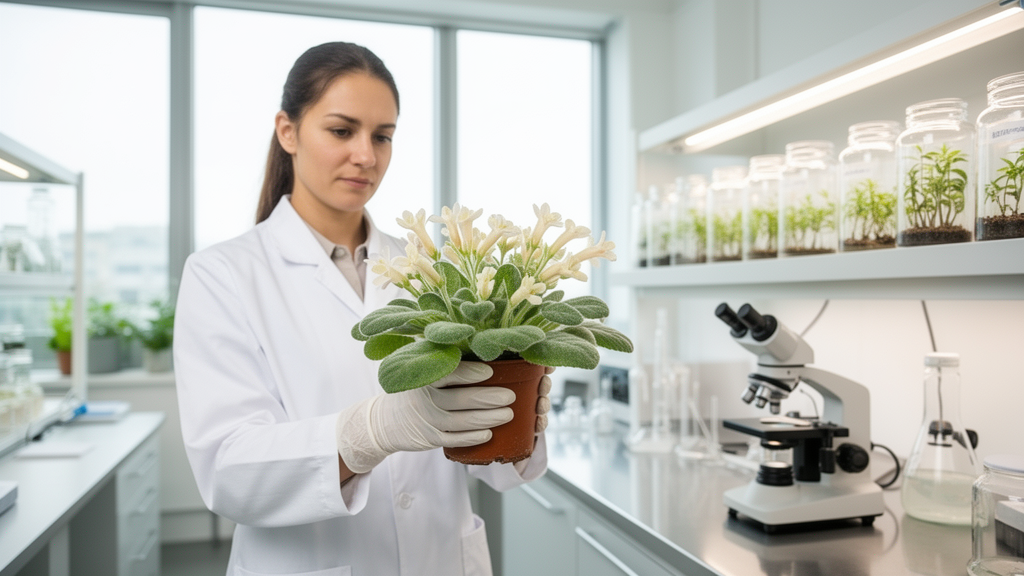
A laboratory comparison found that methanolic extracts of the Balkan endemic plant Stachys thracica Davidov, commonly called Thracian woundwort, inhibited four of 11 tested microorganisms. Activity was most consistent against Acinetobacter calcoaceticus: extracts from wild, in vitro-cultivated and field-adapted plants each produced an inhibition zone of 8 mm and a minimum inhibitory concentration of 8 mg/ml. The study tested plant extracts in vitro and did not assess clinical efficacy, safety or medical applications in people or animals.
The researchers compared extracts prepared from aboveground material collected from plants growing in their natural habitat near Sinemorets, Bulgaria, plants maintained in vitro, and plants adapted to an experimental field. The extracts did not show a clear overall relationship between cultivation setting and antimicrobial activity. Instead, their patterns of inhibition varied among microbial strains, with no consistent activity advantage associated with any one source of plant material.
To establish an in vitro collection, the team sterilized ripe, dried seeds with 70% ethanol for five minutes, placed them on a water-and-agar germination medium and transferred sprouting seedlings to Murashige and Skoog medium supplemented with 3% sucrose and 0.7% agar but no growth regulators. Cultures were maintained under controlled conditions with 16 hours of light and eight hours of darkness, a photosynthetic photon flux density of 60 mmol/(m²s), a temperature of 25 °C and 60–70% relative humidity.
Regenerated plants developed abundant leaf biomass and well-developed roots, permitting acclimation in three stages: one month in a phytotron chamber, one month in a greenhouse and subsequent planting at the experimental field of Sofia University “St. Kliment Ohridski.” Plants maintained at that site had an observed survival rate of 83%. This demonstrates that the researchers could multiply the species in vitro and transfer regenerated plants to an outdoor experimental site, although the study did not directly measure long-term persistence, genetic diversity, population-level performance or conservation of the species in the wild.
For antimicrobial testing, the investigators finely powdered three grams of dried aboveground material from each of the three plant sources. After triple sonication with chloroform, the biomass was extracted three times with methanol for 30 minutes. The resulting extracts were concentrated in a vacuum evaporator and dried to constant weight. Reported yields were 13.8% for wild material, 28.46% for in vitro material and 13.6% for field-adapted material. Each dried extract was dissolved in 5% dimethyl sulfoxide; the study did not establish whether the higher yield from in vitro material reflected increased production of antimicrobial compounds.
The extracts were tested against seven Gram-negative bacterial strains—Pseudomonas aeruginosa, Proteus mirabilis, Proteus hauseri, Enterobacter cloacae, Acinetobacter calcoaceticus, Escherichia coli and Klebsiella pneumoniae—three Gram-positive strains—Staphylococcus aureus, Staphylococcus epidermidis and Enterococcus faecalis—and the yeast Candida albicans. The bacteria were cultured overnight on Mueller-Hinton agar, while the yeast was cultured on Sabouraud dextrose agar. Initial screening used paper disks containing 8 mg of extract. Tetracycline and amikacin were positive controls for bacteria, nystatin was the positive control for C. albicans, and 5% dimethyl sulfoxide served as a negative control.
Plates were incubated for 24 hours for bacteria and 48 hours for the yeast, and inhibition zones were measured. Bacterial strains that appeared sensitive in this screen were then examined by micro-well dilution to determine minimum inhibitory concentrations. Extract concentrations ranged from 64 to 2 mg/ml before bacterial suspensions were added. Across the three plant sources, activity was detected against four tested organisms: A. calcoaceticus, K. pneumoniae, P. mirabilis and E. faecalis.
All three extracts inhibited A. calcoaceticus with minimum inhibitory concentrations of 8 mg/ml. The highest reported minimum inhibitory concentration was 16 mg/ml against K. pneumoniae, for which the smallest inhibition zone was 7 mm. P. aeruginosa produced zones described as bacteriostatic in the disk-diffusion assay, but activity was not detected in the microdilution assay. No extract showed activity against C. albicans. Overall, the extracts tended to be more active against Gram-negative than Gram-positive bacteria, although most tested strains were resistant to one or more extracts and the results did not establish a consistent advantage associated with a particular cultivation method.
The findings support the use of in vitro propagation and field acclimation as an experimental approach for maintaining this rare species while studying its biological activity. However, the evidence is limited to laboratory testing of methanolic extracts and the establishment of propagated plants; it does not establish therapeutic benefit in humans or animals, safety, or effectiveness as a conservation measure over long periods. The authors concluded that analysis of the plant’s chemical profile would be needed to determine which compounds were associated with the measured antimicrobial activity.
Subject of Research: Laboratory comparison of antimicrobial activity in Stachys thracica extracts from three cultivation settings
Article Title: Comparative determination of antimicrobial activity of the Balkan endemic species Stachys thracica Davidov during the process of ex situ conservation
Article References: Mantovska, D., Petrova, D., Yocheva, L., & Yordanova, Z. (2022). Comparative determination of antimicrobial activity of the Balkan endemic species Stachys thracica Davidov during the process of ex situ conservation. BioRisk, 17, 357-365. https://doi.org/10.3897/biorisk.17.77484
Image Credits: AI Generated
Keywords: Stachys thracica, Thracian woundwort, antimicrobial activity, plant extracts, in vitro propagation, ex situ conservation, Acinetobacter calcoaceticus, Gram-negative bacteria, microdilution assay, Comparative, determination, antimicrobial
Cite Scienmag News
Morgan Morrow. (October 20, 2026). Laboratory study finds limited antimicrobial activity in Thracian woundwort extracts. Scienmag. https://scienmag.com/laboratory-study-finds-limited-antimicrobial-activity-in-thracian-woundwort-extracts/
Morgan Morrow. "Laboratory study finds limited antimicrobial activity in Thracian woundwort extracts." Scienmag, 20 October 2026, https://scienmag.com/laboratory-study-finds-limited-antimicrobial-activity-in-thracian-woundwort-extracts/. Accessed 20 October 2026.
Morgan Morrow. "Laboratory study finds limited antimicrobial activity in Thracian woundwort extracts." Scienmag. October 20, 2026. https://scienmag.com/laboratory-study-finds-limited-antimicrobial-activity-in-thracian-woundwort-extracts/


