


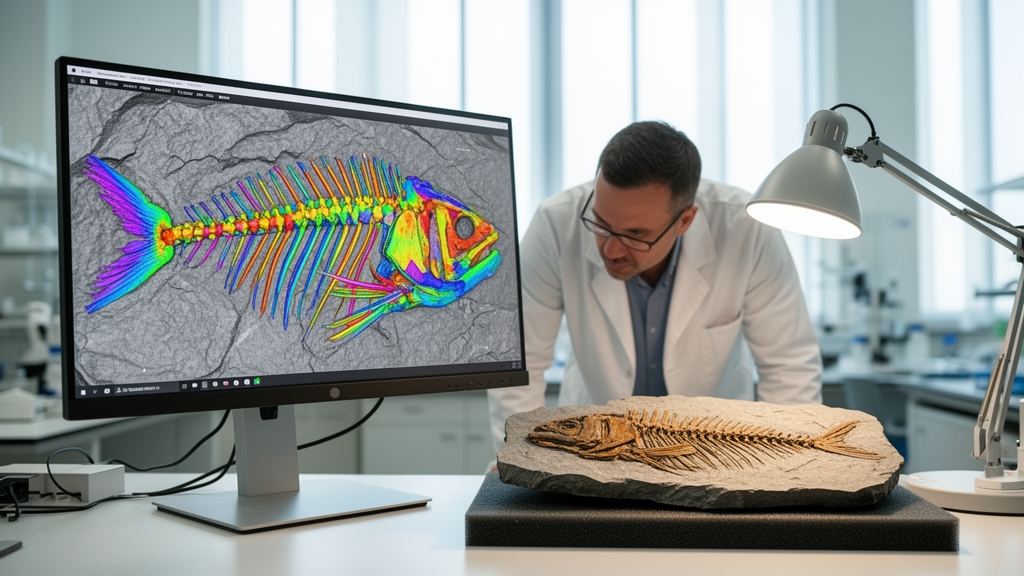
Researchers developed and evaluated ml4paleo, an open-source software suite and online service for segmenting large synchrotron X-ray tomography volumes of fossils. In leave-one-out cross-validation using two-dimensional slice training, its default random-forest classifier performed best on the high-contrast Burrow dataset, with an F1 score of 0.777 ± 0.129, but produced substantially weaker results on lower-contrast and lower-resolution fossil scans.
The software evaluation used five public datasets from the ESRF Palaeontology database, covering different fossil types, scan resolutions and imaging conditions. The tests included complete Thrinaxodon and Broomistega skeletons from the Early Triassic Karoo Basin of South Africa, scanned at 45.5 µm resolution; a Middle Triassic Nothosaurus marchicus skull from the Netherlands, scanned at 12.82 µm; two Late Cretaceous paddlefish, Parapsephurus willybemisi, scans from North Dakota, at 45.53 and 13.67 µm; and an Early Cretaceous squamate embryo from an egg at Phu Phok, Thailand, scanned at 5.06 µm.
X-ray tomography can reveal anatomy concealed by surrounding matrix without physically preparing the specimen, but the resulting three-dimensional volumes demand substantial storage and computing resources. Manual segmentation and modelling can take months or years, and some projects remain unfinished. The ml4paleo package combines traditional machine-learning tools, neural image-segmentation options and batch processing. Its web interface supports machine-guided annotation of two-dimensional slices, while a conversion queue reorganises large image stacks into chunked volumes that can be processed without loading complete datasets into memory.
Workers apply a trained model to subvolumes, save segmentation masks and optionally produce OBJ or STL meshes for rendering in three-dimensional software. The package uses the Zarr format for chunked storage and lazy loading. Its default algorithm is a random forest trained on heuristic pixel features such as texture, intensity and edge information; by default, 50% of available annotated pixels are sampled during training. A convolutional residual U-Net is also available, although efficient training of that model requires a GPU. The interfaces are designed so that other specialised algorithms can be added.
One palaeontological segmentation expert initially annotated 20 slices from each dataset. The Nothosaurus and Phu Phok Egg volumes required 10 additional annotated slices and model retraining, followed by a final five slices, giving 35 annotations for each. A saved model could generate a proposed segmentation for subsequent annotation tasks, allowing the annotator to correct an existing mask with a brush or eraser rather than begin from scratch. The authors reported that replacing the default random forest with a neural model resolved many failures in the two difficult datasets, at the cost of additional execution time and GPU requirements.
On the Burrow dataset, which had relatively clear contrast between fossil and matrix, the random-forest model achieved precision of 0.861 ± 0.142, recall of 0.726 ± 0.154 and F1 score of 0.777 ± 0.129. Accuracy was 0.982 and the Jaccard index was 0.759, indicating substantial overlap between predicted and expert-annotated masks. These results came from sampled slices and five datasets, rather than from every fossil scan.
Performance varied for the paddlefish. At 13.67 µm, precision was 0.583 ± 0.298, recall was 0.492 ± 0.278 and F1 score was 0.488 ± 0.257; visual inspection indicated that the model generally captured gross morphology but did not correctly segment internal bone volumes. At 45.53 µm, precision was 0.718 ± 0.427, recall was 0.191 ± 0.187 and F1 score was 0.185 ± 0.181. Accuracy was 0.979, although the model tended to confuse bone with other bright objects and captured relatively little of the fossil.
The Nothosaurus dataset produced precision of 0.602 ± 0.227, recall of 0.496 ± 0.264 and F1 score of 0.522 ± 0.24. The authors linked the weaker result to the low-contrast texture and a crack through the skull that affected phase contrast. The Phu Phok Egg dataset was the most difficult for the default model: precision was 0.401 ± 0.295, recall was 0.020 ± 0.014 and F1 score was 0.035 ± 0.027. Visual assessment showed poor segmentation, with the model interpreting some high-phase-contrast edges as bone. Additional annotation increased Phu Phok precision from 0.232 at 20 slices to 0.401 at 35 slices, while recall changed from 0.06 to 0.02.
The comparisons also documented the time required for manual segmentation: more than six weeks of full-time work for the Nothosaurus, approximately eight weeks for the Phu Phok Egg and two weeks for the paddlefish scans. The Burrow volume was segmented relatively quickly using simple intensity thresholding. The authors present ml4paleo as an accessible option for groups without commercial software, but the evaluation showed that its default model was not equally suited to every specimen, especially where contrast, texture or resolution limited distinguishability. The code is released under the Apache 2.0 licence, the tested datasets are available through the ESRF Palaeontology database, and a public version of the service is available at ml4paleo.com.
Subject of Research: Evaluation of an open-source machine-learning pipeline for segmenting synchrotron X-ray tomography volumes of fossils
Article Title: Automated segmentation of synchrotron-scanned fossils
Article References: During, M. A. D., Matelsky, J. K., Gustafsson, F. K., Voeten, D. F. A. E., Chen, D., Wester, B. A., Kording, K. P., Ahlberg, P. E., & Schön, T. B. (2025). Automated segmentation of synchrotron-scanned fossils. Fossil Record, 28(1), 103-114. https://doi.org/10.3897/fr.28.139379
Image Credits: AI Generated
DOI: 10.3897/fr.28.139379
Keywords: fossil imaging, synchrotron tomography, image segmentation, machine learning, palaeontology, open-source software, X-ray tomography, 3D modelling, Automated, segmentation, synchrotron-scanned, fossils
Cite Scienmag News
Teresa Odom. (October 20, 2026). Open-source software evaluation finds variable fossil-segmentation performance across five synchrotron tomography datasets. Scienmag. https://scienmag.com/open-source-software-evaluation-finds-variable-fossil-segmentation-performance-across-five-synchrotron-tomography-datasets/
Teresa Odom. "Open-source software evaluation finds variable fossil-segmentation performance across five synchrotron tomography datasets." Scienmag, 20 October 2026, https://scienmag.com/open-source-software-evaluation-finds-variable-fossil-segmentation-performance-across-five-synchrotron-tomography-datasets/. Accessed 20 October 2026.
Teresa Odom. "Open-source software evaluation finds variable fossil-segmentation performance across five synchrotron tomography datasets." Scienmag. October 20, 2026. https://scienmag.com/open-source-software-evaluation-finds-variable-fossil-segmentation-performance-across-five-synchrotron-tomography-datasets/


