


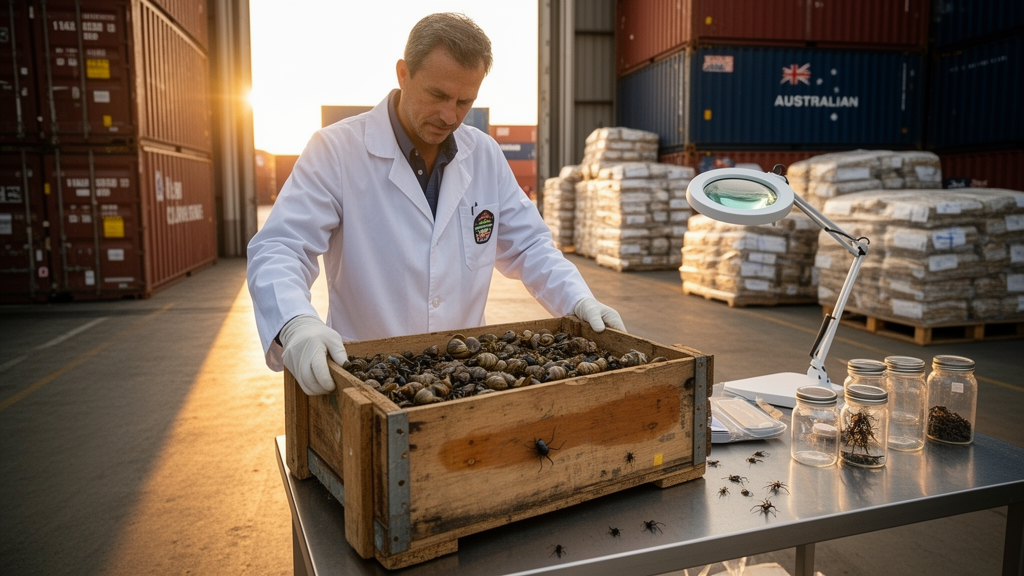
A national observational analysis of Australian border records identified 2,414 terrestrial invertebrate species among 178,887 unique taxon-incident combinations recorded from 1 January 2016 through 26 September 2024. The study found continued additions to the recorded species and genus diversity, with rarefaction curves that did not reach an asymptotic plateau even when extrapolated to twice the observed sampling effort.
The authors described the work as the first national, cross-taxonomic assessment of terrestrial invertebrate interceptions. It examined records obtained from the Australian Department of Agriculture, Fisheries and Forestry incident database for specimens intercepted at national air and sea ports of entry and quarantine facilities. Each record included the date and location of interception, source country, transport and movement vectors, associated commodity and the finest available taxonomic identification.
For analyses of transport pathways, the researchers combined the interception data with monthly international passenger, mail and air-freight figures and quarterly sea-freight figures for 2018–2024. They used Spearman rank correlations to assess monotonic associations and negative binomial generalized linear models to examine relationships among interceptions, intercepted species richness and globally described species richness. Intercepted taxa were also compared with Australia’s National Priority List of Exotic Environmental Pests, Weeds and Diseases and the National Priority Plant Pest List.
Interceptions reached their highest annual level in 2019, with 26,650 records, and fell to 15,395 in 2021 before increasing in later years. This decline coincided with Australia’s closure of its international border to travellers in March 2020 and pandemic-related restrictions, but the records alone cannot establish the cause. Cargo accounted for 79.3% of interceptions, followed by travellers at 12.6%, vessels at 4.7% and mail at 3.3%. Air was the main transport vector overall at 56.4%, compared with 38.4% by sea, while sea transport predominated during 2020–2022.
Incoming passenger numbers had a moderately strong positive association with interception frequency, with a Spearman coefficient of 0.66. The association was weaker for mail volume, at 0.35, while the analysis found no evidence of an association with air-freight volume, at 0.02, or sea-freight volume, at −0.14. Inspection effort, risk-based targeting, commodity types and the likelihood that organisms hitchhiked with particular goods or transport vessels could also have influenced these relationships. The data therefore identify associations with passenger volume rather than demonstrating that passenger arrivals caused the rise in interceptions.
Only 40.5% of the 178,887 records were identified to species level. Of the 2,414 species recorded, 46% were intercepted once, while 108 species—4.5% of the total—accounted for 32% of all interceptions. The fauna spanned five phyla: Annelida, Arthropoda, Mollusca, Nematoda and Platyhelminthes. Insects were the most abundant group, followed by arachnids and gastropods. Rarefaction indicated that family accumulation had begun to level off and class accumulation had reached an asymptotic plateau, unlike the continuing accumulation of species and genera.
Plant products were associated with 117,401 interceptions, or 61.5% of the dataset, and with 1,318 identified species. Of those plant-product records, 110,154 involved fresh products and 7,247 involved dried products. Wood products were associated with 15,283 interceptions and 563 species, while animal products were associated with 6,435 interceptions and 279 species. Species-accumulation curves for all three commodity groups continued without plateauing in the reported extrapolation, indicating continued detection of taxa, although heightened scrutiny of products considered high risk may have affected detection rates.
Twelve intercepted species appeared on the National Priority List of Exotic Environmental Pests, Weeds and Diseases, including six in its higher-risk category for species not established in Australia. The most frequently intercepted higher-risk species were the multicoloured Asian lady beetle, Harmonia axyridis, with 109 records; the red imported fire ant, Solenopsis invicta, with 36; and the Formosan subterranean termite, Coptotermes formosanus, with 17. Among taxa on the National Priority Plant Pest List, the brown marmorated stink bug had 476 interceptions, followed by Erthesina fullo with 202, Trogoderma granarium with 119 and Lissachatina fulica with 100.
The records also included eight live non-native arachnids intercepted alongside four live non-native reptiles. These consignments were labelled as live animals without a declared commodity. Because the animals are documented in the international exotic-pet trade, deliberate trafficking was a possible explanation, but the dataset could not distinguish trafficked animals from hitchhikers or establish that the consignments were illegal.
Important limitations constrain interpretation of the observational results. Import volumes were unavailable for individual commodities, inspection protocols and comprehensive sampling effort were not provided, and only 40.5% of records had species-level identifications. Damaged specimens, differences among life stages and sexes, variation in inspection methods among ports and missing commodity information also limited analysis. The authors recommended standardising taxonomy through a national backbone, reporting sampling effort and negative inspections, integrating interception data with wildlife-trade and enforcement records, and continued investment in taxonomic expertise, training, reference libraries, DNA barcoding and environmental DNA methods.
Subject of Research: Observational assessment of terrestrial invertebrate border interceptions in Australia from 2016 to 2024
Article Title: Invertebrate interceptions at Australia's borders: a nine-year assessment of trends and biosecurity challenges
Article References: Lassaline, C. R., Toomes, A., Fagan-Jeffries, E. P., & Cassey, P. (2026). Invertebrate interceptions at Australia's borders: a nine-year assessment of trends and biosecurity challenges. NeoBiota, 106, 161-189. https://doi.org/10.3897/neobiota.106.165823
Image Credits: AI Generated
DOI: 10.3897/neobiota.106.165823
Keywords: terrestrial invertebrates, border interceptions, Australian biosecurity, international trade, non-native species, cargo pathways, taxonomic diversity, passenger travel, priority pests, exotic pet trade, Invertebrate, interceptions
Cite Scienmag News
Margaret Porter. (October 20, 2026). Nine-year observational analysis maps 178,887 terrestrial invertebrate interceptions at Australian borders. Scienmag. https://scienmag.com/nine-year-observational-analysis-maps-178887-terrestrial-invertebrate-interceptions-at-australian-borders/
Margaret Porter. "Nine-year observational analysis maps 178,887 terrestrial invertebrate interceptions at Australian borders." Scienmag, 20 October 2026, https://scienmag.com/nine-year-observational-analysis-maps-178887-terrestrial-invertebrate-interceptions-at-australian-borders/. Accessed 20 October 2026.
Margaret Porter. "Nine-year observational analysis maps 178,887 terrestrial invertebrate interceptions at Australian borders." Scienmag. October 20, 2026. https://scienmag.com/nine-year-observational-analysis-maps-178887-terrestrial-invertebrate-interceptions-at-australian-borders/


