


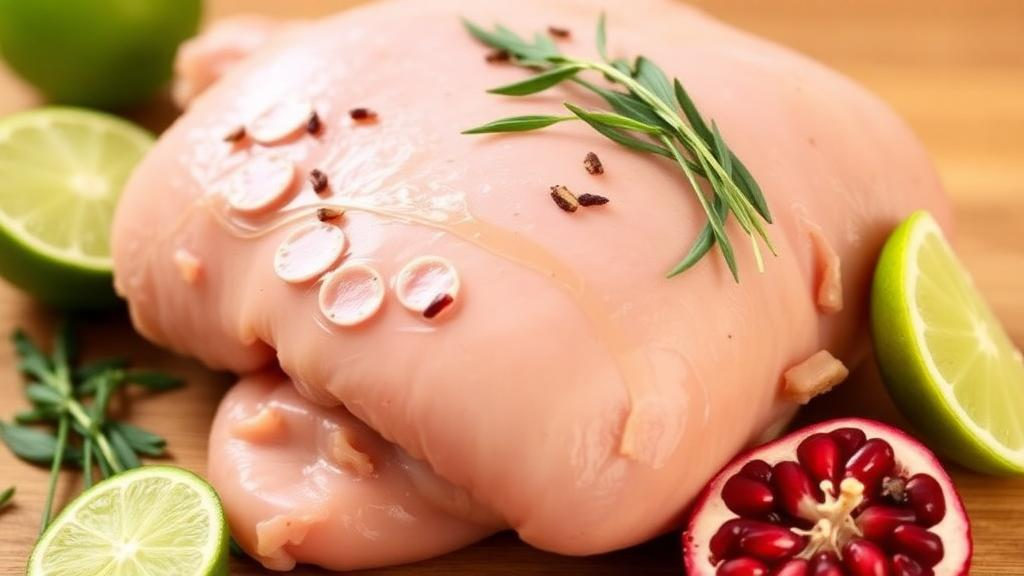
Chicken breast is one of the world’s most popular proteins, but it is also one of the most perishable foods on the shelf. Freshly slaughtered chicken stored at 4 degrees Celsius typically lasts only four to six days before spoilage sets in, driven by a natural microbiota rich in spoilage organisms and a fat profile high in oxidation-prone unsaturated fatty acids. Among the pathogens that complicate this picture, Salmonella enterica serovar Enteritidis stands out as one of the most frequently reported foodborne threats in poultry products, and the industry has long struggled to inactivate it without damaging the meat’s nutritional and sensory appeal. Now, a team of researchers in South Korea has tested whether three humble kitchen ingredients—chive juice, pomegranate juice, and lime juice—could do double duty as natural preservatives, simultaneously curbing Salmonella growth and slowing the chemical decay that makes refrigerated chicken unappetizing.
The study, published in Food Science of Animal Resources, was led by Joko Sujiwo and Aera Jang of Kangwon National University together with colleagues from the National Institute of Animal Science and Seoul National University. The researchers pressed fresh chives (Allium tuberosum Rottler), pomegranates (Punica granatum), and limes (Citrus aurantifolia) purchased from a commercial market in Chuncheon, Korea, collected only the liquid fraction, and then freeze-dried—lyophilized—each juice to create a stable powder. The lyophilization yields varied considerably: 4.71 percent by weight for chive juice, 11.53 percent for pomegranate juice, and 9.50 percent for lime juice. These powders were then reconstituted for laboratory assays and dissolved in water at low concentrations for direct application to meat, a format the authors argue could eventually fit cleanly into existing poultry dipping and marination processes.
The first question was how well each juice could stop Salmonella Enteritidis on its own. In paper disc diffusion tests, chive juice showed no inhibition at 2.5 or 5 milligrams per disc but produced a moderate 10.44-millimeter zone of inhibition at 10 milligrams per disc, slightly exceeding the streptomycin positive control. Pomegranate juice behaved similarly, reaching 10.11 millimeters only at the highest dose. Lime juice was the clear standout, generating inhibition zones of 11.11 millimeters at 5 milligrams per disc and 12.67 millimeters at 10 milligrams per disc—significantly larger than the antibiotic control. Using broth microdilution, the team determined minimum inhibitory concentrations (MIC) and minimum bactericidal concentrations (MBC). Lime juice again led with an MIC of just 50 milligrams per milliliter, while chive and lime juices both achieved bactericidal activity at 100 milligrams per milliliter. Pomegranate juice required 200 milligrams per milliliter for both endpoints, marking it as the weakest direct antimicrobial of the three.
Antioxidant capacity told a different story. In the DPPH radical scavenging assay, pomegranate juice was the most potent, with the lowest IC50 value of 2.17 milligrams per milliliter, followed by lime (4.91) and chive (7.96). The ABTS assay confirmed the same ranking, with pomegranate again on top at 4.08 milligrams per milliliter. The researchers attribute pomegranate’s radical-scavenging prowess to its dense polyphenol content, particularly punicalagin, alongside anthocyanins and ellagitannins. Lime juice, however, dominated the ferric reducing antioxidant power (FRAP) assay with an EC50 of just 0.68 milligrams per milliliter, far outperforming both chive (2.62) and pomegranate (2.65), suggesting an exceptional ability to donate electrons and reduce ferric ions. Chive juice, despite its organosulfur chemistry, showed the weakest antioxidant activity across all four assays, which also included the oxygen radical absorbance capacity (ORAC) test.
With the laboratory profiles in hand, the team moved to the meat itself. Fresh, skinless chicken breasts were obtained from a local slaughterhouse, artificially inoculated with Salmonella Enteritidis at 6 to 7 Log CFU per milliliter, and then dipped for 15 minutes in either distilled water (the control) or a 1 percent aqueous solution of one of the three lyophilized juices. The 1 percent concentration was a deliberate compromise: preliminary trials showed that higher levels—3 and 5 percent—produced greenish hues from chive juice, excessive redness from pomegranate, surface sliminess, and lingering odors that would undermine consumer acceptance. Sixty samples were assigned across four treatment groups, with biological replicates from different carcasses analyzed on storage days 0, 3, 5, 7, and 9 at 4 degrees Celsius, spanning the typical chilled shelf life of poultry.
The pH results revealed a subtle but consistent preservative effect. All samples began around pH 6, but the control climbed steadily to 6.68 by day 9—a threshold the authors note marks the onset of detectable deterioration, since pH values above roughly 6.20 signal alkalinization from ammonia produced by Enterobacteriaceae and other spoilage microbes. From day 5 onward, all three juice treatments maintained significantly lower pH values than the control. Pomegranate-treated meat stayed lowest throughout, ending at 6.31, while lime-treated samples also held pH down effectively. The mechanism is straightforward: pomegranate and lime are rich in citric and malic acids, and acidic conditions collapse the proton motive force bacteria rely on for energy production, denature key enzymes such as ATPase and DNA polymerase, and disrupt membrane integrity by interacting with phospholipids, causing leakage of cellular contents.
Microbial counts told a more nuanced story. Total aerobic bacteria started at 5.50 to 5.57 Log CFU per gram and rose in all samples, but chive- and lime-treated meat carried significantly lower counts than the control on days 3, 5, 7, and 9. For Salmonella specifically, the differences emerged later: on day 5, chive-treated samples recorded 5.16 Log CFU per gram versus 5.46 in the control, and by days 7 and 9 all three juice treatments showed significantly reduced pathogen populations compared with untreated meat. The magnitude was modest—the largest reductions were 0.36 Log CFU per gram—which the authors attribute to the low 1 percent concentration and the use of crude, single-batch juices. Even so, they caution that treated samples approached the Korean regulatory limit of 6.70 Log CFU per gram for total aerobic bacteria by day 3, meaning the juices delay but do not eliminate the need for other preservation measures.
Chemical freshness indicators reinforced the quality benefits. Volatile basic nitrogen (VBN), a marker of protein breakdown by microbial and enzymatic activity, was significantly lower in all treated samples from day 5 to 9, with chive-treated meat leading at 25.09 milligrams per 100 grams on day 7, followed by pomegranate (26.84) and lime (28.28). Lipid oxidation, tracked by thiobarbituric acid reactive substances (TBARS), rose more slowly in treated meat: lime-treated samples delayed significant TBARS increases until day 7, compared with day 3 in the control, and finished at 0.18 milligrams of malondialdehyde per kilogram versus 0.21 in the control—well below the 0.4 to 1.0 range generally considered acceptable. The underlying chemistry is elegant: chive allyl sulfides donate hydrogen atoms to interrupt lipid peroxidation chain reactions and chelate pro-oxidant metals, while lime’s citric acid binds metal ions and its ascorbic acid regenerates other antioxidants.
Color and texture rounded out the quality picture. Lime juice proved the best guardian of appearance, maintaining lightness (CIE L*) values until day 7, an effect the researchers link to D-limonene and beta-pinene and to its inhibition of the lipid oxidation that drives discoloration. Chive juice imparted a greenish tint and elevated yellowness, while pomegranate raised redness values—cosmetic trade-offs inherent to using crude, pigmented juices. Water holding capacity and shear force were unaffected by treatment, with tenderness increasing in all samples over storage as myofibrillar proteins degraded. The authors conclude that lime juice, despite its modest direct antimicrobial effect, delivered the most favorable overall package: preserved meat quality, controlled pH, lower lipid oxidation, and no significant color penalty.
The study has clear limitations that the researchers acknowledge candidly. Only a single batch of each juice was prepared, only one strain of Salmonella Enteritidis was tested, and no sensory evaluation was possible because the meat was deliberately pathogen-contaminated. Future work, they suggest, should use multi-strain inocula, purified or concentrated extracts that pack more bioactive compounds without altering appearance, and pilot-scale trials to standardize coverage. They also point toward encapsulation and freeze-drying as scalable techniques for stabilizing the bioactives, and toward sourcing extracts from low-cost agricultural by-products to make the economics work against synthetic preservatives. For now, the message is intriguingly simple: the same juices that brighten a salad or flavor a marinade carry measurable antimicrobial and antioxidant chemistry, and with the right formulation they could become legitimate tools in the clean-label fight to keep chicken safe and fresh for longer.
Subject of Research: Natural plant juice preservatives for controlling Salmonella Enteritidis and preserving quality in refrigerated chicken breast
Article Title: Effect of the chives, pomegranate, and lime juices on the meat quality and microbial reduction of chicken breast inoculated with Salmonella Enteritidis
Article References: Sujiwo, J., Kim, H.-J., Kim, H.-J., & Jang, A. (2026). Effect of the chives, pomegranate, and lime juices on the meat quality and microbial reduction of chicken breast inoculated with Salmonella Enteritidis. Food Science of Animal Resources, 46(1), Article 62. https://doi.org/10.1007/s44463-025-00019-8
Image Credits: AI Generated
DOI: 10.1007/s44463-025-00019-8
Keywords: chicken breast, Salmonella Enteritidis, lime juice, chive juice, pomegranate juice, natural preservatives, antimicrobial activity, antioxidant, meat quality, shelf life, lipid oxidation, food safety
Cite Scienmag News
Alan Morgan. (October 3, 2026). Kitchen Juices Take On Salmonella: Lime, Chive, and Pomegranate Extracts Extend Chicken Shelf Life. Scienmag. https://scienmag.com/kitchen-juices-take-on-salmonella-lime-chive-and-pomegranate-extracts-extend-chicken-shelf-life/
Alan Morgan. "Kitchen Juices Take On Salmonella: Lime, Chive, and Pomegranate Extracts Extend Chicken Shelf Life." Scienmag, 3 October 2026, https://scienmag.com/kitchen-juices-take-on-salmonella-lime-chive-and-pomegranate-extracts-extend-chicken-shelf-life/. Accessed 17 October 2026.
Alan Morgan. "Kitchen Juices Take On Salmonella: Lime, Chive, and Pomegranate Extracts Extend Chicken Shelf Life." Scienmag. October 3, 2026. https://scienmag.com/kitchen-juices-take-on-salmonella-lime-chive-and-pomegranate-extracts-extend-chicken-shelf-life/


