


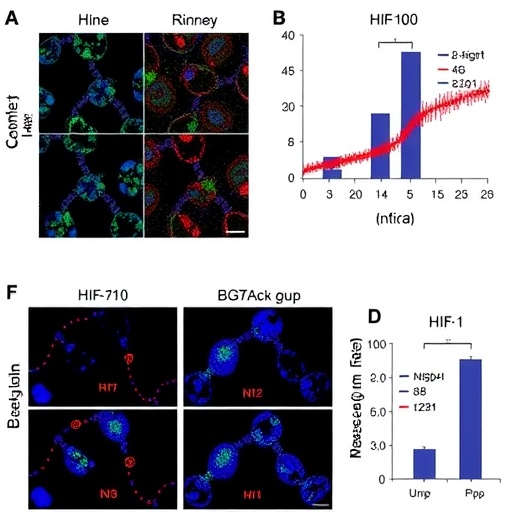
In a groundbreaking study published this April in the British Journal of Cancer, a team of researchers has uncovered a pivotal molecular mechanism that drives clear cell renal cell carcinoma (ccRCC), the most common and aggressive form of kidney cancer. The study reveals that the overexpression of a specific pair of regulatory molecules, ARL10 and miR-1271-5p, is governed by the hypoxia-inducible factor 1-alpha (HIF-1α) within kidney tissues. This discovery not only sheds new light on the complex pathways of kidney cancer progression but also opens promising avenues for targeted therapeutic interventions that could revolutionize treatment strategies for ccRCC patients.
Clear cell renal cell carcinoma is characterized by a distinct pathological hallmark: the accumulation of lipid and glycogen within kidney cells, giving tumors their signature pale appearance. The molecular drivers behind this phenotype and the cancer’s notorious resistance to conventional chemotherapy have long eluded scientists. This new study conducted by Page, Laperrière, Dastous, and colleagues focuses on the hypoxic microenvironment of kidney tumors, which is known to activate HIF-1α—a transcription factor that orchestrates the cellular response to low oxygen levels. HIF-1α has been implicated in various cancer processes, including angiogenesis, metabolism, and survival, but its downstream regulatory effects in ccRCC were incompletely understood until now.
The researchers found that HIF-1α directly stimulates the expression of ARL10, a GTPase associated with intracellular trafficking, and miR-1271-5p, a microRNA involved in post-transcriptional gene silencing. Their study meticulously detailed how these molecules are overexpressed specifically in kidney tissues plagued by ccRCC. Utilizing patient-derived tumor samples and advanced molecular profiling techniques, the team demonstrated that this overexpression is not a generalized cancer phenomenon but tightly linked to the renal hypoxia axis regulated by HIF-1α. This kidney-specific regulation underscores the sophisticated tissue-specific interplay underlying tumor biology.
Delving deeper, the investigation revealed that ARL10 interacts with cellular pathways implicated in vesicle trafficking and membrane dynamics, processes critical to cancer cell survival and proliferation. By promoting vesicular transport, ARL10 might enhance the secretion of pro-tumorigenic factors, supporting tumor expansion and immune evasion. Concurrently, miR-1271-5p was shown to repress a set of tumor-suppressor genes, thereby facilitating a more aggressive cancer phenotype. The combination of these molecular effects suggests a synergistic mechanism by which HIF-1α drives ccRCC progression, coordinating both upregulation of oncogenic pathways and silencing of tumor suppressors.
The implications of these findings stretch beyond basic science. Given the kidney-specific nature of ARL10 and miR-1271-5p overexpression, they represent highly attractive therapeutic targets. The team posits that novel drugs designed to inhibit ARL10 activity or modulate miR-1271-5p levels could selectively impair tumor growth without damaging healthy tissues. This approach contrasts with current therapies that often exert systemic toxicity. The possibility of developing RNA-based therapies to counteract miR-1271-5p’s oncogenic effects is particularly tantalizing, as microRNAs are increasingly recognized as versatile targets in cancer treatment.
Moreover, the study offers new biomarkers for early detection and prognosis. Monitoring ARL10 and miR-1271-5p expression levels in patient biopsies or bodily fluids could enable clinicians to better stratify patients by disease aggressiveness and tailor therapeutic regimens accordingly. This precision medicine angle addresses the pressing need for diagnostic tools that can predict tumor behavior and response to therapy in real-time, improving outcomes while minimizing overtreatment.
Technically, the research leveraged cutting-edge genomics, transcriptomics, and proteomics to untangle the complex regulatory web orchestrated by HIF-1α. Chromatin immunoprecipitation followed by sequencing (ChIP-seq) was pivotal in confirming that HIF-1α directly binds to promoter regions of the ARL10 gene, establishing a causal link. Meanwhile, small RNA sequencing and functional assays elucidated the role of miR-1271-5p in post-transcriptional repression. These advanced methodologies underpin the robustness of the study, showcasing how integrated multi-omics is transforming cancer biology.
The kidney specificity of these molecular changes is a fascinating aspect, suggesting that microenvironmental conditions—particularly hypoxia—are intricately wired to organ-specific cancer pathways. This organotropism observed here reinforces the necessity of studying cancer within the physiological context of its native tissue, rather than relying solely on generic cell lines or animal models. It also hints at the evolutionary adaptations tumors harness to thrive under diverse conditions, a theme that could be relevant to other hypoxia-driven cancers.
While the study focuses keenly on ccRCC, the authors speculate that this HIF-1α/ARL10/miR-1271-5p axis might have parallels in other hypoxia-prone tumors, such as hepatocellular carcinoma or certain subtypes of breast cancer. Future research is needed to explore these possibilities, which could broaden the therapeutic impact of targeting this pathway. Additionally, unraveling how this axis interacts with other well-characterized signaling networks in ccRCC, including the VHL tumor suppressor pathway, might provide a more comprehensive understanding of tumor pathogenesis.
The potential clinical translation of these findings is already underway. The research group is collaborating with pharmaceutical developers to create small molecule inhibitors and oligonucleotide therapeutics aimed at these targets. Early preclinical trials in animal models demonstrate promising efficacy with manageable side effects, setting the stage for eventual human trials. If successful, these innovations could significantly improve the prognosis for ccRCC patients, who currently face limited treatment options and often poor outcomes.
This new paradigm in ccRCC research highlights how dissecting tumor-specific regulatory networks can unearth vulnerabilities that are otherwise masked by cancer’s complexity. The identification of the HIF-1α-dependent ARL10/miR-1271-5p axis as a key driver of kidney tumor biology exemplifies the power of precision oncology. It underscores the importance of targeted molecular investigations in crafting the next generation of cancer therapies.
In conclusion, the elucidation of this kidney-specific HIF-1α regulated mechanism represents a major leap forward in our understanding of ccRCC. By connecting the dots between hypoxia signaling, vesicle trafficking, and microRNA-mediated gene silencing, the study paves the way for innovative diagnostic and treatment strategies. With kidney cancer incidence on the rise globally, advances of this nature provide hope for more effective and less toxic therapies, ultimately aiming to improve survival and quality of life for patients worldwide.
The discovery of the ARL10/miR-1271-5p pathway not only enriches the molecular landscape of renal cancer but also broadens the horizons for oncology research as a whole. It illustrates the intricate ballet of transcription factors, protein regulators, and microRNAs dictating cancer cell fate. As science continues to delve deeper into tumor microenvironments and tissue-specific oncogenic programs, we can anticipate a wave of similarly transformative insights redefining how cancers are diagnosed, monitored, and treated.
The future of ccRCC therapy, illuminated by these findings, embodies the vision of personalized medicine—precisely targeting the molecular aberrations unique to each patient’s tumor. It is a compelling reminder of the extraordinary complexity and adaptability of cancer, yet also of the relentless innovation within biomedical research committed to defeating it.
Page, P.M., Laperrière, T., Dastous, S.A. et al. Kidney-specific HIF-1α-dependent ARL10/miR-1271-5p overexpression in clear cell renal cell carcinoma.
Br J Cancer (2026). https://doi.org/10.1038/s41416-026-03399-w
Cite Scienmag News
Nathaniel Bowman. (April 17, 2026). Kidney-Specific HIF-1α Drives ARL10/miR-1271-5p Overexpression. Scienmag. https://scienmag.com/kidney-specific-hif-1%ce%b1-drives-arl10-mir-1271-5p-overexpression/
Nathaniel Bowman. "Kidney-Specific HIF-1α Drives ARL10/miR-1271-5p Overexpression." Scienmag, 17 April 2026, https://scienmag.com/kidney-specific-hif-1%ce%b1-drives-arl10-mir-1271-5p-overexpression/. Accessed 4 September 2026.
Nathaniel Bowman. "Kidney-Specific HIF-1α Drives ARL10/miR-1271-5p Overexpression." Scienmag. April 17, 2026. https://scienmag.com/kidney-specific-hif-1%ce%b1-drives-arl10-mir-1271-5p-overexpression/


