


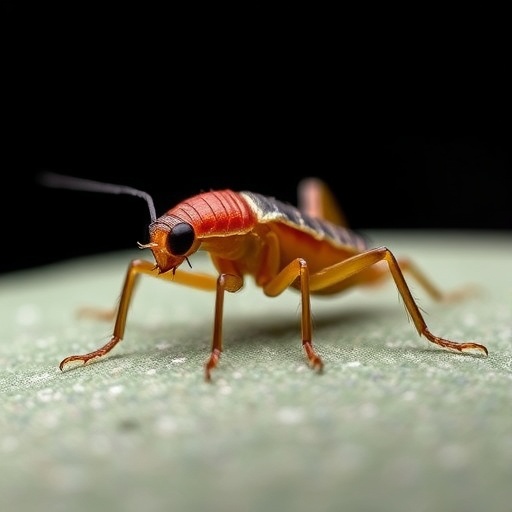
In a groundbreaking study emerging from Tokyo Metropolitan University, researchers have delineated the precise biochemical pathways by which confinement stress induces prolonged sexual dysfunction in male Drosophila melanogaster, commonly known as fruit flies. This revelation centers on the pivotal role of dopamine, a neurotransmitter previously implicated in stress responses across many species, but now identified as a critical mediator in the persistence, rather than initiation, of stress-related courtship suppression. The implications extend far beyond entomology, potentially unraveling complex neurobiological underpinnings of stress-induced sexual dysfunction in mammals, including humans.
The phenomenon of stress-related behavioral alterations has long captivated the attention of neuroscientists, yet the molecular intricacies remain elusive. Exposure to adverse stimuli triggers a cascade of neurochemical events, often resulting in long-lasting behavioral modifications. Sexual dysfunction as a consequence of stress is notably prevalent in post-traumatic stress disorder (PTSD) sufferers, yet the mechanistic pathways linking stress to reduced sexual motivation have lacked comprehensive elucidation. Tokyo Metropolitan University’s investigative team, led by Professor Takaomi Sakai, approached this challenge using fruit flies as an experimental model, capitalizing on their neurobiological homology with higher organisms and amenability to controlled laboratory manipulation.
The experimental paradigm employed involved subjecting male fruit flies to varying durations of confinement within restrictive spatial environments—an analog to “small-space” or confinement stress known to impact behavioral phenotypes in diverse species. Intriguingly, the duration of confinement was directly proportional to the persistence of suppressed courtship behavior. Flies confined for a mere ten minutes displayed negligible deviation from baseline mating efforts. However, as confinement intervals extended to 30 and 60 minutes, a measurable and significant dampening of courtship activity was observed post-release. Chronic exposures spanning 7 to 24 hours culminated in sustained sexual motivation deficits persisting for five days or longer, underscoring the lasting imprint of protracted stress exposure.
Crucially, the reduction in courtship behaviors was not attributable to confounding factors such as compromised locomotion or appetite deficits, thereby pinpointing a specific neuropsychological impact rather than generalized malaise. This specificity steered the research towards dissecting dopaminergic signaling pathways, given dopamine’s well-documented involvement in modulating stress responses and behaviors in vertebrates and invertebrates alike. Utilizing genetic tools to suppress dopamine synthesis alongside pharmacological interventions targeting dopamine pathways, the team unveiled that while basal courtship suppression following stress remained unaffected, the durability of this suppression was significantly altered when dopamine signaling was impaired.
The investigation proceeded to anatomically map the locus of dopamine’s influence, revealing the mushroom body—a specialized brain structure known to integrate sensory inputs—as a key site for dopamine receptor-mediated maintenance of stress-induced behavioral changes. This discovery emphasizes the mushroom body’s role not just in immediate behavioral responses but in the sustained encoding of stress-related behavioral modifications, a finding with profound implications for understanding neural plasticity and memory in relation to stress.
From a neurobiological perspective, these findings illuminate dopamine’s selective function in reinforcing and perpetuating stress-induced sexual dysfunction, rather than initiating it. This insight represents a paradigm shift, suggesting therapeutic interventions for stress-related sexual dysfunction should target dopaminergic pathways responsible for behavioral persistence, potentially opening avenues to reverse or mitigate long-term sexual impairment following traumatic experiences.
The translational potential of these results cannot be overstated. Given the conservation of dopaminergic systems across phyla, elucidating the biochemical cascades in Drosophila provides a crucial framework for dissecting similar mechanisms in mammalian models, including humans. Elevated comprehension of these pathways could foster novel clinical approaches for treating sexual dysfunction linked to chronic stress and psychiatric disorders.
Moreover, this research underscores the utility of fruit flies as indispensible model organisms in neuropsychiatric research. Their genetic tractability, combined with conserved neurochemical pathways, offers a powerful platform for uncovering fundamental neurobiological processes with relevance to human health. The study sets the stage for further inquiries into how environmental stressors reshape neural circuits governing complex behaviors.
The Tokyo Metropolitan University study exemplifies the convergence of genetics, neurobiology, and behavioral science, presenting compelling evidence that can catalyze a reexamination of how sexual dysfunction is approached clinically. It bridges basic science with potential therapeutic strategies, addressing a multifaceted health issue that affects millions worldwide.
Supporting the endeavor were JSPS KAKENHI Grants 21H02528 and 21H00434, reinforcing the commitment to advancing neurobiological understanding and its application to human well-being. The collaborative effort reflects the evolving landscape of stress research, where integrative, interdisciplinary approaches are essential to unraveling the complexities of brain and behavior.
In conclusion, the discoveries made by Professor Sakai’s team accentuate dopamine’s indispensable role in sustaining the behavioral consequences of confinement stress, primarily in the domain of sexual motivation. Their research not only enriches fundamental neurobiological knowledge but also opens promising pathways toward alleviating sexual dysfunction arising from stress, with broad implications across diverse species including humans.
News Publication Date: 27-Apr-2026.
Web References: http://dx.doi.org/10.1016/j.isci.2026.115906.
Keywords
Dopamine, sexual dysfunction, stress, Drosophila melanogaster, confinement stress, courtship suppression, neurotransmitter signaling, neurobiology, behavioral persistence, mushroom body, neuroplasticity, post-traumatic stress disorder (PTSD).
Cite Scienmag News
Grant Pearson. (May 30, 2026). Unraveling the Biochemical Links Between Stress and Sexual Dysfunction in Model Organisms. Scienmag. https://scienmag.com/unraveling-the-biochemical-links-between-stress-and-sexual-dysfunction-in-model-organisms/
Grant Pearson. "Unraveling the Biochemical Links Between Stress and Sexual Dysfunction in Model Organisms." Scienmag, 30 May 2026, https://scienmag.com/unraveling-the-biochemical-links-between-stress-and-sexual-dysfunction-in-model-organisms/. Accessed 4 September 2026.
Grant Pearson. "Unraveling the Biochemical Links Between Stress and Sexual Dysfunction in Model Organisms." Scienmag. May 30, 2026. https://scienmag.com/unraveling-the-biochemical-links-between-stress-and-sexual-dysfunction-in-model-organisms/


