


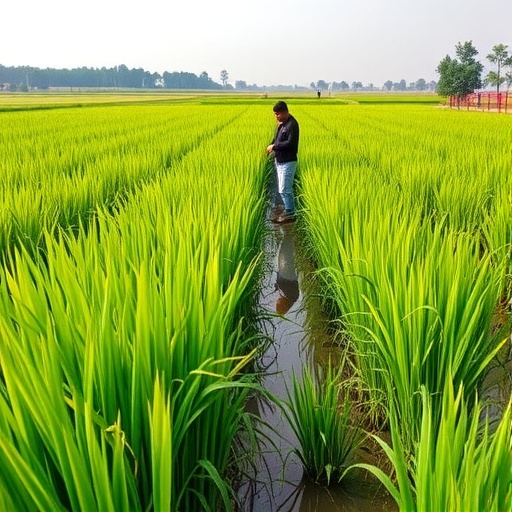
Rice cultivation stands as one of the pivotal pillars sustaining over half of the global population, yet it has long been entangled with severe environmental challenges. Traditional continuous flooding practices in paddy fields, although effective for stable yield production, impose unsustainable demands on water resources and contribute markedly to ammonia emissions—a significant environmental concern. Recent advancements in sustainable agriculture have highlighted a novel approach combining alternate wetting and drying irrigation (AWD) with nitrogen-loaded biochar, offering a transformative pathway to optimize rice production while drastically reducing ecological footprints.
The principle of alternate wetting and drying (AWD) involves cycles of irrigation interspersed with dry periods, moving away from the conventional practice of maintaining continuous submergence in rice paddies. This technique enhances water use efficiency by allowing paddy fields to dry during specific growth stages, thereby curtailing water consumption without compromising productivity. However, the intrinsic variability in nitrogen availability under AWD presents challenges for nutrient management, suggesting the necessity for innovative approaches to maintain stable nitrogen supply and mitigate associated environmental emissions.
Enter nitrogen-loaded biochar—a cutting-edge soil amendment derived from rice straw pyrolysis, engineered to adsorb ammonium ions and release them gradually within the soil matrix. Biochar’s porous architecture and chemical properties endow it with the ability to serve as both a slow-release fertilizer and a soil conditioner, improving water retention and nutrient cycling. When biochar is impregnated with nitrogen, it becomes an effective reservoir, regulating nitrogen dynamics under the fluctuating moisture regimes characteristic of AWD systems.
A comprehensive two-year experimental study conducted in Northeast China rigorously evaluated the synergistic impacts of AWD combined with nitrogen-loaded biochar against traditional continuous flooding methods. The controlled trials illuminated a series of multifaceted benefits. AWD alone achieved a substantial water-saving margin, reducing consumption by approximately 14 to 16 percent. Simultaneously, this irrigation strategy elicited yield improvements ranging between 2 and 5 percent—an indication that water conservation can coexist with productivity enhancement.
Remarkably, when nitrogen-loaded biochar was integrated within AWD regimes, rice yields surged further, showing yield increases of nearly 7 to 13 percent over AWD-only systems. This enhancement underscores the pivotal role of biochar in stabilizing nitrogen availability, preventing leaching and volatilization, and aligning nutrient release with crop demand cycles. Moreover, water use efficiency was boosted beyond AWD alone, with additional water savings of 7 to 12.4 percent, highlighting biochar’s role in improving soil moisture retention during drying phases.
One of the paramount environmental concerns addressed by this integrated system is the mitigation of ammonia volatilization—a process where nitrogen applied as fertilizer escapes to the atmosphere, contributing to air pollution and reducing soil fertility. The study revealed that nitrogen-loaded biochar, when applied under continuous flooding, paradoxically elevated ammonia emissions, likely due to localized nitrogen concentration spikes. However, the combination of biochar with AWD dramatically attenuated this effect, significantly lowering ammonia losses compared to flooded biochar treatments. This finding reveals a critical mechanistic synergy: AWD’s fluctuating moisture conditions and biochar’s nitrogen buffering capacity jointly suppress volatile nitrogen losses.
The underlying biological and physicochemical mechanisms synergizing AWD and nitrogen-loaded biochar hinge on improved root zone dynamics and nutrient modulation. AWD’s wet-dry cycles stimulate root system vigor and enhance soil aeration, fostering microbial communities that optimize nitrogen transformations. Simultaneously, biochar’s adsorption of ammonium fosters a microenvironment that buffers temporal nitrogen fluctuations, ensuring a more continuous nutrient supply aligned with plant uptake patterns. Additionally, biochar improves soil water-holding capacity during dry phases, buffering plants from transient drought stress.
Advanced statistical modeling via partial least squares path analysis substantiated these observations, demonstrating that both AWD and nitrogen-loaded biochar independently and interactively enhanced rice nitrogen accumulation, reduced irrigation water demand, and mitigated ammonia volatilization. The integrated approach offers a scalable and sustainable model for rice cultivation that harmonizes food security imperatives with water conservation and environmental protection, epitomizing the alignment of agronomic productivity and ecological stewardship.
The implications of this integrated strategy are profound, particularly as climate change intensifies water scarcity and nitrogen fertilizer inefficiencies threaten global food systems. By outmaneuvering the entrenched trade-offs known as the rice production “trilemma”—balancing yield, water use, and nitrogen loss—this approach ushers in a new paradigm of precision rice farming. Farmers adopting AWD coupled with nitrogen-loaded biochar stand to benefit from enhanced yield stability, reduced input costs, and a minimized environmental footprint, advancing the goals of climate-smart agriculture.
Nevertheless, the journey towards widespread adoption demands further investigation. Long-term field trials across diverse agroecological zones are essential to validate performance consistency. Economic analyses must define cost-benefit thresholds and market viability for nitrogen-loaded biochar production and application. Moreover, site-specific management guidelines must be developed, tailoring irrigation scheduling and biochar amendment rates to diverse soil types, climatic conditions, and rice cultivars for maximal efficacy.
In summary, the innovative integration of alternate wetting and drying irrigation with nitrogen-loaded biochar represents a quantum leap in sustainable rice production technology. By harmonizing water savings with yield improvements and ammonia emission reductions, this synergy addresses critical challenges in global food system sustainability. As researchers and practitioners amplify efforts to refine and deploy this strategy, the vision of resilient, resource-efficient, and environmentally sound rice production moves closer to reality—cultivating hope for feeding future generations while safeguarding our shared environment.
News Publication Date: March 17, 2026
Web References:
References:
Chen, H., Liu, G., Sun, Y. et al. Closing the rice production trilemma: AWD and nitrogen-loaded biochar synergy achieves co-benefits in yield improvement, water saving, and ammonia mitigation. Biochar 8, 79 (2026).
Cite Scienmag News
Alan Morgan. (June 5, 2026). Innovative Rice Cultivation Method Enhances Water Efficiency, Increases Yield, and Minimizes Ammonia Emissions. Scienmag. https://scienmag.com/innovative-rice-cultivation-method-enhances-water-efficiency-increases-yield-and-minimizes-ammonia-emissions/
Alan Morgan. "Innovative Rice Cultivation Method Enhances Water Efficiency, Increases Yield, and Minimizes Ammonia Emissions." Scienmag, 5 June 2026, https://scienmag.com/innovative-rice-cultivation-method-enhances-water-efficiency-increases-yield-and-minimizes-ammonia-emissions/. Accessed 3 September 2026.
Alan Morgan. "Innovative Rice Cultivation Method Enhances Water Efficiency, Increases Yield, and Minimizes Ammonia Emissions." Scienmag. June 5, 2026. https://scienmag.com/innovative-rice-cultivation-method-enhances-water-efficiency-increases-yield-and-minimizes-ammonia-emissions/


