


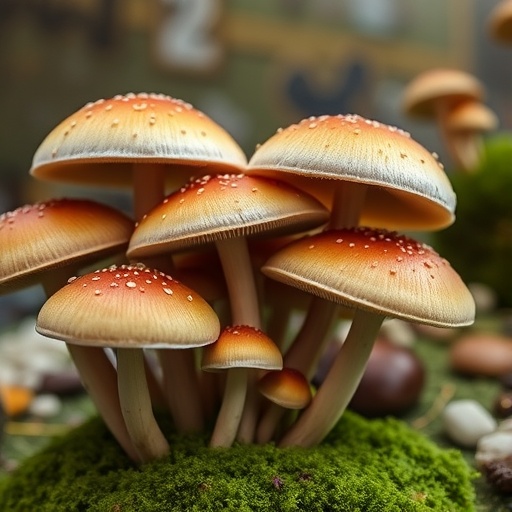
A handbag grown from fungus could offer a new route beyond both animal leather and petroleum-based vegan alternatives. Researchers in Finland have developed a mycelium-based textile that can be produced continuously in long sheets, shaped into accessories and engineered to match the tensile strength of conventional leather. Unlike plastic-based substitutes, the material is designed to break down at the end of its useful life, potentially reducing the long-term waste associated with fashion products.
The material is made from mycelium, the branching network of microscopic fibers that forms the main body of a fungus beneath the familiar mushroom cap. These fibers are composed largely of structural biopolymers and naturally grow by consuming nutrients in their surroundings. Because mycelium can form dense, interconnected networks, scientists have increasingly explored it as a renewable feedstock for packaging, insulation and leather-like materials. The challenge has been producing enough material quickly and consistently for commercial applications.
Traditional mycelium textiles are typically manufactured by allowing fungi to grow across flat trays. As the organism spreads, its thread-like hyphae bind together into a coherent sheet that can be harvested and processed. Although this method can create attractive materials, it is difficult to scale efficiently: growth takes place over large surface areas, production is relatively slow and the final properties can be difficult to control. The Finnish team pursued a different strategy by growing the fungus in liquid fermentation tanks.
The researchers cultivated the filamentous fungus Trichoderma reesei in nutrient-rich liquid inside vessels similar to those used in industrial brewing. Instead of forming a single continuous sheet, the fungus developed into a thick, fiber-rich pulp suspended throughout the tank. This approach separates biological growth from sheet formation, allowing the fungal biomass to be produced in large vessels and shaped later using conventional manufacturing equipment. In principle, that could make mycelium textiles more compatible with existing biotechnology and paper-processing infrastructure.
After harvesting the fungal pulp, the researchers washed it and blended it with sorbitol and cellulose. Sorbitol is a sugar alcohol widely used in foods, pharmaceuticals and cosmetics, and it can act as a plasticizing agent by helping polymeric networks move more freely. That flexibility is important because untreated fungal fibers can be brittle when dried. Cellulose, the primary structural material in plant cell walls, was added to reinforce the network and improve mechanical performance. The resulting mixture was spread into thin layers and dried, producing a nonwoven fabric with a leather-like appearance and feel.
The pulp-based process also gave the scientists greater control over the material’s design. They could modify thickness, incorporate color and texture, and laminate the mycelium layer onto cotton fabrics. Such control is crucial for products that must meet different performance requirements: a soft wallet, a structured handbag and a flexible shoe upper may all require distinct combinations of stiffness, strength and surface finish. The ability to adjust the formulation could also allow manufacturers to produce materials with more consistent properties than those obtained from uncontrolled fungal growth.
To determine whether the concept could move beyond small laboratory samples, the team adapted a roller-based system resembling equipment used in paper manufacturing. The process continuously produced sheets approximately 20 centimeters wide and 8 meters long. Researchers then cut and stitched the material into a prototype accessory bag, demonstrating that the textile could be handled with familiar fabrication techniques rather than requiring an entirely new production system. The prototype’s black coloration showed that the material could also be dyed for consumer products.
Mechanical testing produced one of the most striking results. The rolled mycelium material reached tensile strengths comparable to traditional leather, indicating that it could withstand substantial pulling forces before breaking. Tensile strength alone does not determine whether a fabric is suitable for everyday use, however. Resistance to tearing, abrasion, moisture and repeated flexing will also be essential for handbags and other products exposed to constant handling. The researchers acknowledge that tear resistance remains a limitation that must be addressed before the material can become a widely available commercial alternative.
The material’s end-of-life behavior could provide another advantage over plastic-based vegan leather. In laboratory tests, it broke down in water within 28 days, while under industrial composting conditions it completely disintegrated in approximately six weeks. These results suggest that the fungal textile is more biologically degradable than petroleum-derived polyurethane or PVC alternatives, although real-world decomposition would depend on product design, dyes, coatings, stitching and any added fabrics. The research team says the manufacturing process is promising because it combines scalable fungal fermentation with equipment already used in biotechnology and printing. If durability can be improved without sacrificing compostability, a handbag grown from fungal fibers could become more than a viral curiosity: it could represent a practical step toward lower-impact materials for the fashion industry.
News Publication Date: 24-Jun-2026
Web References: https://doi.org/10.1021/acsabm.6c00471
References: ACS Applied Bio Materials, DOI: 10.1021/acsabm.6c00471
Cite Scienmag News
Roger Howard. (August 6, 2026). Mushrooms could soon help create your next handbag. Scienmag. https://scienmag.com/mushrooms-could-soon-help-create-your-next-handbag/
Roger Howard. "Mushrooms could soon help create your next handbag." Scienmag, 6 August 2026, https://scienmag.com/mushrooms-could-soon-help-create-your-next-handbag/. Accessed 3 September 2026.
Roger Howard. "Mushrooms could soon help create your next handbag." Scienmag. August 6, 2026. https://scienmag.com/mushrooms-could-soon-help-create-your-next-handbag/


