


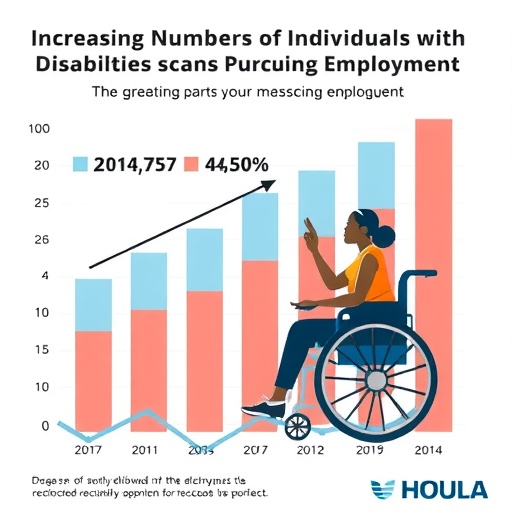
The June 2026 National Trends in Disability Employment (nTIDE) report illuminates pivotal shifts in the employment landscape for people with disabilities, revealing a pronounced increase in labor force engagement that underscores the growing economic pressures faced by this demographic. Originating from the collaboration between the Kessler Foundation and the University of New Hampshire’s Institute on Disability, nTIDE offers rigorous, data-driven insights into how macroeconomic forces uniquely impact employment opportunities for individuals with disabilities, compared to those without disabilities. This latest report brings to light nuanced labor market dynamics, emphasizing a surge in job-seeking behavior among disabled individuals amid an inflationary economic environment.
Dissecting the latest labor statistics derived from the U.S. Bureau of Labor Statistics (BLS) Jobs Report, nTIDE reveals a marginal decline in the employment-to-population ratio for people with disabilities, from 37.9 percent in April 2026 to 37.8 percent in May 2026. This ratio represents the proportion of working individuals within the total population aged 16 to 64, a critical metric that indicates the degree of workforce integration. Contrastingly, individuals without disabilities experienced a slight increase in employment-to-population ratio, climbing from 74.9 to 75.0 percent over the same interval. While seemingly minimal, these changes reflect deeper labor market dynamics influenced by broader economic conditions.
Importantly, the labor force participation rate—a broader measure encompassing those working, temporarily unemployed, or actively seeking employment—increased significantly for people with disabilities, rising from 41.1 percent in April to 42.0 percent in May 2026. Among non-disabled populations, this metric experienced a smaller uptick from 77.9 percent to 78.0 percent. This divergence suggests that despite a slight decrease in actual employment, more individuals with disabilities are entering or re-entering the labor force, actively searching for job opportunities. These statistics articulate a critical narrative: the labor market is seeing greater engagement from people with disabilities who are motivated to overcome systemic employment barriers.
Economists interpreting these data posit that heightened labor force participation amid flat or declining employment ratios signals a rising pool of job seekers struggling to convert their search efforts into actual employment. Andrew Houtenville, PhD, an esteemed economist and director at the UNH Institute on Disability, contextualizes this finding within the current inflationary climate, suggesting that increasing living costs compel more people with disabilities to seek employment as a necessary economic survival strategy. This is corroborated by the latest Annual Report on People with Disabilities, which highlights the disproportionate poverty rates within this community, amplifying the urgency of stable wage employment.
Examining longitudinal trends from May 2025 to May 2026, the employment-to-population ratio for people with disabilities decreased slightly from 38.0 to 37.8 percent, while the corresponding figure for people without disabilities rose from 74.8 to 75.0 percent. Concurrently, labor force participation rates improved for both groups. These patterns reinforce the complexity of the labor market experience for people with disabilities, where increased participation does not necessarily translate into enhanced employment outcomes, underlining persistent systemic challenges.
The quantification of the current workforce included approximately 6.48 million workers with disabilities, constituting 4.3 percent of the total 151.3 million workforce population aged 16 to 64 in the United States. This demographic remains significantly underrepresented relative to their share within the general population, highlighting the urgent need for policy interventions aimed at greater inclusion. The nTIDE report serves as a vital barometer for such initiatives, providing policymakers and advocates with timely, evidence-based insights.
Beyond the raw numbers, the nTIDE initiative engages stakeholders directly through a monthly Lunch and Learn webinar, fostering dialogue and disseminating knowledge. The session on June 5, 2026, featured notable leaders such as Vicki Phillips, Donald Campbell, and Shoshana Marin, who contribute expertise spanning mental health, independent living, and disability policy. This interactive forum embodies nTIDE’s commitment to a collaborative approach in addressing disability employment barriers through research, education, and advocacy.
The Kessler Foundation, a cornerstone in rehabilitation science since 1985, alongside the University of New Hampshire’s Institute on Disability, synergizes its empirical rigor to illuminate how economic fluctuations affect workers with disabilities. Their combined efforts emphasize not only capturing labor statistics but also examining the underlying systemic and societal determinants that influence workforce accessibility. This multidisciplinary research framework drives innovative solutions designed to improve employment outcomes for people with disabilities.
Understanding the employment-to-population ratio and labor force participation rate in detail is essential for grasping labor market dynamics. The former indicates the share of employed individuals relative to the total population, while the latter includes all individuals engaged in or seeking work. nTIDE’s nuanced approach to these indicators allows for comprehensive analysis beyond simplistic employment measurements, highlighting factors such as active job seeking and temporary unemployment that affect workforce participation.
The disparities revealed by the nTIDE data reinforce the need for continued advocacy and research focused on dismantling structural barriers in employment. Efforts to improve accessibility, accommodation, and anti-discrimination policies are critical to leveling the playing field and ensuring equitable opportunities for skilled workers with disabilities. As economic pressures intensify, the intersection of disability and employment becomes increasingly salient for social scientists, labor economists, and policymakers alike.
Finally, the continued provision of monthly labor market updates by nTIDE exemplifies a forward-looking commitment to data transparency and public engagement. By leveraging meticulous analysis and cross-sector collaboration, the nTIDE report not only tracks the progress of labor market inclusion but also serves as a catalyst for action aimed at expanding economic participation for people with disabilities, fostering resilience during challenging economic times.
Cite Scienmag News
Courtney Benton. (June 5, 2026). Increasing Numbers of Individuals with Disabilities Pursuing Employment. Scienmag. https://scienmag.com/increasing-numbers-of-individuals-with-disabilities-pursuing-employment/
Courtney Benton. "Increasing Numbers of Individuals with Disabilities Pursuing Employment." Scienmag, 5 June 2026, https://scienmag.com/increasing-numbers-of-individuals-with-disabilities-pursuing-employment/. Accessed 3 September 2026.
Courtney Benton. "Increasing Numbers of Individuals with Disabilities Pursuing Employment." Scienmag. June 5, 2026. https://scienmag.com/increasing-numbers-of-individuals-with-disabilities-pursuing-employment/


