


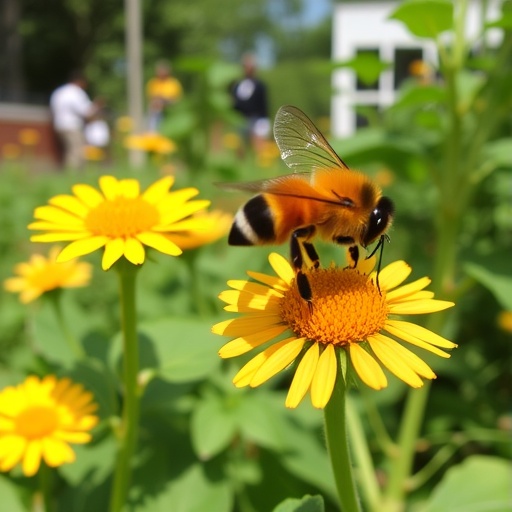
Urban farms may be surrounded by biodiversity, yet the decision to protect and support pollinators appears to depend less on what growers plant—or who those growers are—than on whether they can access the resources needed to act. A new study by Michigan State University entomologists Jen Roedel, Karma Thomas and Zsofia Szendrei reports that labor, funding, land access and educational support are stronger drivers of pollinator-management practices than grower demographics or the pollination requirements of individual crops.
The findings offer a new perspective on a rapidly expanding feature of American food systems. Urban farms and community growing spaces are increasingly used to improve food access, strengthen food sovereignty and provide environmental benefits, particularly in underserved neighborhoods. These farms often differ sharply from large conventional operations: they occupy smaller plots, grow diverse collections of crops and operate with limited labor and infrastructure. That diversity can create valuable habitat for insects, but it can also make farm management more complex.
Many vegetables, fruits and herbs grown in urban settings rely partly or entirely on insects to transfer pollen between flowers. Bees, hoverflies, butterflies, beetles and other insects can increase fruit set, improve seed production and support the productivity of crops such as squash, cucumbers, tomatoes and berries. Pollinator management can include planting flowering habitat, reducing pesticide risks, preserving nesting areas, providing water and adjusting farm practices to protect beneficial insects. Yet adopting these strategies requires time, knowledge, materials and, in many cases, land that can be dedicated to noncrop habitat.
To investigate what shapes these decisions, the researchers surveyed 74 urban growers. They examined whether demographic characteristics—including age, gender, farm income, educational attainment and years of agricultural experience—were associated with pollinator-supportive management. The team also considered growers’ perceptions and motivations, the resources available to them and the types of educational information they used. In addition, the researchers assessed the relationship between management practices and overall crop richness, a measure of how many different crops were grown on a farm.
The results challenge the assumption that pollinator conservation is primarily a matter of personal background or environmental awareness. The study found no significant influence of the measured demographic factors on growers’ pollinator-management decisions. Older and younger growers, people with different levels of formal education and farmers with varying degrees of experience did not appear to differ systematically in their adoption of these practices.
Instead, practical constraints stood out. Access to labor, money and land had a stronger relationship with whether growers implemented pollinator-supportive measures. A farm may have an enthusiastic and knowledgeable grower, but maintaining flowering plants, monitoring insect activity, modifying pest-control methods or creating nesting habitat can be difficult when a site lacks workers, funding or sufficient space. In this context, pollinator management is not simply an ecological choice; it is also an operational decision shaped by the resources available to a farm.
The researchers also identified the type of educational resource as an important factor. Growers most commonly relied on printed books and field guides, conversations with fellow growers and farmers, online articles produced by Extension services and resources from nonprofit organizations. These channels reflect the blended information networks used by urban farmers, who may learn through peer-to-peer exchange as often as through formal agricultural programs. The study further suggests that some pollinator practices may be adopted more effectively when guidance is delivered online rather than exclusively through hard-copy materials, although printed references remained among the most frequently used sources.
One of the study’s most striking findings was a disconnect between the importance of pollination to the crops being grown and the use of pollinator-management methods. In other words, producing crops that benefit from insect pollination did not necessarily lead growers to adopt practices designed to support pollinators. This gap may arise because the benefits of pollination are difficult to observe directly, while the costs of management—labor, space, money and time—are immediate. Growers may recognize that pollinators matter but still lack the capacity to change farm design or daily routines.
The findings have practical implications for agricultural educators, urban-farming organizations and policymakers. Training programs may be more effective when they are paired with tangible support, such as small grants, shared labor, accessible land, habitat materials and concise digital guidance. Rather than assuming that a single demographic group is most likely to adopt pollinator-friendly practices, Extension educators could focus on removing the logistical barriers that prevent growers from acting on existing knowledge. For urban farms, the message is clear: protecting pollinators may depend as much on strengthening the farm itself as on explaining the ecological importance of insects. As cities look to urban agriculture for food, environmental and community benefits, making pollinator management practical could determine whether those benefits extend beyond the harvest.
Web References: https://www.cambridge.org/core/journals/renewable-agriculture-and-food-systems/article/educational-sources-and-resource-accessibility-are-drivers-of-pollinator-management-in-urban-farming-systems/1E0C840971E5EBF4C09C9883C7D5527E
References: Renewable Agriculture and Food Systems. DOI: 10.1017/S1742170526100453
Cite Scienmag News
Alan Morgan. (August 6, 2026). Study Finds Accessible Education Helps Urban Growers Adopt Pollinator-Friendly Practices. Scienmag. https://scienmag.com/study-finds-accessible-education-helps-urban-growers-adopt-pollinator-friendly-practices/
Alan Morgan. "Study Finds Accessible Education Helps Urban Growers Adopt Pollinator-Friendly Practices." Scienmag, 6 August 2026, https://scienmag.com/study-finds-accessible-education-helps-urban-growers-adopt-pollinator-friendly-practices/. Accessed 4 September 2026.
Alan Morgan. "Study Finds Accessible Education Helps Urban Growers Adopt Pollinator-Friendly Practices." Scienmag. August 6, 2026. https://scienmag.com/study-finds-accessible-education-helps-urban-growers-adopt-pollinator-friendly-practices/


