


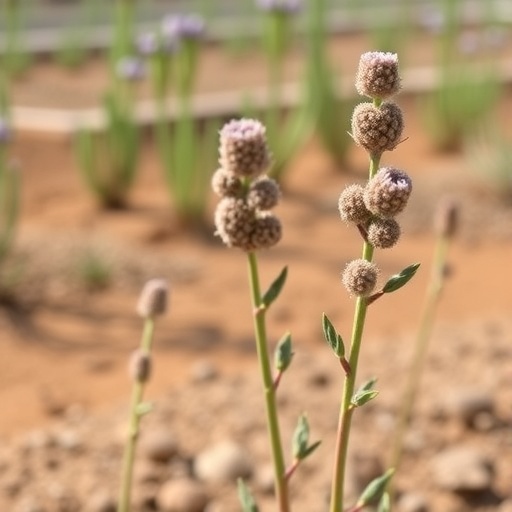
Water scarcity is becoming one of the most serious threats to global agriculture as climate change intensifies droughts and raises temperatures. Now, an international research team led by Tohoku University has identified two synthetic compounds that may help plants survive prolonged water shortages while avoiding some of the growth penalties associated with their natural stress hormone. The molecules, known as NS5806 and UA49, were found to improve drought tolerance by targeting an ion channel involved in the opening of stomata—the microscopic pores plants use to exchange gases and regulate water loss.
The findings, published in Nature Communications on July 27, 2026, offer a new approach to crop protection. Rather than activating the plant’s entire drought-response system, the compounds act more selectively on the machinery that controls stomatal movement. This distinction could be important for agriculture because conventional drought responses often force plants to conserve water at the cost of growth, seed germination, or root development.
Plants naturally respond to drying soil by producing abscisic acid, or ABA, a phytohormone that coordinates several physiological changes. One of ABA’s most immediate effects is to signal guard cells surrounding each stoma to close the pore. By reducing stomatal aperture, the plant limits the escape of water vapor through transpiration. The response can dramatically improve short-term water conservation, but ABA also influences seed dormancy, root growth, and other developmental processes. A treatment that closes stomata without triggering these broader effects could therefore provide a more precise way to protect crops during drought.
“We want the plants to conserve water to improve survivability, but we don’t want them to suddenly stop growing,” said Nobuyuki Uozumi of Tohoku University. His team pursued this goal by searching for compounds that inhibit the molecular signals responsible for stomatal opening. Their attention turned to KAT1, a potassium ion channel found in the plasma membrane of Arabidopsis thaliana guard cells. KAT1 promotes the uptake of potassium ions, which changes the electrical and osmotic conditions inside guard cells. Water then follows osmotically, the cells become more swollen, and the stomatal pore opens.
The researchers used an electrophysiological chemical screen to test small molecules for their ability to interfere with KAT1 activity. This approach measures electrical currents across cell membranes and can reveal whether a compound blocks or modifies the movement of ions through a channel. The screen identified NS5806 as a KAT1 inhibitor. The team subsequently designed and synthesized a related compound, UA49, by altering the molecule’s chemical structure in an effort to refine its activity and potential usefulness.
Experiments on leaf epidermal strips showed that both NS5806 and UA49 promoted stomatal closure and suppressed stomatal opening. The compounds were then applied directly to plant leaves, a method known as foliar application. When treated plants were subjected to drought by withholding water, they displayed enhanced tolerance and improved recovery after rewatering. The results suggest that temporarily limiting water loss through the leaves can help plants maintain enough internal water to survive a period of severe stress.
The compounds also appeared to avoid several unwanted effects associated with ABA. In the experiments described by the researchers, NS5806 and UA49 did not cause the same delays in seed germination or inhibition of root growth observed with ABA treatment. This difference is particularly significant for agricultural development. A drought-protective spray that preserves growth under normal conditions could potentially be used as a biostimulant, allowing farmers to prepare crops for water stress without imposing a persistent developmental cost.
The study also revealed that the compounds do more than simply close stomata through a conventional ABA pathway. To investigate the mechanism, the researchers compared normal Arabidopsis plants with genetically modified plants lacking KAT1 channels. They also monitored calcium ions inside guard cells, where changes in intracellular Ca²⁺ concentration act as important signals controlling stomatal movement. In normal plants treated with NS5806 or UA49, the team observed a sustained influx of calcium. That response disappeared in plants without KAT1, indicating that the potassium channel is required for the calcium signal triggered by the compounds.
This finding points to an unexpected relationship between ion transport and cellular signaling. KAT1 has traditionally been understood mainly as a channel that helps drive stomatal opening by regulating potassium uptake. The new results suggest that its activity may also influence the calcium signaling network that determines how guard cells respond to environmental stress. In this model, KAT1 is not merely a molecular “door opener”; it may also help coordinate the internal messages that tell the stomatal door when to close.
The discovery does not yet represent a ready-to-use treatment for drought-stricken crops. Further work will be needed to determine how the compounds perform in major agricultural species, how long their effects persist in field conditions, whether they remain safe for beneficial organisms, and how they behave under combinations of heat, salinity, and water stress. Nevertheless, NS5806 and UA49 provide valuable chemical tools for studying plant ion channels and offer a possible route toward more targeted climate-resilient agriculture. As drought becomes more frequent and severe across farming regions, the ability to conserve water without shutting down plant growth could become one of the most important goals in crop science.
News Publication Date: July 27, 2026
Web References: https://doi.org/10.1038/s41467-026-75894-w
References: Nature Communications, DOI: 10.1038/s41467-026-75894-w
Cite Scienmag News
Alan Morgan. (August 5, 2026). New Molecule Class Produces Hardy, Drought-Tolerant Plants. Scienmag. https://scienmag.com/new-molecule-class-produces-hardy-drought-tolerant-plants/
Alan Morgan. "New Molecule Class Produces Hardy, Drought-Tolerant Plants." Scienmag, 5 August 2026, https://scienmag.com/new-molecule-class-produces-hardy-drought-tolerant-plants/. Accessed 5 September 2026.
Alan Morgan. "New Molecule Class Produces Hardy, Drought-Tolerant Plants." Scienmag. August 5, 2026. https://scienmag.com/new-molecule-class-produces-hardy-drought-tolerant-plants/


