


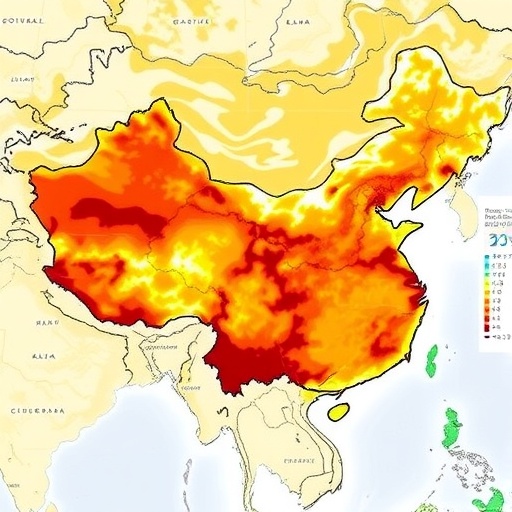
Climate change is often framed as a story of too much water or too little, but new research from Central China suggests the future may deliver both at once — more rain, and worse droughts. A study published in the journal Regional Environmental Change projects that even as regional precipitation climbs by more than 10 percent by the end of the century, droughts in the Central China Triangle will become more frequent, more intense and harder to predict, because the extra rainfall will not be enough to stop soils from drying out.
The study, led by Jinhui Hu of the School of Civil and Hydraulic Engineering at Huazhong University of Science and Technology, together with Qiuwen Zhang, Changtao Deng of the Pearl River Water Resources Research Institute, and Wenting Zhou, offers one of the most detailed looks yet at how compound droughts — events that combine meteorological, agricultural and hydrological dimensions — will evolve in Central China under a warming climate. It also marks the first time the team’s recently developed drought index has been applied to future climate projections, a step the researchers say could change how drought risk is assessed in a warming world.
Droughts are deceptively difficult to measure. A drought can begin as a shortfall in precipitation, but its true damage emerges when that deficit propagates through the water cycle — reducing soil moisture, drying up streams, and stressing crops. Traditional drought indices, such as the Palmer Drought Severity Index or the Standardized Precipitation Index, typically capture only one slice of that chain. The new research tackles the problem with the state-space gradient drought index, or SSGDI, a framework the same group introduced in the Journal of Hydrology in 2026. Rather than relying on a single variable, SSGDI integrates three key hydrological indicators — precipitation, soil moisture and runoff — into a single composite measure built on a statistical architecture that combines Gaussian mixture models with minimum spanning tree analysis. The result is a physically interpretable index that tracks the full propagation of drought through the hydrological system, from the sky to the soil to the river.
Applying such a framework to future climate projections, however, requires tackling a second challenge: the biases baked into global climate models. The team drew on the sixth phase of the Coupled Model Intercomparison Project, CMIP6, the international effort that underpins most modern climate projections. CMIP6 models are run at relatively coarse spatial resolutions, and their raw outputs are notorious for distorting regional precipitation and soil moisture patterns. To address this, the researchers employed a technique called trend-preserving quantile delta mapping, or QDM, a bias-correction method designed to adjust a model’s historical errors while preserving the long-term climate change signal it projects. That preservation matters: conventional bias-correction approaches can inadvertently flatten or exaggerate projected trends, potentially erasing precisely the changes scientists are trying to detect. By combining QDM with the SSGDI framework, the team constructed fine-resolution, multivariable projections of compound drought across three future emissions scenarios — SSP1-2.6, a low-emissions pathway compatible with the Paris Agreement’s ambitions; SSP2-4.5, an intermediate scenario; and SSP5-8.5, a high-emissions trajectory representing continued heavy fossil fuel use.
The projections were based on an ensemble of 11 CMIP6 models, and the consensus among them proved strikingly robust. Even where individual models disagreed on the details, the ensemble converged on a consistent and counterintuitive picture of Central China’s hydrological future. By the period 2081 to 2100, regional mean precipitation is projected to increase by 10.0 to 12.8 percent across the scenarios. On its face, that sounds like good news for a region that depends heavily on agriculture, including substantial rice cultivation. But the models tell a different story beneath the surface: soil moisture persistently declines by 1.5 to 3.4 percent over the same period, with the sharpest reductions occurring under the highest-emissions SSP5-8.5 scenario.
The mechanism behind this apparent paradox is well understood in hydrology but often lost in public discussion of climate projections. Warmer air holds more moisture and drives higher evapotranspiration, pulling water from soils faster than rainfall can replenish it. Increased precipitation, particularly when it arrives in more intense, episodic bursts, runs off the landscape more quickly and penetrates soil less effectively. The result is a hydroclimate that grows simultaneously wetter in the atmosphere and drier in the ground — a divergence the authors describe as the defining feature of the region’s future. Rainfall, in other words, cannot offset the escalating risk of droughts that dig deeper into the water cycle.
That deepening shows up clearly in the drought statistics. The study projects that regional drought frequency will rise robustly by up to 14.1 percent, while drought intensity strengthens substantially — the mean value of the SSGDI index during drought events drops by as much as 0.754, a significant deepening on a scale where negative values indicate more severe conditions. More alarming still is the composition of that increase. The intensification of drought in Central China is disproportionately driven by a surge of 3.17 to 11.40 percent in extreme droughts — the rare but devastating events that strain water supplies, collapse crop yields and stress hydropower generation. Moderate droughts, which water managers can typically absorb, are not growing nearly as fast. The tail of the distribution is what thickens.
The character of droughts is also changing, not merely their severity. The study finds that drought composition in the region is transitioning toward a more complex structure, in which multiple types of drought increasingly overlap. Under the high-emissions SSP5-8.5 scenario, agricultural drought — the soil-moisture deficit that directly withers crops — rises to approximately 25 percent of the drought signal in late-century extreme years. That matters because compound droughts, in which meteorological and agricultural deficits coincide, are far more damaging than any single type: they hit water systems and food systems simultaneously, leaving fewer buffers for recovery.
Timing, too, proves critical. The projections show that drought amplification is most pronounced in winter and spring — seasons that many might assume would offer relief. Winter and spring droughts in Central China can be particularly consequential, arriving ahead of the growing season and depleting soil moisture reserves at exactly the moment when crops are being established. A drier start to the agricultural year, combined with the overall decline in soil moisture, suggests the region’s farming systems could face compounding stress even in years when total annual rainfall is above historical norms.
For the researchers, the findings carry a two-part message. The first is methodological: drought projections that rely on single-variable indices risk underestimating the future, because they miss the propagation chain through which atmospheric deficits become agricultural and hydrological crises. The SSGDI framework, applied to bias-corrected CMIP6 ensembles, offers what the authors describe as a robust methodological reference for other regions grappling with the same problem — and it comes at a moment when compound droughts are drawing growing attention worldwide, from the flash droughts recently identified as underappreciated risks in China’s grain belts to multi-year megadroughts documented in other parts of the world.
The second message is for policymakers. The study emphasizes the critical need for spatially explicit adaptation — drought management tailored to fine-scale local conditions rather than broad regional averages — and for aggressive emission mitigation. The contrast between scenarios in the projections makes the stakes clear: under SSP1-2.6, the drying of soils and the intensification of droughts are moderated; under SSP5-8.5, they accelerate. The trajectory of drought risk in Central China over the coming decades, in other words, is not yet written. It depends on choices about emissions that are being made now, on a global stage, in a region where water, energy and food security increasingly hang in the balance.
Cite Scienmag News
Sloane Callahan. (September 5, 2026). New drought index framework projects future compound drought in Central China. Scienmag. https://scienmag.com/new-drought-index-framework-projects-future-compound-drought-in-central-china/
Sloane Callahan. "New drought index framework projects future compound drought in Central China." Scienmag, 5 September 2026, https://scienmag.com/new-drought-index-framework-projects-future-compound-drought-in-central-china/. Accessed 5 September 2026.
Sloane Callahan. "New drought index framework projects future compound drought in Central China." Scienmag. September 5, 2026. https://scienmag.com/new-drought-index-framework-projects-future-compound-drought-in-central-china/


