


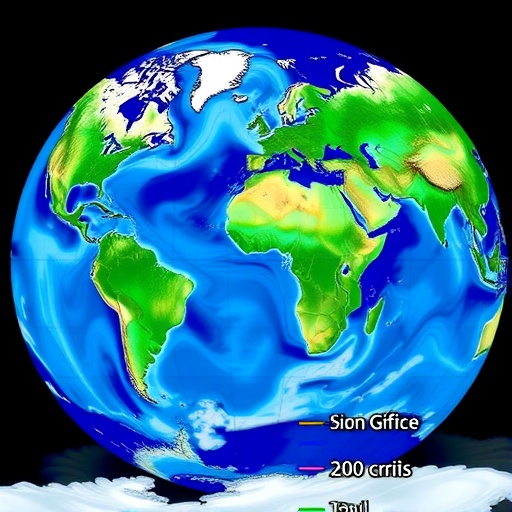
A team of climate scientists in Germany and the United Kingdom has unveiled a machine learning framework that can generate realistic, high-resolution global precipitation maps in about two seconds per field — a task that conventional Earth system models approach with costly, bias-prone physics approximations. The study, published in the journal Climate Dynamics, demonstrates that a two-stage artificial intelligence pipeline combining a regression network with a generative diffusion model can learn to reconstruct daily rainfall across the entire planet from just four large-scale atmospheric variables, producing results that are markedly closer to observational data than the raw output of a leading climate model.
The research, led by Michael Aich of the Technical University of Munich and the Potsdam Institute for Climate Impact Research, together with Sebastian Bathiany, Philipp Hess, Yu Huang and Niklas Boers, addresses one of the most persistent weaknesses in modern climate simulation: precipitation. Earth system models, or ESMs, are the workhorses of climate projection, numerically solving the equations of atmospheric motion on discretized grids. But their grids are coarse, typically on the order of one degree or more, and the processes that actually generate rain — convection, cloud microphysics, the organization of thunderstorm complexes — unfold at scales far smaller than a single grid cell. To cope, modelers rely on parameterizations: simplified, column-based schemes that approximate subgrid physics independently at each vertical column of the atmosphere. These schemes are computationally expensive, depend on subjective calibration, and ignore horizontal interactions between neighboring columns, which makes it difficult to capture phenomena such as mesoscale convective organization. The result is a suite of systematic biases, the most famous being the “double Intertropical Convergence Zone” problem, in which models paint excessive rainfall across the southern tropics.
The new framework sidesteps these column-based assumptions entirely. Instead of treating each atmospheric column as an isolated regression problem, the researchers’ models operate on global two-dimensional fields, allowing information to flow between distant locations and between different physical variables. The inputs are deliberately minimal: specific humidity at the 850 hectopascal pressure level, the eastward and northward wind components at ten meters above the surface, and mean sea-level pressure — all at a coarse one-degree resolution. Remarkably, the authors show that these four surface and near-surface fields contain enough implicit information about the three-dimensional state of the atmosphere to reconstruct detailed rainfall patterns. Mean sea-level pressure, for instance, captures the integrated mass of the entire air column, while surface winds are intrinsically coupled to the larger-scale circulation.
The pipeline works in two stages. The first is a deterministic UNet regression model, a convolutional neural network of roughly 24 million parameters with four downsampling stages built from residual blocks and a single bottleneck attention layer. Trained on the ERA5 reanalysis — a state-of-the-art dataset produced by the European Centre for Medium-Range Weather Forecasts that fuses observations with numerical weather prediction — the network learns to map the four coarse atmospheric variables to one-degree daily precipitation. A single forward pass through this network takes about nine milliseconds on a modern Nvidia H100 graphics card.
The second stage is where the generative magic happens. A conditional denoising diffusion probabilistic model, an architecture descended from the same family of techniques behind modern image generators, is trained to transform the coarse one-degree precipitation estimate into a genuine quarter-degree field — a sixteenfold increase in the number of grid cells, from a 180-by-360 global grid to 720 by 1440. Diffusion models work by learning to reverse a gradual noising process; here, the model is conditioned on a degraded, noisy version of the coarse precipitation field and learns to regenerate the fine-scale spatial texture that such coarse inputs lack. The researchers inject Gaussian noise of a carefully calibrated magnitude into the conditioning field during training, chosen by analyzing where the spatial power spectra of the coarse and fine datasets intersect, at a threshold scale of roughly 900 kilometers. Scales larger than this threshold are preserved from the conditioning input; scales below it are regenerated stochastically in a manner consistent with the ERA5 distribution. This design turns the diffusion model into both a downscaling engine and a bias-corrector: it wipes away the flawed, overly smooth small-scale features of the coarse input and replaces them with statistically realistic texture, while anchoring the result to the trustworthy large-scale structure.
Bridging the gap between reanalysis data and climate model output posed a further challenge, because the statistics of ESM fields differ from those of ERA5. The researchers solved this with quantile delta mapping, a bias-correction technique fitted on the historical overlap between the model and the reanalysis, applied to the regression output before it enters the diffusion stage. The noise-injection step then serves double duty as a domain adaptation device: by corrupting the small-scale information of the bias-corrected field to the same degree as during training, it renders the inference-time data distribution approximately identical to the training distribution, allowing the diffusion model to operate on climate model data it has never seen.
The results are striking. When applied to the GFDL-ESM4 model from the U.S. National Oceanic and Atmospheric Administration, the framework reduced the mean absolute precipitation bias from 0.561 millimeters per day in the raw climate model to 0.164 millimeters per day after the regression stage, and further to 0.111 millimeters per day after the diffusion stage. The notorious double ITCZ bias, glaring in the GFDL fields, largely disappears. Spatial power spectral analysis reveals why: the climate model’s precipitation is blurry, lacking variability at scales below about 400 kilometers, whereas the diffusion model’s output aligns closely with the observed spectrum down to the finest resolved scales. The generated fields also reproduce the distribution of rainfall intensities far more faithfully, capturing both the frequency of moderate events and the rare extremes exceeding 150 millimeters per day.
Extreme events, arguably where accurate precipitation matters most for society, received particular attention. Using the R95p index — the annual total precipitation falling on days above the 95th percentile — the team found that the AI-generated fields track ERA5 closely during the historical period, while the raw GFDL model overestimates tropical extreme rainfall. Under the SSP3-7.0 high-emissions scenario, all approaches agree that extreme precipitation will intensify in the tropics by the late twenty-first century, but the diffusion model projects a more moderate amplification than either the raw climate model or the regression stage alone, suggesting it partially corrects the wet bias baked into the driving model. Indices of consecutive wet and dry days, critical for flood and drought assessment, are likewise reproduced more faithfully than by the original ESM.
A distinctive advantage of the generative approach is uncertainty quantification. Because the diffusion model is stochastic, running it fifty times on the same coarse input yields fifty equally plausible high-resolution realizations, forming an ensemble that reflects the inherent ambiguity of inferring fine detail from coarse data. Evaluating this ensemble with the continuous ranked probability score over a validation year, the researchers found a mean score of 0.56 millimeters per day — better than both a bi-linearly interpolated ERA5 baseline at 0.73 and the interpolated regression output at 1.42 millimeters per day. The spread-skill relationship of the ensemble roughly follows the ideal one-to-one line, indicating that the model’s stated uncertainty is well calibrated rather than overconfident or underconfident.
Perhaps the most consequential test involved the future. The SSP3-7.0 scenario is, from the model’s perspective, an out-of-distribution challenge: a warming world with systematically higher specific humidity. The regression stage alone produced precipitation with unrealistically inflated inter-annual variance, yielding a projected rainfall trend far steeper than that of the driving climate model — a known artifact of applying quantile mapping to overly smooth deterministic outputs. The diffusion stage corrected this, damping the spurious variance and aligning the global average trend with the GFDL projection while refining the spatial pattern of change. Crucially, when the pre-trained framework was applied without retraining to a second, independent model — the Max Planck Institute’s MPI-ESM-HR — it preserved that model’s own climate signal rather than forcing the data toward the ERA5 historical trend, demonstrating that the framework adapts to the input climate model rather than overfitting to its training distribution. The authors caution, however, that the approach implicitly assumes the statistical relationship between large-scale circulation and small-scale precipitation, learned from present-day observations, remains valid under future warming.
The computational economics of the method are a major part of its appeal. Running a full Earth system model at quarter-degree resolution for large ensembles remains prohibitive; generating a single global high-resolution precipitation field with the new framework takes roughly two seconds on one GPU, and each of the two networks contains fewer than 25 million parameters. This opens the door to the large ensembles of high-resolution precipitation projections that impact assessments, flood management and water resource planning urgently need but have never had. It also enables a practical decoupling: climate models can continue running at coarse resolution while precipitation is generated afterwards as a post-processing step, coupling directly to land surface and impact models without inflating the cost of the underlying simulation.
The authors are careful to frame the work as a proof of concept rather than an operational replacement for fully coupled three-dimensional parameterizations. The model is trained frame by frame, so the stochastic fine-scale details it generates are not explicitly temporally consistent from one day to the next — a limitation that matters less for daily data than for sub-daily applications, but one the team hopes to address with video diffusion architectures. ERA5 itself carries known biases, including a tendency toward wet conditions and an underestimation of extreme intensities, and the framework would need retraining on other datasets for specific operational uses. Integrating the scheme directly into a running climate model, extending it to predict three-dimensional tendencies, enforcing physical conservation laws, and accelerating the sampling process through distillation all remain open challenges, as does the risk of instability and drift that has plagued earlier machine learning parameterization efforts.
Even so, the study marks a significant step in the ongoing convergence of generative artificial intelligence and climate science. It follows a wave of machine learning successes in weather forecasting, but tackles a harder problem: not predicting the atmosphere’s next state, but reconstructing the hidden fine structure of rainfall from its coarse, resolved circulation — and doing so in a way that reduces bias, quantifies uncertainty, and respects the climate change signal. If the approach can be hardened for fully coupled deployment, the blurry rain maps of tomorrow’s climate projections may acquire the crisp, physically plausible texture of the real thing.
Cite Scienmag News
Russell Cooper. (September 5, 2026). Simulating realistic global rainfall patterns from atmospheric circulation models. Scienmag. https://scienmag.com/simulating-realistic-global-rainfall-patterns-from-atmospheric-circulation-models/
Russell Cooper. "Simulating realistic global rainfall patterns from atmospheric circulation models." Scienmag, 5 September 2026, https://scienmag.com/simulating-realistic-global-rainfall-patterns-from-atmospheric-circulation-models/. Accessed 5 September 2026.
Russell Cooper. "Simulating realistic global rainfall patterns from atmospheric circulation models." Scienmag. September 5, 2026. https://scienmag.com/simulating-realistic-global-rainfall-patterns-from-atmospheric-circulation-models/


