


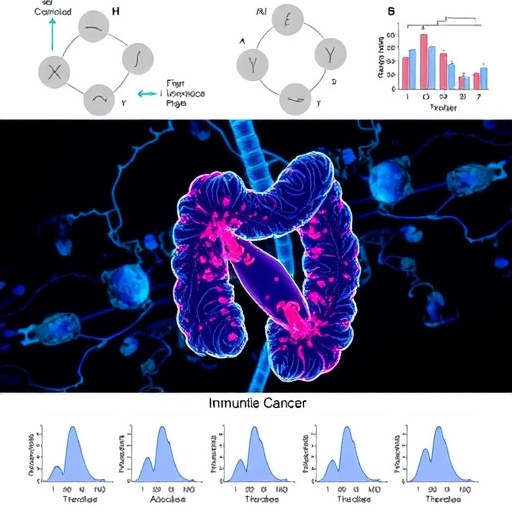
In an extraordinary stride forward for oncological therapeutics, scientists from Tianjin University’s School of Medicine have engineered an innovative bio-nano interface that profoundly alters colorectal cancer treatment paradigms. Their breakthrough is a microbial fuel cell (MFC) system that seamlessly integrates electrogenic bacteria with piezoelectric barium titanate (BaTiO₃) nanoparticles. This newly crafted platform synergistically actuates tumor destruction, immunomodulation, and microbiome remodeling, thereby addressing the colossal challenges posed by colorectal malignancies.
At the core of this technology is a meticulously designed bio-heterojunction that electrostatically assembles PEGylated BaTiO₃ nanoparticles onto the surface of the sulfate-reducing bacterium Desulfovibrio desulfuricans (Dsv). The complex, named Dsv@BTO, is further protected and targeted using enteric-coated chitosan capsules, ensuring robust oral administration with precision delivery to the colon. This architectural innovation ensures that both microbial and abiotic components operate cooperatively within the tumor microenvironment.
Activation of this system is triggered by noninvasive ultrasound, a modality that not only penetrates deep tissues but also offers exquisite spatiotemporal control. Upon ultrasound stimulation, the BaTiO₃ nanoparticles exhibit piezoelectric catalysis, generating localized reactive oxygen species (ROS) and potent electric fields. This electromechanical phenomenon catalyzes oxidative stress that jeopardizes tumor cell viability. Concurrently, the Dsv bacteria engage in extracellular electron transfer, shuttling metabolic electrons to amplify piezocatalytic activity. Importantly, these bacteria also produce hydrogen sulfide (H₂S), a gaseous mediator that disrupts mitochondrial function, collectively inducing apoptotic and pyroptotic tumor cell death pathways.
The dual-threat inflicted on colorectal tumor cells was rigorously evaluated in an orthotopic mouse model of colorectal cancer. Remarkably, treatment with Dsv@BTO encapsulated in chitosan capsules (Dsv@BTO@CS), combined with ultrasound administration, realized an approximately 90% tumor growth inhibition. This dramatic suppression not only extended median survival beyond 30 days but also exhibited a favorable safety profile with no observable systemic toxicity. These results underscore the therapeutic precision and robustness of this bioelectrochemical modality in a complex in vivo environment.
Beyond direct cytotoxicity, this platform exerts profound immunological remodeling within the tumor microenvironment. Flow cytometric and immunohistochemical analyses revealed that therapy stimulated dendritic cell maturation, a critical checkpoint for initiating adaptive immune responses. Additionally, macrophages were reprogrammed towards the M1 phenotype, known for antitumor activity, while regulatory T cells (Tregs), which often facilitate immune evasion in tumors, were markedly suppressed. This reprogramming culminated in enhanced infiltration of cytotoxic CD8⁺ T lymphocytes, amplifying the antitumor immune milieu.
Intriguingly, 16S rRNA gene sequencing elucidated that the treatment also restores gut microbial homeostasis, which is frequently disrupted in colorectal cancer. Post-therapy, there was a notable reversal of cancer-associated dysbiosis characterized by increased microbial diversity and expansion of beneficial taxa, coupled with suppression of pathogenic bacteria. This restoration of the gut microbiome may provide synergistic benefits by modulating systemic immunity and reducing inflammation, factors crucial in cancer progression and patient outcomes.
Professor Xiaoyuan Ji, the study’s lead author, emphasized the significance of this multi-dimensional strategy: “Our approach establishes a novel paradigm in solid tumor therapeutics by building a bio-abiotic electron-transfer interface. Essentially, we create a micro-nano microbial fuel cell within the tumor that couples bacterial metabolism to piezocatalysis. Ultrasound triggers BaTiO₃ to produce local electric fields and cytotoxic species enhanced by bacterial electron transfer. Simultaneously, the immune system is invigorated, and gut microbiota equilibrium is restored. For multifaceted diseases like colorectal cancer, such comprehensive tactics are indispensable.”
This marvel of design overcomes persistent hurdles in existing catalytic therapies, which often suffer from limited charge-separation efficiency and insufficient targeting specificity. The unique ability of bacteria to home to hypoxic tumor regions, combined with their extracellular electron transfer capabilities, provides a critical biological advantage. Ultrasound’s noninvasive nature affords remote, precise control over the therapeutic activation, distinguishing it from conventional modalities and potentially broadening clinical applicability.
Looking toward future horizons, the research team plans to extend investigations of this bioelectrochemical framework to other immunosuppressive, hypoxia-rich solid tumor types. Moreover, significant efforts will be directed towards refining this platform’s scalability and biocompatibility to accelerate its translation from animal models to clinical trials. Such advancements could herald a new era of cancer treatments anchored in bio-hybrid nanotechnology.
The transformative potential of this microbial fuel cell-based bioelectrochemical therapy was showcased in the landmark study entitled “Bio-Heterojunction-based Micro-Nano Microbial Fuel Cell Mediated Bioelectrochemical Therapy of Cancer,” recently published in Science Bulletin. This work was generously supported by the National Natural Science Foundation of China, reflecting a global commitment to pioneering breakthroughs in cancer therapeutics.
By converging microbiology, piezoelectric nanomaterials, and immunotherapy, this innovation illuminates a promising multidisciplinary path forward. The ability to precisely manipulate tumor biology, immune responses, and microbiome health concurrently exemplifies a sophisticated strategy needed to tackle complex diseases like colorectal cancer with unprecedented efficacy.
As cancer therapy increasingly embraces the interplay between the tumor microenvironment and systemic factors, technologies like the Dsv@BTO microbial fuel cell platform will likely become foundational. Their dual capacity to eradicate tumors while orchestrating immune revival and microbiome balance epitomizes next-generation oncological interventions destined to reshape survival prospects and quality of life for affected patients worldwide.
Web References: DOI: 10.1016/j.scib.2025.11.012
Cite Scienmag News
Nathaniel Bowman. (November 15, 2025). Innovative Bioelectroceutical Platform Induces Dual Cell Death and Reverses Immunosuppression in Colorectal Cancer. Scienmag. https://scienmag.com/innovative-bioelectroceutical-platform-induces-dual-cell-death-and-reverses-immunosuppression-in-colorectal-cancer/
Nathaniel Bowman. "Innovative Bioelectroceutical Platform Induces Dual Cell Death and Reverses Immunosuppression in Colorectal Cancer." Scienmag, 15 November 2025, https://scienmag.com/innovative-bioelectroceutical-platform-induces-dual-cell-death-and-reverses-immunosuppression-in-colorectal-cancer/. Accessed 5 September 2026.
Nathaniel Bowman. "Innovative Bioelectroceutical Platform Induces Dual Cell Death and Reverses Immunosuppression in Colorectal Cancer." Scienmag. November 15, 2025. https://scienmag.com/innovative-bioelectroceutical-platform-induces-dual-cell-death-and-reverses-immunosuppression-in-colorectal-cancer/


