


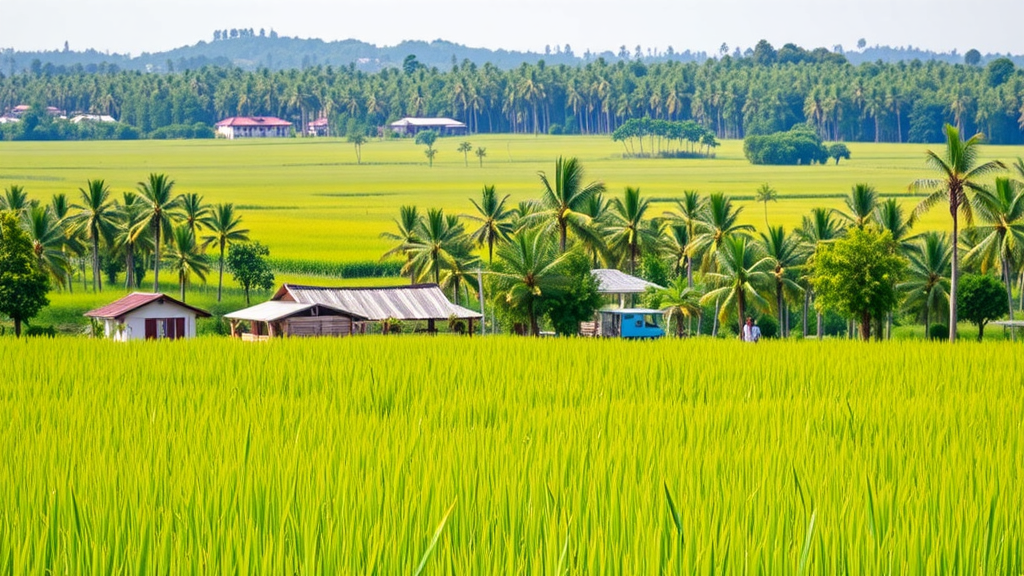
Indonesia stands at a crossroads between two of its most ambitious national goals: achieving a 50 percent biodiesel blending mandate and securing complete self-sufficiency in rice production. A new study published in Nature Sustainability warns that pursuing both simultaneously, under current land constraints and policy settings, could unleash a wave of deforestation on a scale that rivals the most catastrophic emissions events in the country’s modern history. Researchers from the University of Maryland’s Center for Global Sustainability, working with Landscape Indonesia in Jakarta, have produced the most detailed spatial assessment to date of how these competing land demands could reshape the archipelago’s forests, peatlands and agricultural landscapes.
The team set out to answer a deceptively simple question: where, exactly, would the land come from? Indonesia’s B50 mandate requires that half of all diesel fuel consumed nationally be derived from crude palm oil, a policy that has been progressively ratcheted upward over the past decade as the country sought to reduce imported fuel dependence and absorb domestic palm oil surpluses. At the same time, the government has pledged rice self-sufficiency through nationally planned food estates, a program with deep historical roots stretching back to presidential decrees of the 1990s and repeatedly revived by successive administrations. Both policies enjoy strong political momentum, and neither accounts explicitly for the other’s appetite for land.
Methodologically, the study is notable for its combination of an improved high-resolution land cover map with a multicriteria evaluation framework and production scenario modelling. The researchers used the analytic hierarchy process, a structured technique for weighting competing decision criteria first formalized by Thomas Saaty, to rank candidate parcels of land according to suitability for oil palm and rice cultivation. Criteria included agroclimatic conditions, soil characteristics, slope, accessibility and, critically, constraints designed to reflect current policy such as moratoria on new permits in primary natural forests and peatlands. Production scenarios were then modelled to determine how much land would need to be converted under different yield assumptions and land restriction regimes, with results disaggregated by island to capture Indonesia’s enormous geographic heterogeneity.
The headline numbers are stark. Meeting the B50 biodiesel target by 2030 would require converting between 4.85 and 8.55 million hectares of land to oil palm, depending on yield trajectories and the strictness of forest and peatland constraints. Achieving rice self-sufficiency through the planned food estate program could convert up to 2.3 million additional hectares. The modelling revealed substantial spatial overlap between the zones most suitable for food production and those targeted for energy crops, meaning the two flagship programs would compete directly for the same finite and increasingly scarce agricultural frontier. On islands such as Kalimantan and Papua, where much of the remaining forest estate lies, this overlap translates into direct pressure on intact tropical ecosystems.
The carbon consequences are potentially enormous. The study estimates that land conversion for oil palm expansion would release between 360 and 3,753 megatonnes of carbon dioxide equivalent, while conversion for rice cultivation could emit a further 509 to 1,297 megatonnes. The upper bounds of these estimates would surpass historic Indonesian emissions events, including the devastating 2015 fire crisis, when burning peatlands and forests released carbon on a scale that briefly made Indonesia one of the world’s largest national emitters. Satellite-based studies of that crisis estimated CO2 emissions exceeding 1,500 megatonnes in a matter of weeks, and the new analysis suggests that gradual, policy-driven land conversion could ultimately deliver a comparable or larger pulse of greenhouse gases, silently and legally, undermining the enhanced nationally determined contribution that Indonesia has submitted under the Paris Agreement.
The researchers emphasize that the ranges are wide precisely because policy choices matter. Where land conversion is constrained to already degraded or non-forest land, and where yields are improved through intensification rather than expansion, both land requirements and emissions fall dramatically at the lower end of the scenarios. Conversely, if constraints are relaxed, as some political proposals to open 20 million hectares of forest for food and energy production would imply, the upper bounds come into play. The yield gap analysis in the study shows that Indonesia’s existing rice and palm oil lands produce well below their agronomic potential, and that closing this gap through better seed varieties, fertilizer management and replanting of aging palm plantations could substitute for a substantial share of new land conversion.
Peatlands emerge as a particularly dangerous fault line in the analysis. Several of the planned food estates are located on or near deep peat soils, including areas with a troubled history such as the former Mega Rice Project in Central Kalimantan, an earlier attempt at rice self-sufficiency that drained vast peat swamps in the 1990s, produced almost no rice, and left behind a landscape chronically vulnerable to fire. Draining and converting peatlands releases not only the carbon stored in vegetation but also the far larger stocks oxidizing in the soil itself, generating emissions that continue for decades. The study’s emission estimates incorporate these soil carbon dynamics, which is why the upper-bound figures for rice are so severe relative to the land area involved.
The authors argue that the solution lies not in abandoning food or energy security but in integrating the planning of both. They call for policy frameworks that explicitly coordinate land allocation across sectors, prioritize intensification on existing agricultural land, enforce existing forest and peatland moratoria rigorously, and steer any necessary expansion toward degraded lands with low carbon stocks and low biodiversity value. The spatial tools developed in the study, which the team has made publicly available through a GitHub repository alongside the underlying data and code, are designed to support exactly this kind of integrated decision-making, allowing planners to visualize trade-offs before commitments are locked in. The analysis also implicitly speaks to a broader global debate about the land requirements of the energy transition, echoing recent findings from studies of food system efficiency in China and bioenergy expansion in Asia that show how poorly coordinated sectoral targets can multiply environmental damage.
For Indonesia, the stakes extend well beyond carbon. Forest conversion on the scale modelled would fragment some of the world’s richest biodiversity reservoirs, threaten the livelihoods of indigenous and local communities whose land tenure remains insecure, and expose the country to heightened fire and flood risks. The study’s authors, led by Claire V. Squire and Jiehong Lou, conclude that without a more coherent national land-use strategy, Indonesia risks trading short-term gains in fuel blending percentages and rice production statistics for long-term losses to its climate commitments, its forests and the communities that depend on them. Whether the country can reconcile its food, energy and environmental ambitions will be one of the defining sustainability tests of the coming decade, and the numbers in this analysis suggest the window for getting the balance right is rapidly narrowing.
Subject of Research: Spatial optimization of land use for biodiesel production, rice self-sufficiency and forest conservation in Indonesia
Article Title: Land-use optimization for food security, bioenergy and forest conservation in Indonesia
Article References: Squire, C. V., Lou, J., Parker, K. J., Schreier, M. A., Hilde, T. C., Sari, A., Lohff, L. C., Shah, K., & Hultman, N. (2026). Land-use optimization for food security, bioenergy and forest conservation in Indonesia. Nature Sustainability. https://doi.org/10.1038/s41893-026-01923-7
Image Credits: AI Generated
DOI: 10.1038/s41893-026-01923-7
Keywords: Indonesia, land-use optimization, biodiesel, rice self-sufficiency, deforestation, oil palm, food estates, carbon emissions, peatlands, forest conservation, bioenergy, Nature Sustainability
Cite Scienmag News
Sloane Callahan. (September 12, 2026). Indonesia’s Biodiesel and Rice Ambitions Could Trigger Massive Deforestation. Scienmag. https://scienmag.com/indonesias-biodiesel-and-rice-ambitions-could-trigger-massive-deforestation/
Sloane Callahan. "Indonesia’s Biodiesel and Rice Ambitions Could Trigger Massive Deforestation." Scienmag, 12 September 2026, https://scienmag.com/indonesias-biodiesel-and-rice-ambitions-could-trigger-massive-deforestation/. Accessed 5 October 2026.
Sloane Callahan. "Indonesia’s Biodiesel and Rice Ambitions Could Trigger Massive Deforestation." Scienmag. September 12, 2026. https://scienmag.com/indonesias-biodiesel-and-rice-ambitions-could-trigger-massive-deforestation/


