


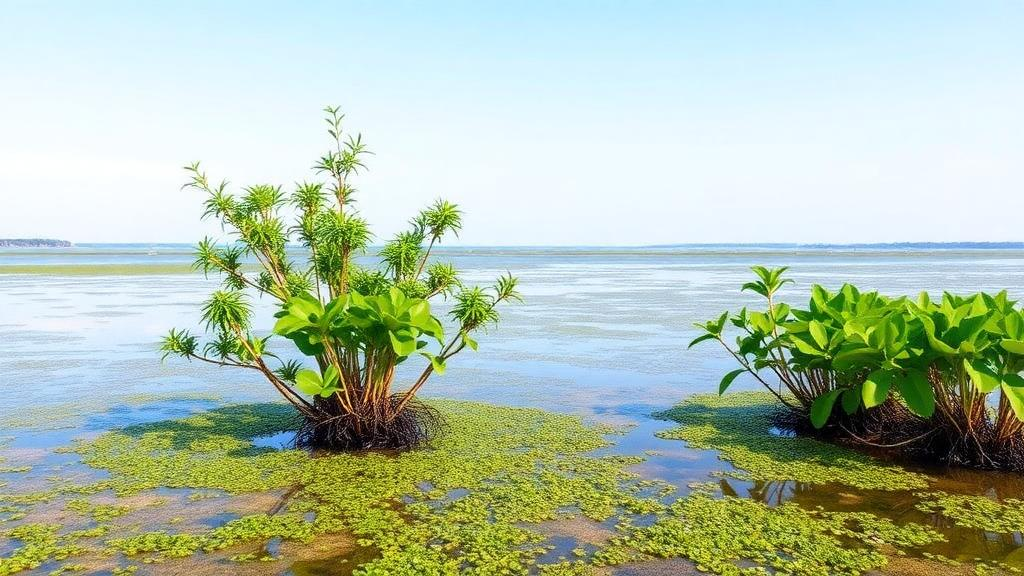
Coastal ecosystems have quietly become one of the most compelling stories in climate science, and a comprehensive new review published in Discover Oceans pulls together two decades of evidence to explain why. The synthesis, led by Yuvaraj Dinakarkumar and colleagues, examines how mangroves, salt marshes and seagrass meadows capture and lock away atmospheric carbon dioxide over hundreds to thousands of years, a process scientists call blue carbon sequestration. Drawing on peer-reviewed studies published between 2000 and 2024, the authors assemble a detailed picture of the biological, chemical and physical machinery that makes these habitats among the most efficient carbon sinks on the planet, while also cataloguing the pollution and land-use pressures that threaten to turn them from sinks into sources.
The numbers behind the review are striking. Mangroves can hold up to 1,023 megagrams of carbon per hectare below ground, supported by anoxic, sulfate-reducing sediments and vertical accretion rates of 3 to 10 millimetres per year. Salt marshes sequester between 150 and 250 grams of carbon per square metre annually, while seagrass meadows bury 30 to 218 grams per square metre each year. Per unit area, these figures rival or exceed the sequestration rates of tropical rainforests, and salt marshes have been reported to store up to ten times more carbon per hectare than many terrestrial ecosystems. Because roughly half of all photosynthesis on Earth occurs in the ocean, the marine carbon cycle exerts a profound influence on atmospheric chemistry, and vegetated coastal habitats sit at the sharp end of that cycle.
The secret to mangrove carbon storage lies largely underground. Between 50 and 70 percent of the carbon in a mangrove forest resides in roots and soils, where prop roots, pneumatophores and fine root networks continuously deliver organic matter to the sediment. Waterlogged, oxygen-poor conditions suppress aerobic decomposition, forcing microbes down slower metabolic pathways such as fermentation and sulfate reduction. As a result, organic matter in mangrove soils breaks down three to ten times more slowly than in upland soils. The leaves and woody tissue of mangroves add another layer of defence, containing high concentrations of lignin, tannins and other polyphenolic compounds that resist microbial attack, extending the residence time of carbon in the sediment for centuries or even millennia.
Physical processes reinforce the biological ones. Dense canopies and root mats slow water flow, trapping fine mineral and organic particles delivered by rivers, tides and waves. This promotes vertical accretion, allowing mangroves in sediment-rich regions to accumulate surface elevation at rates exceeding 10 millimetres per year, which helps them keep pace with moderate sea-level rise while continuously burying carbon. Salt marshes operate on similar principles, trapping suspended sediments and building elevation under favourable tidal conditions. Seagrass meadows, descended from land plants that returned to the sea roughly 100 million years ago, stabilise sediments with dense root and rhizome mats, and global syntheses indicate they can store roughly twice as much carbon per hectare as terrestrial forests. Nutrient supply through their roots allows seagrasses to keep accumulating carbon even in otherwise nutrient-poor waters.
Microbes and algae add further dimensions to the story. The review highlights the microbial carbon pump, a process by which marine bacteria convert labile organic matter into refractory dissolved organic carbon that resists degradation and persists in the ocean for long periods. Alongside the biological pump, which transports roughly 10 to 15 percent of ocean primary production into the deep sea, and microbially induced carbonate precipitation, these mechanisms extend carbon storage far beyond the coastal zone. Macroalgae contribute as well, with an estimated 90 percent of algal carbon sequestration exported to the deep sea and the remainder buried in coastal sediments. Microalgae, which fix carbon dioxide at rates up to ten times more efficient per unit of solar energy than terrestrial plants, are attracting attention as candidates for engineered carbon removal.
Yet the review is equally clear about the fragility of these systems. Disturbance can flip a blue carbon sink into a carbon source with alarming speed. Converting mangrove forests to aquaculture ponds can release carbon at rates up to 50 times higher than the sequestration achieved by intact forests, while deforestation and hydrological alteration raise emissions to levels 10 to 40 times above normal sequestration. Drainage and aeration of organic-rich soils accelerate decomposition, and sediment erosion exposes long-buried carbon to oxidation. Methane generation under shifting hydrological regimes adds another greenhouse gas pathway. The authors also flag bioturbation as a double-edged factor: crabs remove an average of 87 percent of daily mangrove litter fall in some Thai forests, and burrowing animals in marshes and seagrass beds alter sediment mixing, burial depth and porewater exchange in ways that can either aid or undermine carbon retention.
Environmental drivers complicate the picture further. Moderate sea-level rise can actually enhance carbon burial by encouraging sediment trapping and peat formation, but rapid rise can drown marshes and mangroves, releasing stored carbon and, in some conditions, promoting methane and nitrous oxide emissions. Elevated temperatures accelerate decomposition of tropical wetland soils, stronger storms erode seagrass meadows and their carbon reserves, and Mediterranean droughts have reduced primary production in Posidonia oceanica meadows. Hydrology matters enormously: tidal connection in mangroves raises sediment deposition from less than 2 millimetres per year in restricted systems to more than 10 millimetres per year in open tidal habitats, and carbon accumulation in salt marshes correlates strongly with tidal amplitude. Nutrients cut both ways, since moderate nitrogen and phosphorus inputs stimulate productivity while excessive loading from agriculture and wastewater drives algal blooms, reduces water clarity and accelerates greenhouse gas emissions.
The pollution control function of blue carbon ecosystems is one of the review’s most intriguing threads. Mangrove and salt marsh root systems slow water flow and promote deposition of suspended particles, immobilising heavy metals such as lead, cadmium and zinc, along with hydrocarbons and persistent organic pollutants, in anoxic soils. Seagrass canopies trap fine particles and microplastics, reducing their transport into coastal waters, while plant uptake and microbial denitrification remove excess nitrogen and improve water quality. Mangrove sediments have even been identified as major sinks for plastic burial. However, the authors caution that accumulating plastics impose physical stress on organisms, risk ingestion by invertebrates and fish, and may alter sediment structure and microbial activity in ways that could affect organic carbon burial and greenhouse gas fluxes, making the interaction between pollution and carbon storage a priority research area.
Restoration offers genuine grounds for optimism. Meta-analyses and long-term field studies indicate that restored mangroves, salt marshes and seagrass beds can recover 50 to 90 percent of depleted carbon stocks over several decades, with some planted mangroves regaining significant portions of ecosystem carbon in under 20 years. Restored seagrass meadows have achieved carbon accumulation rates of roughly 20 to 40 grams per square metre per year within a decade, and managed realignment of salt marshes has produced rapid carbon accumulation in its early years. Measurement techniques are advancing in parallel, with lidar remote sensing enabling precise biomass estimates in inaccessible terrain, sediment coring paired with radiometric dating revealing long-term storage, and GIS-based carbon budgeting scaling local measurements to regional estimates.
The policy implications are substantial. Mangroves alone are estimated to capture up to 42 million tons of carbon annually worldwide, and blue carbon offsetting is emerging as a mechanism for channelling finance into coastal conservation, with co-benefits spanning storm protection, fisheries support and biodiversity. The authors argue that realising this potential requires marine protected areas, hydrological restoration, catchment-level management of nutrient inputs, standardised monitoring protocols and integration of blue carbon into national climate strategies and carbon markets. The IPCC’s Sixth Assessment Report recognises ecosystem restoration as a significant natural option for boosting carbon burial and coastal resilience. As the review concludes, protecting intact mangroves, marshes and meadows is not merely a carbon accounting exercise; it is an investment in living infrastructure that filters pollutants, buffers storms and quietly performs one of the most valuable services on the planet, one gram of buried carbon at a time.
Subject of Research: Blue carbon sequestration mechanisms and pollution control in coastal ecosystems for climate change mitigation
Article Title: Mechanisms, processes, and implications of blue carbon sequestration and pollution control for climate change mitigation
Article References: Dinakarkumar, Y., Selvam, M. M., Inayathullah, N., Pavithra, K. S., Mallikarjuna, H. N., Indhusuvitha, S., Jebacani, M. J., Romauld, S. I., & Muthezhilan, R. (2026). Mechanisms, processes, and implications of blue carbon sequestration and pollution control for climate change mitigation. Discover Oceans, 3(1), Article 5. https://doi.org/10.1007/s44289-026-00118-4
Image Credits: AI Generated
DOI: 10.1007/s44289-026-00118-4
Keywords: blue carbon, mangroves, salt marshes, seagrass meadows, carbon sequestration, climate change mitigation, coastal ecosystems, sediment carbon burial, pollution control, sea-level rise, ecosystem restoration, microbial carbon pump
Cite Scienmag News
Sloane Callahan. (October 5, 2026). Mangroves, Marshes and Seagrass Meadows Emerge as Powerful Climate Allies. Scienmag. https://scienmag.com/mangroves-marshes-and-seagrass-meadows-emerge-as-powerful-climate-allies/
Sloane Callahan. "Mangroves, Marshes and Seagrass Meadows Emerge as Powerful Climate Allies." Scienmag, 5 October 2026, https://scienmag.com/mangroves-marshes-and-seagrass-meadows-emerge-as-powerful-climate-allies/. Accessed 5 October 2026.
Sloane Callahan. "Mangroves, Marshes and Seagrass Meadows Emerge as Powerful Climate Allies." Scienmag. October 5, 2026. https://scienmag.com/mangroves-marshes-and-seagrass-meadows-emerge-as-powerful-climate-allies/


