


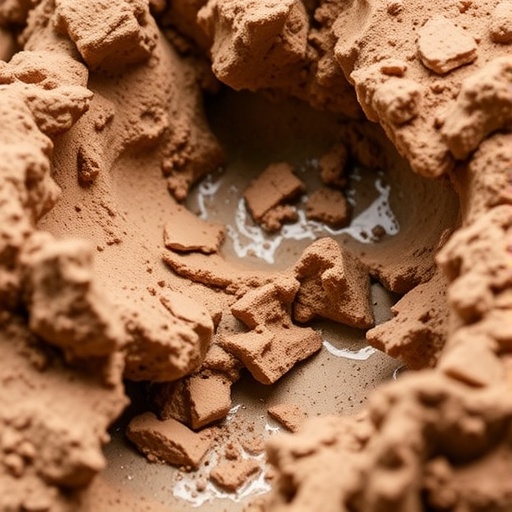
In the pursuit of sustainable and effective soil stabilization techniques, the recent comprehensive review on hydrothermal stabilization of clay soils using industrial by-products represents a significant leap forward in geomaterials engineering. This innovative approach focuses on the transformation of problematic clay soils into stable substrates, leveraging the synergy of heat and industrial waste to enhance the mechanical and chemical properties of soils. The implications of this research span environmental remediation, civil engineering, and waste management, offering a promising avenue for circular economy solutions within geotechnical applications.
Clay soils, often characterized by their fine particle size and high plasticity, present substantial challenges for construction and infrastructure projects. Their propensity for volume change, low strength, and poor drainage complicate foundation stability and roadbed durability. Traditional stabilization methods, such as lime or cement addition, while effective, are sometimes costly, environmentally taxing, or limited by local availability and long-term sustainability concerns. Hence, innovations that exploit industrial by-products not only address soil behavior issues but also contribute to waste valorization and carbon footprint reduction.
The hydrothermal stabilization process involves subjecting clay soils mixed with industrial residues to elevated temperatures and pressurized steam or water, fostering chemical reactions and phase transformations that fundamentally alter soil microstructure. Such treatments accelerate pozzolanic reactions, enhance particle bonding, and promote the formation of cementitious compounds within the soil matrix. The review meticulously elucidates how these microstructural changes lead to improved soil strength, reduced plasticity, and enhanced durability against environmental factors.
From a chemical standpoint, the inclusion of industrial by-products – such as fly ash, slag, and red mud – introduces reactive alumino-silicate components that, under hydrothermal conditions, actively participate in forming stable calcium silicate hydrates (C-S-H), ettringite, and other neoformed minerals. These compounds act as binding agents, filling voids between clay particles and creating a denser, more cohesive soil matrix. Such interactions not only reduce permeability but also enhance resistance to water-induced deterioration, a common weakness in untreated clayey soils.
The microstructural evolution, observed via advanced microscopy and spectroscopy techniques, reveals a marked transition from flaky and loosely bonded clay platelets to a more compacted granular architecture. Hydrothermal activation facilitates the dissolution of original mineral components and subsequent reprecipitation in a form that supports higher load-bearing capacity. This rearrangement at the microscale is the foundation for the macroscale improvements in geotechnical parameters such as unconfined compressive strength and California bearing ratio values.
Importantly, the review highlights the significance of optimizing hydrothermal conditions — including temperature, pressure, and treatment duration — to tailor soil stabilization outcomes. Elevated temperatures, typically between 100°C and 250°C, accelerate secondary mineral formation but necessitate energy inputs that must be balanced against environmental and economic factors. Duration of treatment governs the extent of chemical transformation, with diminishing returns beyond a certain threshold, emphasizing the need for process efficiency.
The choice of industrial by-product also critically influences stabilization efficacy. Fly ash rich in silica and alumina provides ample reactive phases for hydrothermal pozzolanic reactions, while slag contributes calcium availability, essential for C-S-H formation. The heterogeneous nature of industrial wastes requires thorough characterization to predict their behavior during treatment and ensure repeatable soil engineering results. Furthermore, incorporating these materials reduces industrial waste disposal challenges, aligning with sustainable development goals.
Mechanically, hydrothermal treatment significantly enhances stabilized soil properties, demonstrating increased stiffness and strength compared to untreated or conventionally stabilized soils. The review collates a wide array of experimental data, showing improvements in bearing capacity and shear strength that enable safer and more durable infrastructure foundations. These gains could translate into cost savings by reducing the need for deep foundations, soil replacement, or extensive drainage systems.
In addition to strength improvements, durability under environmental stressors such as freeze-thaw cycles, wet-dry sequences, and chemical exposure is also markedly improved. The densification and mineralogical transformations triggered by hydrothermal stabilization make clay soils less susceptible to moisture-induced volume changes and erosion. This aspect is critical for long-term performance, especially in regions facing climatic variability or aggressive soil-water chemistry.
Environmental benefits emerge as a compelling aspect of hydrothermal soil stabilization with industrial by-products. By valorizing waste materials, this method reduces reliance on virgin resources and mitigates landfill burden. When considering life cycle assessments, hydrothermal stabilization may lower overall greenhouse gas emissions associated with soil treatment. Yet, responsible sourcing and processing of by-products remain vital to prevent introduction of heavy metals or pollutants into soil ecosystems.
The review also identifies knowledge gaps and future research directions necessary for widespread commercial adoption. These include scaling-up pilot experiments for field applications, refining energy consumption models, and assessing long-term environmental impacts under real-world conditions. Integrating hydrothermal treatments within existing geotechnical workflows and regulatory frameworks will require interdisciplinary collaboration among geotechnical engineers, materials scientists, and environmental specialists.
Emerging analytical techniques and modeling approaches contribute to a growing mechanistic understanding of hydrothermal stabilization chemistry and mechanics. Synchrotron-based imaging, nuclear magnetic resonance (NMR), and electron microscopy unveil transient phases and reaction kinetics previously unrecognized. Computational simulations coupling chemical thermodynamics with mechanical behavior are increasingly sophisticated, offering predictive tools to optimize formulations and treatment regimes.
This innovation dovetails with broader trends in infrastructure resilience and green engineering. As urbanization accelerates and climate change exacerbates geotechnical hazards, techniques offering durability, resource circularity, and environmental compatibility become indispensable. Hydrothermal stabilization with industrial by-products situates itself as a technology addressing these intertwined challenges, providing a scalable solution to reinforce foundational soils while contributing to sustainable industry practices.
In summary, the reviewed research delineates a compelling narrative of how hydrothermal processes utilizing industrial waste can revolutionize clay soil stabilization. By comprehensively linking microstructural evolution, chemical speciation, and mechanical property enhancement, the study offers both fundamental insights and practical guidelines for engineers and policymakers. Such integration paves the way for safer, more sustainable infrastructure development that aligns with ecological stewardship.
The implications for future engineering projects are profound. With appropriate adaptation, hydrothermal stabilization could significantly expand the portfolio of soil improvement methods, enabling construction in previously unsuitable locations or enhancing existing infrastructure lifespan. Moreover, this approach fosters industrial symbiosis, turning waste liabilities into valuable resources, exemplifying principles of circular economy in the built environment.
Overall, this holistic examination underscores the transformative potential of coupling advanced material science with industrial ecology in tackling persistent geotechnical challenges. As climate resilience and resource optimization rise in priority globally, the hydrothermal stabilization of clay soils via industrial by-products stands out as a vanguard strategy that harmonizes technical performance with environmental responsibility.
Cite Scienmag News
Violet Maxwell. (August 2, 2025). Hydrothermal Clay Stabilization with Industrial By-products. Scienmag. https://scienmag.com/hydrothermal-clay-stabilization-with-industrial-by-products/
Violet Maxwell. "Hydrothermal Clay Stabilization with Industrial By-products." Scienmag, 2 August 2025, https://scienmag.com/hydrothermal-clay-stabilization-with-industrial-by-products/. Accessed 5 September 2026.
Violet Maxwell. "Hydrothermal Clay Stabilization with Industrial By-products." Scienmag. August 2, 2025. https://scienmag.com/hydrothermal-clay-stabilization-with-industrial-by-products/


