


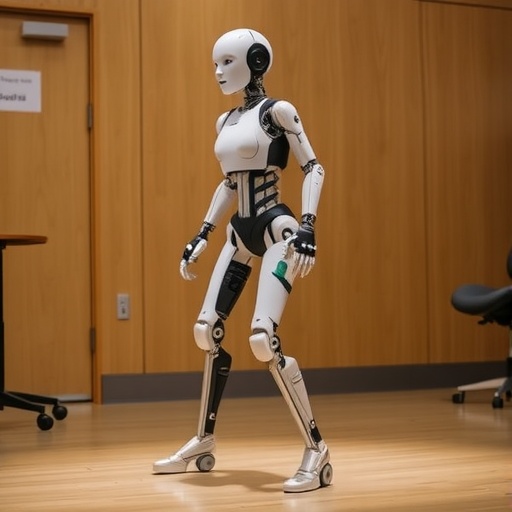
In a groundbreaking advancement poised to redefine neurorehabilitation, researchers have unveiled a sophisticated hybrid electrical stimulation (ES) and robotic device designed specifically for gait training in individuals suffering from neurological disorders. This innovative technology represents a remarkable convergence of bioengineering, robotics, and neurophysiology, offering new hope for millions worldwide who face mobility challenges due to conditions such as stroke, spinal cord injury, or multiple sclerosis.
Central to this transformative development is the integration of electrical stimulation with robotic assistance, a dual approach that amplifies therapeutic potential beyond conventional methods. While robotic gait trainers have gained traction for their ability to support weight and guide limb movements repetitively, their combination with targeted ES introduces a novel mechanistic synergy. Electrical stimulation acts on peripheral nerves and muscles to evoke contractions and modulate neural circuits, which, when paired with precise robotic facilitation, promotes neuroplasticity and functional recovery more effectively.
The device itself comprises a wearable exoskeleton equipped with multi-joint actuators that deliver controlled mechanical assistance during walking motions. Embedded electrodes provide finely-tuned electrical impulses to stimulate specific muscle groups at critical phases of the gait cycle. Such synchronization ensures that muscle activation patterns closely mimic physiological norms, an aspect crucial for retraining the central nervous system and restoring natural motor function. This harmonious stimulation and mechanical guidance is designed not only to improve immediate mobility but also to induce long-term neurological remodeling.
Researchers employed advanced sensor arrays and real-time feedback algorithms to adaptively modulate the intensity and timing of both electrical and robotic outputs. This closed-loop system tailors the intervention to individual patient capacity and progression, maximizing therapeutic efficacy while minimizing fatigue or discomfort. The ability to dynamically customize treatment parameters marks a significant departure from static rehabilitation protocols, heralding an era of personalized neurorehabilitation based on continuous biofeedback.
Preliminary clinical trials demonstrated that patients using this hybrid device exhibited enhanced improvements in walking speed, endurance, and overall gait quality compared to groups receiving either robotic or electrical stimulation therapy alone. Notably, neuroimaging studies revealed increased activation in motor cortical areas and enhanced corticospinal tract integrity after extended training sessions, suggesting that the intervention facilitates cortical reorganization and neural repair. These findings underscore the profound capacity of combined ES-robotic training to harness innate neuroplastic mechanisms.
The implications of such a multifaceted approach are expansive. For individuals paralyzed or weakened by neurological insults, regaining independent mobility is paramount—not only for physical health but also for psychological wellbeing and social reintegration. Devices that can accelerate and augment recovery trajectories while being adaptable to a wide range of impairments could dramatically reduce healthcare burdens and improve quality of life. Moreover, the modular nature of this technology permits integration with emerging therapeutic modalities such as brain-computer interfaces or pharmacological agents aimed at enhancing neural regeneration.
From a biomechanical perspective, fine-tuning the interplay between robotic assistance and electrical stimulation required overcoming significant challenges. The reported system accounts for inter-individual variability in musculoskeletal dynamics, spasticity levels, and residual neural control. To do so, the engineering team developed novel algorithms capable of interpreting electromyographic signals and adapting stimulation patterns accordingly. This represents an unprecedented level of sophistication in closed-loop rehabilitation devices, combining human-machine interaction with physiological responsiveness.
Equally pivotal is the psychological dimension addressed by the device’s design. By fostering active patient engagement and offering instant sensory feedback, the system encourages motor learning processes fundamental to neurorehabilitation. Unlike passive modalities, this empowering interface ensures patients are not mere recipients but active participants in their recovery journey. Clinicians noted increased motivation and adherence due to the device’s intuitive controls and gamified training scenarios, further amplifying therapeutic outcomes.
The path from concept to clinical application entailed meticulous multidisciplinary collaboration bridging neuroscience, robotics, clinical rehabilitation, and computational modeling. The research team validated their prototype through extensive bench tests, simulations, and pilot human studies before launching the current clinical trial phase. Ethical considerations were scrupulously addressed, ensuring patient safety and informed consent throughout development, with promising early results paving the way for larger-scale adoption.
Financial accessibility and scalability remain critical considerations for widespread dissemination. The investigators outlined strategies to streamline manufacturing costs and integrate with existing rehabilitation infrastructures to facilitate deployment across diverse healthcare settings—including outpatient clinics, rehabilitation centers, and even home-based therapy. Such adaptability is crucial to democratize access to cutting-edge neurorehabilitation technologies, overcoming geographical and economic barriers.
As neurological disorders continue to impose profound societal and economic burdens globally, innovations like this multifaceted hybrid ES-robotic device offer a beacon of hope. By harnessing the convergence of engineering ingenuity and neurophysiological insight, this technology not only restores physical function but also redefines the possibilities for recovery and autonomy after neurological injury. Ongoing research will undoubtedly refine its capabilities, optimize patient protocols, and expand its applications to other motor impairments.
Looking ahead, integration with artificial intelligence promises to further enhance the system’s capacity to personalize and adapt rehabilitation dynamically. AI-driven data analytics could uncover subtle patterns in patient progress, informing clinicians of optimal intervention strategies. Such advancements will usher in an era where rehabilitation is not static and generic but a responsive, evolving process tailored to the neurobiological needs and potentials of each individual.
In essence, the emergence of this hybrid ES-robotic device marks a paradigm shift, moving rehabilitation closer to a future where technology seamlessly augments the body’s inherent healing mechanisms. Its development underscores the critical importance of interdisciplinary collaboration in solving complex biomedical challenges. For millions affected by neurological disabilities, it shines as a testament to how human ingenuity and compassion can converge to restore mobility, dignity, and hope.
Cite Scienmag News
Cassandra Pierce. (September 27, 2025). Hybrid ES-Robotic Device Advances Neurological Gait Training. Scienmag. https://scienmag.com/hybrid-es-robotic-device-advances-neurological-gait-training/
Cassandra Pierce. "Hybrid ES-Robotic Device Advances Neurological Gait Training." Scienmag, 27 September 2025, https://scienmag.com/hybrid-es-robotic-device-advances-neurological-gait-training/. Accessed 4 September 2026.
Cassandra Pierce. "Hybrid ES-Robotic Device Advances Neurological Gait Training." Scienmag. September 27, 2025. https://scienmag.com/hybrid-es-robotic-device-advances-neurological-gait-training/


