


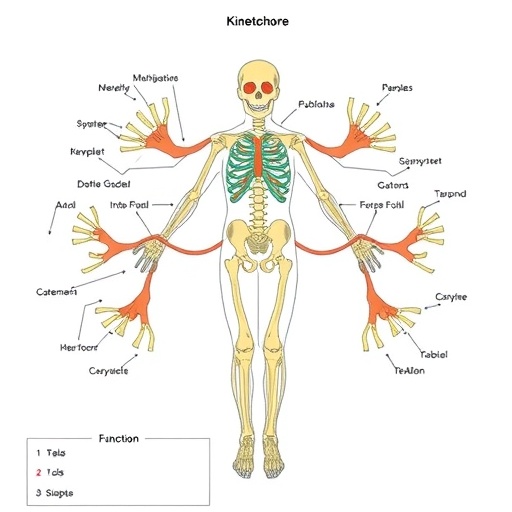
The molecular machine that decides when a chromosome is ready to move during cell division is coming into sharper focus. In a new Review published in Nature Reviews Molecular Cell Biology, researchers examine how the outer kinetochore coordinates microtubule attachment, chromosome alignment and the spindle assembly checkpoint. The work highlights a striking biological challenge: each chromosome-binding site may contain only a small number of core kinetochore complexes, yet those complexes must make highly accurate decisions under the intense mechanical and chemical activity of mitosis.
The kinetochore forms on the centromere, a specialized region of chromosome DNA packaged into distinctive chromatin. It is organized into an inner region, which connects the complex to centromeric chromatin, and an outer region, which interfaces with the mitotic spindle. The outer kinetochore acts as both a mechanical coupler and a signaling platform. It must capture dynamic microtubules extending from opposite spindle poles, withstand pulling forces and communicate whether chromosome attachment is correct.
At the center of this outer structure is the Knl1–Mis12–Ndc80, or KMN, network. The Mis12 complex helps assemble the outer kinetochore architecture, while Knl1 provides a large platform for regulatory proteins. The Ndc80 complex extends toward spindle microtubules and binds their tubular walls through a specialized, elongated structure. Together, these components create the principal microtubule-binding interface at the kinetochore and organize the molecular regulators that control attachment stability and mitotic timing.
Microtubules are not static cables. They constantly grow and shrink as tubulin subunits are added or removed, creating a rapidly changing environment at chromosome attachment sites. The Ndc80 complex must remain connected to these dynamic polymers while allowing the kinetochore to respond to force. Structural and biochemical studies suggest that the outer kinetochore behaves less like a rigid clamp and more like a flexible, multicomponent coupling device. Its parts can shift relative to one another, enabling attachment to remain productive as microtubules change shape and generate tension.
That tension is essential for chromosome biorientation, the condition in which sister kinetochores attach to microtubules connected to opposite spindle poles. Correct biorientation produces opposing forces that stabilize the attachment and help position chromosomes at the cell’s equator. Incorrect attachments, including those in which both sister kinetochores connect to the same pole, must be detected and corrected before the cell exits mitosis. The Review brings together live-cell imaging and reconstituted biochemical systems to explain how the kinetochore distinguishes durable, tension-bearing attachments from unstable or erroneous ones.
The same KMN network also serves as the main platform for the spindle assembly checkpoint, a surveillance system that delays mitotic progression until chromosomes are properly attached. Knl1 is particularly important in this process because it recruits checkpoint proteins to unattached or improperly attached kinetochores. These factors can assemble signaling complexes that generate a “wait” message, preventing activation of the machinery that drives mitotic exit. Once attachment is completed and checkpoint signaling is silenced, the cell can proceed with chromosome separation.
A central question is how one molecular assembly can perform apparently conflicting tasks. The kinetochore must hold microtubules firmly enough to move chromosomes, yet it must also release faulty attachments and transmit a biochemical warning when attachment is incomplete. The emerging answer involves regulated changes in molecular interactions rather than a single on-or-off switch. Phosphorylation, mechanical tension, protein turnover and the spatial organization of checkpoint factors can alter the behavior of KMN components within seconds.
High-resolution structural analyses have revealed how the individual parts of the KMN network fit together, while biochemical reconstitutions have tested how purified components bind microtubules and respond to regulatory signals. Live-cell imaging adds a crucial dimension by showing how these interactions operate in real time inside dividing cells. When combined, these approaches indicate that kinetochore function depends on the coordinated behavior of a limited number of complexes, each contributing to attachment, force transmission and checkpoint control.
The Review also underscores why errors at the kinetochore matter far beyond the mechanics of cell division. If chromosomes are distributed incorrectly, daughter cells can inherit abnormal chromosome numbers, a condition known as aneuploidy. Such errors are associated with developmental disorders, infertility and cancer. By clarifying how the outer kinetochore integrates mechanical and biochemical information, the work provides a framework for understanding both the precision of normal mitosis and the vulnerabilities that may arise when kinetochore regulation fails.
Rather than presenting the kinetochore as a fixed molecular scaffold, the authors describe it as a dynamic decision-making system. Its small collection of KMN complexes must continuously interpret microtubule behavior, mechanical tension and checkpoint status, then adjust attachment and signaling accordingly. This view is reshaping research into chromosome segregation and may eventually help explain how dividing cells maintain genomic stability despite the inherently unstable nature of the spindle.
Cite Scienmag News
Ophelia Keating. (August 3, 2026). How the Outer Kinetochore Is Built and Functions. Scienmag. https://scienmag.com/how-the-outer-kinetochore-is-built-and-functions/
Ophelia Keating. "How the Outer Kinetochore Is Built and Functions." Scienmag, 3 August 2026, https://scienmag.com/how-the-outer-kinetochore-is-built-and-functions/. Accessed 3 September 2026.
Ophelia Keating. "How the Outer Kinetochore Is Built and Functions." Scienmag. August 3, 2026. https://scienmag.com/how-the-outer-kinetochore-is-built-and-functions/


