


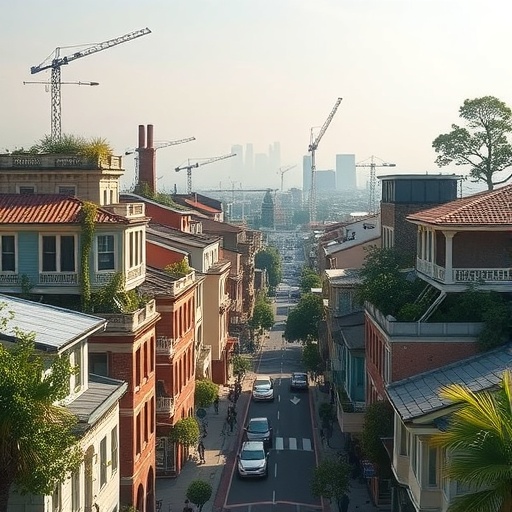
The shape of a building’s roof could dramatically alter how quickly traffic pollution escapes an urban street, according to a new study that combines computational fluid dynamics with wind-tunnel experiments. The research suggests that urban air quality cannot be managed reliably by treating trees, buildings and roads as separate design problems. Instead, the interaction between roof geometry and vegetation may determine whether polluted air is swept away from pedestrians or held in a stagnant pocket at street level. In the most striking result, a carefully configured vaulted-roof street canyon increased its dimensionless air-exchange rate by almost 90 percent and raised its dimensionless net escape velocity by more than four times. The findings point toward a more precise form of “urban breathability,” in which architectural details and green infrastructure are designed together rather than added independently.
Street canyons are the corridors formed by rows of buildings on either side of a road. Their geometry can create atmospheric conditions very different from those above the city. When wind passes over the buildings, it may circulate within the canyon as a large recirculating vortex, drawing exhaust from vehicles upward along one wall and back down along the other. If the flow is weak or obstructed, pollutants can accumulate near the pavement, where people walk, cycle and wait for transport. The problem is especially complex because trees both influence and respond to this flow. Their crowns absorb momentum from the wind, creating aerodynamic resistance, while their branches and leaves can redirect air and alter turbulence. Vegetation may therefore improve dispersion in one configuration but impede it in another.
To examine these competing effects, Minghao Lu and colleagues modeled idealized street canyons containing four common roof forms: flat, vaulted, slanted and trapezoidal. The researchers then introduced different vegetation arrangements to represent green-infrastructure strategies. Each scenario used either a single row of trees along the centerline of the street or two rows positioned along both sides. The simulated trees were assigned three crown-height scales relative to the building height, represented as H/2, H/3 and H/4. These variations allowed the team to test not only whether trees were present, but also where they stood and how high their leafy crowns extended into the moving air. The model was validated against wind-tunnel experiments, a crucial step because small changes in turbulence and flow separation can strongly affect pollutant predictions.
The study used computational fluid dynamics, or CFD, to solve equations describing the motion of air and the transport of pollutants through the canyon. In such models, buildings act as solid boundaries that deflect wind, while vegetation is represented through parameters that approximate the drag and turbulence generated by leaves and branches. The model calculates velocity, pressure, turbulent mixing and pollutant concentration throughout the simulated space. The researchers evaluated the results using two dimensionless indicators. The first, ACH, represents an air-exchange rate: how effectively air inside the canyon is replaced by cleaner air from outside. The second, NEV, or dimensionless net escape velocity, measures the net rate at which polluted air leaves the canyon while accounting for imperfect mixing. Together, these measures provide more information than an average concentration alone, because they reveal both the speed of ventilation and the efficiency of pollutant removal.
Roof geometry emerged as a powerful control on the canyon’s internal airflow. A flat roof, by itself, offers relatively little assistance in lifting polluted air out of the street, but the researchers found that lower tree crowns improved both ventilation and pollutant removal in this setting. Shorter crowns leave more open volume above the pedestrian zone and reduce the amount of wind momentum absorbed close to the ground. That additional space can strengthen the circulation that transports exhaust upward and outward. The result does not mean that taller trees are always harmful; rather, it shows that a crown extending too deeply into the principal flow may act as a porous barrier. In a flat-roof canyon, trimming the effective height of the vegetation configuration—or selecting species and planting arrangements that maintain a clearer lower-air pathway—could make the difference between enhanced mixing and increased pollutant retention.
The pattern changed when the roofs became more complex. Slanted and trapezoidal roofs performed better in scenarios without vegetation, indicating that their inclined or stepped geometry can generate stronger upward transport on its own. The researchers also found that reducing roof height decreased pollutant accumulation at pedestrian level in vaulted, slanted and trapezoidal canyons. The effect likely reflects changes in the way wind separates from the roofline and re-enters the canyon. Lower structures can reduce the depth of the sheltered region and make it easier for the outer flow to interact with polluted air below. Yet the optimal tree-crown height was not universal. The best configuration depended on both the roof shape and the metric used to judge performance, demonstrating why a design that maximizes air exchange may not be identical to one that maximizes net pollutant escape.
The vaulted roofs produced the most dramatic gains. In the best vaulted-roof configuration, ACH rose by nearly 90 percent, while NEV increased more than fourfold. For slanted roofs, the maximum improvement in ACH was about 15 percent, accompanied by an approximately 50 percent increase in NEV. Trapezoidal roofs delivered an ACH gain of around 13 percent and a NEV increase of roughly 60 percent. These numbers describe relative, dimensionless changes within the modeled scenarios rather than a universal promise that every vaulted or slanted roof will produce the same improvement in a real city. Actual performance would also depend on street width, building height, wind direction, traffic emissions, atmospheric stability, tree species and seasonal leaf density. Even so, the contrast among the roof types shows that the physical form of a street can amplify or suppress the effects of planting decisions.
The findings carry an important warning for cities embracing trees as a straightforward remedy for pollution. Urban vegetation can provide shade, cooling, habitat and aesthetic benefits, but its aerodynamic effect is not automatically positive. Dense crowns placed directly in a canyon’s main circulation zone may slow the wind and alter the location of pollutant hotspots. Conversely, appropriately positioned and lower crowns can support ventilation in some building configurations. The study’s scenarios used a unified arrangement—one central row or two side rows—so they do not represent every possible planting plan, climate or species. Nor do the results show that roof redesign alone can substitute for reducing emissions at their source. Cleaner vehicles, fewer combustion emissions and effective regional air-quality controls remain fundamental. The research instead adds a design layer: once emissions exist, the shape and contents of the surrounding canyon influence where those pollutants go.
For planners and architects, the central message is that green infrastructure and building form should be optimized as a coupled system. A tree plan developed without considering roof height and roof shape may unintentionally obstruct the very airflow needed to clear the street. Likewise, a roof chosen for architectural or drainage reasons may create a ventilation opportunity that is lost if vegetation is installed without aerodynamic analysis. CFD models validated by wind-tunnel measurements could help test these interactions before construction, while field monitoring could determine how well idealized predictions translate to complicated real streets. The authors report that their data are available on request and that the work received no external funding. Published in Air Quality, Atmosphere & Health, the study reframes the urban street not simply as a road bordered by buildings and trees, but as a dynamic air-handling system—one whose ability to breathe may depend on details far above pedestrians’ heads.
Cite Scienmag News
Russell Cooper. (August 28, 2026). How Roofs and Vegetation Together Shape Airflow and Pollution in Street Canyons. Scienmag. https://scienmag.com/how-roofs-and-vegetation-together-shape-airflow-and-pollution-in-street-canyons/
Russell Cooper. "How Roofs and Vegetation Together Shape Airflow and Pollution in Street Canyons." Scienmag, 28 August 2026, https://scienmag.com/how-roofs-and-vegetation-together-shape-airflow-and-pollution-in-street-canyons/. Accessed 3 September 2026.
Russell Cooper. "How Roofs and Vegetation Together Shape Airflow and Pollution in Street Canyons." Scienmag. August 28, 2026. https://scienmag.com/how-roofs-and-vegetation-together-shape-airflow-and-pollution-in-street-canyons/


