


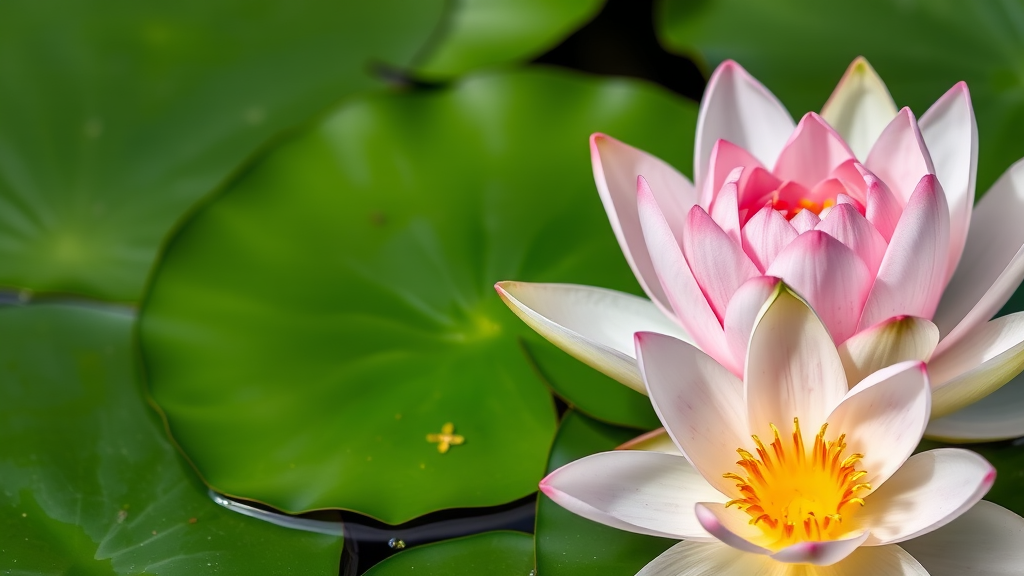
The water lily is one of those rare plants that manages to be beautiful, delicious, and potentially medicinal all at once. Botanists of the genus Nymphaea have long adorned garden ponds and temple pools, but in parts of Asia and Africa the flowers, stems, and roots have also been brewed as remedies for coughs, inflamed glands, and diabetes. Now a research team working in Yunnan Province, China, has delivered the most thorough look yet at a deceptively simple question: what happens to all those valuable compounds when you dry the petals?
In a study published in Food Chemistry: X, Xuhong Zhou of Yunnan and colleagues harvested fresh flowers of four ornamental cultivars — ‘Eldorado’, ‘Blue Bird’, ‘Purpledo’, and ‘Ruby’ — in March 2024 and subjected their petals to four drying treatments: gentle indoor shade drying over three days, hot air drying at 60 degrees Celsius for four hours, a swift burst of microwave energy at 800 watts lasting just two to three minutes, and vacuum freeze drying at minus 50 degrees for 48 hours. Every sample was then ground, stored cold, and run through a battery of chemical and biological assays, each performed in triplicate.
The team’s findings overturn a common intuition that the gentlest, most expensive method is always best. Freeze drying did win decisively on presentation: petals dried by sublimating ice under vacuum shrank the least and retained their natural brightness and hue best, because the frozen water within cells vaporized away without collapsing the tissue. Shade and hot air dried petals, by contrast, wrinkled and darkened noticeably, since surface evaporation outpaces internal moisture diffusion and the structure caves in on itself. Microwave drying occupied a curious middle ground — its rapid internal steam generation props the cell structure open, leaving a porous matrix that resists contraction, and in three of the four cultivars it actually deepened the blue tones measured in the CIE Lab color space.
Aroma told a similar story, tracked with an electronic nose fitted with ten metal-oxide sensors that mimic human olfaction. Principal component analysis explained an impressive 91 to 96.6 percent of the variance among samples on just two axes, and in every cultivar the fresh petals formed a cluster cleanly separated from the dried ones along the first component. Sensors S7 and S9, which respond to sulfur-containing compounds, dominated the scent signatures, hinting that volatile sulfur chemistry underlies the water lily’s distinctive fragrance. For ‘Blue Bird’, ‘Purpledo’, and ‘Ruby’, freeze-dried petals clustered closest to the fresh material, confirming that low-temperature vacuum processing preserves the floral nose; only in ‘Eldorado’ did microwave drying rival the fresh profile.
The real surprises emerged when the researchers quantified the chemistry rather than the aesthetics. Across all four cultivars, drying of any kind raised total phenolics, flavonoids, anthocyanins, vitamin C, free amino acids, and polysaccharides above fresh petal levels, an effect the authors attribute partly to simple water removal concentrating the remaining solids. But the method mattered. Shade drying produced the highest flavonoid and vitamin C contents in most cultivars, while microwave drying drove polysaccharide accumulation to striking peaks — 134.95 milligrams per gram in ‘Blue Bird’ and 136.65 in ‘Ruby’ — and elevated amino acid levels, likely because intense vapor pressure ruptures cell wall polymers and releases bound compounds.
Antioxidant capacity followed suit. Measured with DPPH, ABTS, and FRAP assays, the dried petals frequently outperformed fresh ones, with microwave treatment generally boosting ABTS radical scavenging and ferric reducing power, and both microwave and shade drying enhancing DPPH scavenging. The single most potent extract came from microwave-dried ‘Blue Bird’, which scavenged DPPH radicals at an IC50 of just 0.08 micrograms per milliliter. Enzyme inhibition added another layer: freeze-dried ‘Blue Bird’ petals suppressed alpha-amylase by 82.66 percent, exceeding the positive control acarbose at the same concentration, while tyrosinase and pancreatic lipase inhibition varied in a cultivar- and method-dependent fashion. All extracts also inhibited E. coli, Staphylococcus aureus, and Pseudomonas aeruginosa, with the strongest effects against the latter.
HPLC quantification of four signature phenolics — gallic acid, methyl gallate, geraniin, and 1,2,3,4,6-O-pentagalloylglucose, or PGG — sharpened the picture. Shade drying generally preserved or enhanced methyl gallate, geraniin, and PGG, whereas microwave drying pushed gallic acid to its highest levels, presumably by hydrolyzing larger gallotannins. When the four purified compounds were tested individually, PGG emerged as the standout: the strongest tyrosinase inhibitor of the group, a near-acarbose-grade alpha-amylase inhibitor, a pancreatic lipase inhibitor reaching 42.32 percent at low micromolar-range concentrations, and a suppressor of A549 lung cancer cell growth at 0.5 to 1 milligram per milliliter. Correlation and network analysis identified anthocyanins, gallic acid, and PGG as central hub nodes linking the chemical composition to antioxidant and enzyme-inhibitory traits.
To probe the mechanism beneath these patterns, the team turned to untargeted metabolomics on ‘Blue Bird’, the cultivar with the best overall bioactivity. Combining LC-MS/MS and GC-MS platforms, they annotated 3,192 metabolites, of which 2,765 came from LC-MS and 427 from GC-MS. Between 1,181 and 1,236 compounds differed significantly between each dried group and the fresh control, with flavonoids the most responsive class — a sign that phenylpropanoid metabolism is particularly sensitive to drying stress. Pathway enrichment pointed repeatedly to ABC transporters, tryptophan metabolism, galactose metabolism, and ascorbate and aldarate metabolism. Weighted gene correlation network analysis then grouped the shifting metabolites into ten co-expression modules, one of which tracked positively with tyrosinase inhibition and another with ferric reducing power and alpha-amylase inhibition, each enriched in distinct metabolic pathways.
The authors read these pathway shifts as evidence of genuine metabolic reprogramming rather than mere concentration. Tryptophan metabolism is known to help plants tolerate abiotic stress and delay senescence, while ABC transporters use ATP hydrolysis to shuttle molecules across membranes — and different drying regimes perturb membrane structure and protein function differently, potentially determining how much bioactive payload survives processing. In practical terms, the study offers a two-track playbook: freeze-dried petals for premium visual and aromatic quality suited to direct floral tea sales, and microwave-dried petals where the goal is extracting polysaccharides and maximizing antioxidant and enzyme-inhibitory activity at low cost.
The team is candid about the caveats. Only technical replicates were performed, so natural variation between individual flowers remains unquantified; all bioactivity assays were conducted in vitro, leaving whole-organism effects untested; and the molecular mechanisms linking drying to compositional change are inferred from pathway enrichment rather than directly demonstrated. Still, the integrative design — spanning colorimetry, electronic-nose profiling, targeted HPLC, enzyme assays, and dual-platform metabolomics across four cultivars — makes this the first comprehensive evaluation of its kind for water lily petals, and it elevates PGG from an obscure gallotannin to a bioactive marker worth pursuing. For a flower long prized in ponds and herbal traditions alike, the path from petal to functional food now runs through the drying cabinet, and the choice of cabinet turns out to matter enormously.
Subject of Research: Effects of four drying methods on the bioactive properties and metabolomic profiles of Nymphaea cultivar petals
Article Title: An integrative evaluation of drying methods in relation to bioactive properties and metabolomic profiles of four Nymphaea cultivar petals
Article References: Zhou, X., Peng, J., Li, Q., Zheng, F., Tian, M., & Qu, S. (2026). An integrative evaluation of drying methods in relation to bioactive properties and metabolomic profiles of four Nymphaea cultivar petals. Food Chemistry: X, 39, Article 104468. https://doi.org/10.1016/j.fochx.2026.104468
Image Credits: AI Generated
DOI: 10.1016/j.fochx.2026.104468
Keywords: Nymphaea, water lily, drying methods, freeze drying, microwave drying, metabolomics, polyphenols, pentagalloylglucose, antioxidant activity, enzyme inhibition, functional foods, floral tea
Cite Scienmag News
Bethany Barker. (September 25, 2026). How Drying Method Reshapes the Chemistry of Water Lily Petals, From Aroma to Anticancer Clues. Scienmag. https://scienmag.com/how-drying-method-reshapes-the-chemistry-of-water-lily-petals-from-aroma-to-anticancer-clues/
Bethany Barker. "How Drying Method Reshapes the Chemistry of Water Lily Petals, From Aroma to Anticancer Clues." Scienmag, 25 September 2026, https://scienmag.com/how-drying-method-reshapes-the-chemistry-of-water-lily-petals-from-aroma-to-anticancer-clues/. Accessed 4 October 2026.
Bethany Barker. "How Drying Method Reshapes the Chemistry of Water Lily Petals, From Aroma to Anticancer Clues." Scienmag. September 25, 2026. https://scienmag.com/how-drying-method-reshapes-the-chemistry-of-water-lily-petals-from-aroma-to-anticancer-clues/


