


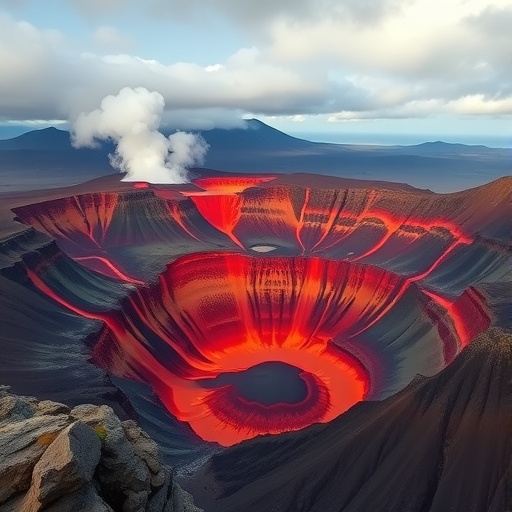
In a groundbreaking development in volcanology, researchers from Kobe University have illuminated the enigmatic processes behind the refilling of supervolcano magma reservoirs, focusing on the Kikai caldera in Japan. This mostly underwater caldera, which unleashed the largest volcanic eruption of the Holocene epoch approximately 7,300 years ago, now provides critical new insights into how giant calderas, such as Yellowstone in the United States and Toba in Indonesia, potentially prepare for their next cataclysmic outbursts.
Supervolcanoes are distinguished by their colossal eruptions, capable of ejecting volumes of magma sufficient to blanket extensive geographical regions several kilometers deep. Their violent nature creates vast depressions called calderas, vast shallow craters formed after the magma chamber beneath has emptied during an eruption. The sheer scale and destructive potential of these volcanoes make understanding their magma dynamics an urgent scientific priority. Yet, until now, the inner workings of their magma reservoirs and the mechanisms driving reactivation have remained largely shrouded in mystery.
The investigative advantage of Kikai’s underwater setting cannot be overstated. “The underwater location allows us to implement systematic, large-scale surveys with higher precision,” explains SEAMA Nobukazu, a leading geophysicist at Kobe University. By collaborating closely with the Japan Agency for Marine-Earth Science and Technology (JAMSTEC), the researchers deployed an innovative combination of airgun arrays and ocean-bottom seismometers. The airguns generate controlled seismic pulses that journey through the Earth’s crust, while the seismometers meticulously record the wave propagation, allowing scientists to map the internal structure of the magma reservoir with unprecedented resolution.
The study, detailed in Communications Earth & Environment, reveals the presence of a large section beneath Kikai’s caldera that is predominantly molten rock. Importantly, this magma body is identified as the same reservoir responsible for the massive eruption thousands of years ago, marking a direct geological lineage. Its extensive size and definite location provide compelling evidence of continuous magma accumulation over millennia, countering previous assumptions that such reservoirs are mostly depleted or inactive post-eruption.
A particularly intriguing discovery pertains to the composition and age of magma within the reservoir. Geological evidence shows that a new lava dome has been forming in the caldera’s center for roughly 3,900 years. Chemical analyses of this recent volcanic material, contrasted with remnants from the last giant eruption, indicate that the magma currently residing beneath the dome is newly injected rather than residual. This magma rejuvenation suggests a dynamic replenishment cycle, where fresh melt intrudes into the emptied magma chamber, recharging and potentially priming the supervolcano for future activity.
The implications of this “magma re-injection” model ripple far beyond Kikai itself. Observations from major calderas worldwide, including Yellowstone and Toba, show similar shallow large magma reservoirs that could follow parallel replenishment dynamics. By establishing a framework for how these vast reservoirs are refilled, the study bridges critical gaps in understanding volcanic lifecycle phases, transitioning from eruption aftermath to the build-up phase that precedes the next supereruption.
Monitoring such processes holds profound significance for hazard assessment and disaster preparedness. Currently, the scientific community struggles with predicting when supervolcanoes will awaken, largely due to incomplete data about the mechanics behind magma accumulation and reactivation. The novel seismic surveying methods validated by the Kobe University team stand to revolutionize monitoring capabilities—allowing volcanologists to detect subtle changes in magma volume, composition, and mobility beneath calderas, thus identifying potential precursors to eruptions earlier and with greater confidence.
Furthermore, these findings highlight the importance of sustained interdisciplinary collaboration and advanced geophysical technology in volcanic research. Funding from Japan’s Ministry of Education, Culture, Sports, Science and Technology (MEXT), alongside support from the Japan Society for the Promotion of Science, has enabled cutting-edge experimental approaches. Utilizing artificial seismic sources coupled with oceanographic deployment of sensors represents a significant leap forward in how scientists gather high-fidelity data from challenging environments like underwater volcanoes.
Additionally, the research underscores the value of long-term geological records and geochemical datasets in interpreting volcanic histories and current activity. The contrast in magma compositions linked to different eruptive episodes allows researchers to parse complex magma supply networks, revealing not only physical reservoir characteristics but also the temporal evolution of magmatic systems. Such sophistication enables a nuanced understanding of supervolcano behavior that blends remote sensing, geochemistry, and geophysics.
The renewal of magma reservoirs through re-injection also raises new questions about the physical and chemical interactions occurring at crustal depths. Processes such as magma mixing, heat transfer, crystallization, and volatile release within these large chambers impact eruption styles and magnitudes. Ongoing and future research aims to refine the seismic imaging techniques and integrate petrological studies to decode these multifaceted phenomena, advancing predictive models of volcanic unrest.
SEAMA Nobukazu emphasizes the ambition behind this research trajectory: “Our goal is to deepen our capability to detect the vital signals that portend giant eruptions, utilizing the methodologies that proved effective in this study. Understanding these processes fundamentally changes how we anticipate volcanic hazards and protect vulnerable communities.” The global scientific community stands to gain immensely from these insights, as supervolcanoes represent among the most destructive natural threats on Earth.
As volcano monitoring technology evolves and explorable datasets accumulate, this study from Kikai caldera could herald a new era in volcanology characterized by predictive precision rather than reactive response. The implications for environmental safety, public policy, and geological sciences are profound, signifying critical progress toward mitigating the impacts of future supervolcanic eruptions.
Kobe University, with its storied academic heritage and multidisciplinary approach, continues to pioneer at the interface of natural science and societal needs. The collaboration with JAMSTEC and the success of this project underscore the potential for integrated research frameworks to tackle Earth’s most formidable geological challenges. By unraveling the mysteries beneath Kikai’s waters, the team charts a course toward a safer and more informed coexistence with Earth’s volatile inner forces.
News Publication Date: 27-Mar-2026
Web References: Not provided
References: DOI: 10.1038/s43247-026-03347-9
Cite Scienmag News
Violet Maxwell. (March 27, 2026). How Do Giant Caldera Volcanoes Recharge? Scienmag. https://scienmag.com/how-do-giant-caldera-volcanoes-recharge/
Violet Maxwell. "How Do Giant Caldera Volcanoes Recharge?" Scienmag, 27 March 2026, https://scienmag.com/how-do-giant-caldera-volcanoes-recharge/. Accessed 4 September 2026.
Violet Maxwell. "How Do Giant Caldera Volcanoes Recharge?" Scienmag. March 27, 2026. https://scienmag.com/how-do-giant-caldera-volcanoes-recharge/


