


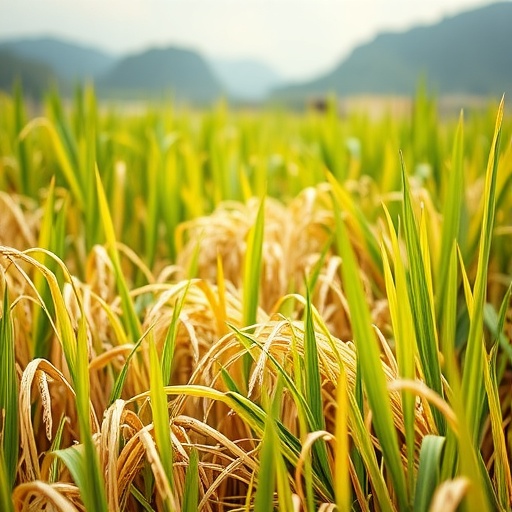
In a world grappling with the dual challenges of feeding an expanding population and combating climate change, rice production stands at a critical crossroads. Rice is a staple food for more than half of the global population, yet its cultivation is a significant source of greenhouse gas emissions, primarily methane. The recent groundbreaking study published in npj Sustainable Agriculture, led by Thai, V.T., Checco, J., Mitchell, J., and colleagues, offers a beacon of hope. Their comprehensive global meta-analysis elucidates pathways to produce more rice while substantially reducing emissions, charting a course toward sustainable agriculture that aligns productivity with environmental stewardship.
The team’s meta-analysis synthesizes data from hundreds of studies worldwide, offering an unprecedented overview of rice cultivation practices and their impact on greenhouse gas emissions. This colossal data aggregation provides robust statistical power and global applicability, underscoring the universality of sustainable approaches across varied geographic and climatic regions. The study dismantles the longstanding perception that increased rice yield inevitably correlates with heightened emissions, revealing innovative methodologies that break this paradigm.
Central to the research is the assessment of water management strategies, particularly alternate wetting and drying (AWD), which contrasts sharply with traditional continuous flooding. The continuous flooded paddy systems, while effective in weed control and nutrient retention, create anaerobic conditions that promote methanogenesis. AWD, by intermittently draining fields, introduces aerobic conditions that suppress methane production. The meta-analysis quantifies this effect, demonstrating substantial emission reductions without yield penalties, advancing AWD as a transformative practice in rice agriculture.
Beyond water management, the study highlights the strategic modulation of organic and inorganic fertilizer applications. The timing, type, and amount of fertilizer influence not only rice yields but also nitrous oxide emissions, another potent greenhouse gas. Optimizing fertilizer usage minimizes excess nitrogen availability, curtailing nitrous oxide release while ensuring nutrient sufficiency for crop growth. The findings advocate for precision agriculture techniques, integrating soil testing and tailored fertilizer regimes to enhance both environmental and agronomic outcomes.
The global meta-analysis also explores the role of crop residue management. Incorporating rice straw into the soil versus burning it significantly affects emission profiles. While straw incorporation enhances soil organic carbon, it can elevate methane emissions under anaerobic conditions. Conversely, residue burning reduces methane but generates carbon dioxide and particulate pollutants. The study’s nuanced analysis characterizes these trade-offs, encouraging site-specific residue management decisions that balance yield, emissions, and local environmental health.
Varietal selection emerges as a critical dimension in reducing emissions intensities. The researchers detail how genetically improved rice cultivars with higher nitrogen use efficiency, stronger root systems, and tolerance to intermittent flooding can sustain or elevate yields while mitigating greenhouse gas emissions. This intersection of plant breeding and environmental science exemplifies the potential of biotechnological innovations to address complex agroecological challenges.
Importantly, the meta-analysis draws attention to socio-economic dimensions influencing the adoption of sustainable practices. Farmer access to technology, knowledge dissemination, and policy incentives are indispensable for scaling emission-reducing techniques globally. The researchers advocate for integrated approaches encompassing capacity building, infrastructure development, and supportive policies that enable farmers, especially in developing nations, to adopt AWD and optimized nutrient management.
The environmental significance of reducing methane emissions from rice cultivation cannot be overstated. Methane has a global warming potential over 25 times that of carbon dioxide on a 100-year timescale. By implementing the methods outlined by the study, rice agriculture could cut its methane emissions by nearly half while meeting the food demands of a growing population. This presents a crucial mitigation strategy within the United Nations’ climate goals, especially for countries heavily reliant on rice as a dietary staple.
Furthermore, the study’s global scale underscores climate resilience benefits. The AWD technique not only reduces emissions but also conserves water, a critical advantage in regions facing increasing water scarcity due to climate variability. Water use efficiency improvements align with broader sustainability goals, promising multifunctional benefits beyond carbon metrics, such as enhanced energy use, labor reduction, and improved soil health.
The meta-analysis also opens avenues for future research. Integrating remote sensing technologies to monitor in-situ methane emissions can refine emission inventories and validate mitigation interventions. Additionally, exploring the microbiome dynamics in paddy soils could unlock new strategies to temper methanogenic microbial activity, marrying molecular biology with agronomy.
Policy frameworks often lag behind scientific advances. The comprehensive evidence base presented by Thai et al. offers compelling support for governments and international bodies to prioritize emission-reducing rice cultivation methods within agricultural extension programs. This science-policy interface is essential for translating knowledge into practice and achieving the dual imperative of food security and climate mitigation.
Equally compelling is the economic perspective. The shift towards sustainable practices, while initially resource-intensive, promises long-term cost savings through reduced input needs and enhanced ecosystem services. The study quantifies these economic co-benefits, reinforcing that environmental sustainability and farmer profitability are not mutually exclusive but mutually reinforcing.
This research marks a pivotal milestone in sustainable agriculture. By leveraging meta-analytic techniques, the authors transcend localized studies, delivering holistic insights with global pertinence. The strategies illuminated provide a science-based blueprint for reconciling agricultural productivity with environmental imperatives, a balance that is vital for future generations.
As the world advances toward 2050, with anticipated population growth demanding significant yield increases, scalable and effective solutions such as those proposed in this study are indispensable. The convergence of innovative water management, optimized fertilization, varietal improvements, and socio-economic integration forms a robust foundation for the rice sector’s sustainable transformation.
In summary, this global meta-analysis signals a paradigm shift in rice cultivation. It redefines the narrative that environmental sustainability and high productivity are incompatible. Instead, it offers a hopeful outlook: through evidence-based interventions, rice production can soar while greenhouse gas emissions plunge, nurturing both people and the planet.
Cite Scienmag News
Alan Morgan. (March 27, 2026). Boosting Rice Yields While Cutting Emissions Globally. Scienmag. https://scienmag.com/boosting-rice-yields-while-cutting-emissions-globally/
Alan Morgan. "Boosting Rice Yields While Cutting Emissions Globally." Scienmag, 27 March 2026, https://scienmag.com/boosting-rice-yields-while-cutting-emissions-globally/. Accessed 4 September 2026.
Alan Morgan. "Boosting Rice Yields While Cutting Emissions Globally." Scienmag. March 27, 2026. https://scienmag.com/boosting-rice-yields-while-cutting-emissions-globally/


